Comments()
  Print
Print  Mail
Mail  Large Medium Small
BEIJING - A map pinpointing the locations of the 77 people who died in Beijing's worst downpours in six decades has brought the Beijing municipal government into the spotlight, rekindling public concerns over the flaws eclipsed by the country's decades of explosive economic growth.
The map, posted by the municipal government on its official Sina Weibo account, Beijing Release, on Thursday night, shows that most of the victims were from suburban Fangshan district, located about 30 kilometers southwest of downtown Beijing.
Of the 61 victims whose identities have been confirmed, 38 were from Fangshan district, six from Chaoyang district and five from Fengtai and Shijingshan districts, respectively. The other seven victims were from five other districts, according to the map.
The post had been forwarded over 10,000 times by Friday evening. Dubbed the "death map," it has become an ironic kind of guide for grieving netizens and the media and offers insights into how the disaster could have caused so many deaths.
Fangshan received the most rainfall, with precipitation in one township reaching 470 mm, compared to the average of 170 mm recorded across Beijing.
Moreover, the downpours triggered flooding and landslides in mountainous areas of the district, leveling more than 8,000 houses and inflicting direct economic losses of about 6.1 billion yuan ($968 million), according the city's flood control office.
Urban/rural gap
The map reveals another bleak reality. Despite being a short distance from the downtown Beijing, Fangshan district has long been overshadowed by the glamorous development taking off in Beijing.
The tremendous gap in economic development between Beijing's downtown and suburban areas is a microcosm of China's unbalanced development between the country's prosperous eastern regions and western hinterlands.
While much investment has been injected into skyscrapers, theaters and other shining facilities downtown, infrastructure in agriculture-oriented Fangshan has been left largely unattended.
More importantly, flood discharge facilities like rivers and reservoirs in the district have not usually been protected and have, therefore, not retained their designed capacities.
At Nanhanji village in Fangshan district, sludge as thick as 20 cm ?remained inside many homes nearly a week after the downpours.
Sun Guo, the village governor, told Xinhua that a nearby quarry often dumps debris to the Jiakuo River, which is meant to be used as a flood discharge channel.
"The blocking of the river by debris and garbage aggravated flooding in our village," Sun said.
Four villagers failed to escape and drowned in waters as much as four meters deep on the night of the downpours, Sun said.
Also on that night, about 350 students were trapped inside a training school in the district. The students were eventually brought to safety by firefighters, but an investigation revealed that the school was built on what had once been a flood discharge channel.
Guo Jinlong, Beijing's Party chief, and other top officials on Friday mourned the victims during a field trip to Fangshan district.
Guo said the disaster taught "usually profound lessons" and exposed many loopholes in urban planning, construction, infrastructure and emergency management.
"We must seriously reflect on the lessons and always bear them in mind," Guo said.
Outmoded drainage network downtown
The rainstorm also left a dozen dead, mostly due to drowning, in the more developed downtown areas, the map shows.
The capital city's drainage networks have received most of the blame for the flooding that inundated many of the city's roads, with water in some lower sections as deep as six meters.
"The victims would have probably never imagined that rain could claim their lives in the capital city," Weibo user "xiaricha" wrote.
"Could the disaster lead to an improvement on China's drainage networks?" "xiaricha" wondered.
Fast urbanization resulting in vast networks of cement roads and the elimination of greenbelts has crippled the city's ability to cope with heavy rains that could otherwise be absorbed underground.
Wang Hao, an expert with the China Institute of Water Resources and Hydropower Research, said more than 80 percent of Beijing's roads are covered in impermeable materials such as concrete and asphalt, hindering the absorption of rainwater.
Meanwhile, the upgrading and expansion of drainage networks lags far behind the development of above-ground construction, experts say.
In July 2004, a heavy downpour triggered similar flooding, submerging buses at the Lianhuaqiao overpass. Eight years later, no improvements appear to have been made at the location, as it was severely affected by rising water.
"More than six decades after the People's Republic of China was founded, many of Beijing's sewers remain unchanged and some can even be traced back to the Ming and Qing dynasties," said Li Yuhong, an expert with the Association of Beijing Water Resources.
Li said Beijing's drainage networks are in urgent need of renovation. "Can't we upgrade the networks in the manner that we build sprawling subway systems?"
In May this year, the Beijing Municipal Commission of Urban Planning laid out a plan to beef up design standards for rainwater pipelines in order to cope with heavy rainfalls.
This year, the city government will upgrade drainage systems, including building underground reservoirs and installing pumps, in 50 locations prone to deluges, according to a government plan.

 Modeling contest part of China-US exchange
 Specially fertilized tea
 Simulator to support A320neo commissioned
 China's cultural sector sees steady growth in 2011
 Travel chaos after snowstorm hits NE China
 Inflation expected to rebound in November
 Grain output grows for 9th consecutive year
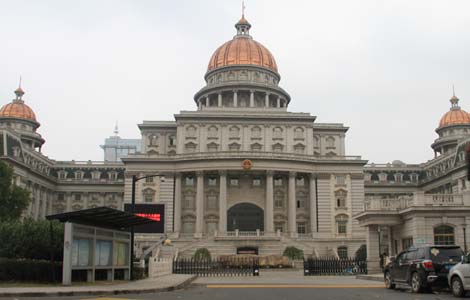 White House-like buildings in E China city
Copyright 1995 - 2010 . All rights reserved. The content (including but not limited to text, photo, multimedia information, etc) published in this site belongs to China Daily Information Co (CDIC). Without written authorization from CDIC, such content shall not be republished or used in any form. Note: Browsers with 1024*768 or higher resolution are suggested for this site.
License for publishing multimedia online 0108263 Registration Number: 20100000002731