Comments()
  Print
Print  Mail
Mail  Large Medium Small
External conditions for Chinese outbound direct investment will become more difficult, making it unlikely such investment will increase greatly in the second half of the year, an official from the United Nations Conference on Trade and Development said on Thursday.
"Chinese outward investment will not increase sharply in the second half unless the global economy deteriorates sharply — unless, for example, the European debt crisis worsens severely and brings greater investment opportunities to Chinese companies," said Zhan Xiaoning, director of UNCTAD's investment and enterprise division.
The amount of foreign direct investment coming from China declined by 5 percent to $65.1 billion in 2011, the first such decline seen since 2003. In consequence, the country fell to ninth place in a ranking of countries that make the most such investments, according to the World Investment Report 2012, which the United Nations Conference on Trade and Development, or UNCTAD, released on Thursday.
"Despite the unexpected decline, China's ODI is in the midst of a period of quick development," Zhan said.
Zhang Jianping, a researcher from the Institute for International Economic Research affiliated to the National Development and Reform Commission, agreed that the pace of China's outbound direct investment will continue to accelerate in the long run as a result of the country's huge foreign exchange reserves and the global reach of its developed industries.
The first five months of the year saw the amount of China's non-financial ODI increase by 40.2 percent year-on-year to $28.52 billion, according to the Ministry of Commerce.
"An increase in investment protectionism may be responsible for the decline seen in the amount of foreign direct investment coming from China," Zhan said. "China is having to deal these more difficult investment conditions overseas because markets have become more difficult to access and there is more protectionism.
"Chinese companies, especially State-owned enterprises, are seeing more risks and obstacles as they enter international markets," said Shi Ziming, deputy head of the ministry's department of outward investment and economic cooperation.
"Some countries have been subjecting foreign investments to stricter investigation while some developing economies have had unstable policies, placing Chinese companies under more investment risks. In addition, the financial crisis and the spreading European debt crisis have reduced the demand coming from international markets but led to more investment protectionism and placed even more external pressure on Chinese companies," Shi said.
Zhan said the changes in large economies' investment policies have complicated matter for Chinese companies.
"Before 2003, more than 95 percent of the policy adjustments made in the world were meant to accommodate trade and investment," Zhan said. "In the first half of this year, though, about 27 percent of the policy adjustments made were done to place foreign investments under stricter regulation.
"Although the US market is generally open to foreign investors, the US government is wary of China's State-owned enterprises and investment in the US from China is increasing at a slower pace than that from Latin America.
"Countries are now adjusting their industrial policies ... Chinese companies should evaluate these policy changes to avoid possible losses."
Zhang said Chinese companies' difficulties have been increased as a result of efforts to protect the environment.
"China has invested a lot in parts of Asia, Africa and Latin America," Zhang said. "And countries in these regions are asking foreign investors to contribute more to local social and environmental development."
Zhan called for the Chinese government to draft guidelines concerning corporate social responsibility in overseas investment.
"Chinese companies must pay special attention to the standards other countries set for corporate social responsibility when they invest overseas and try to establish reputations of being good corporate citizens. This is a big and very important project and will lay a solid foundation for the globalization of Chinese companies."
He said the government, when establishing regional investment agreements, should do more to protect Chinese companies that go overseas and to ensure they have access to markets.
Fu Xiaolan, an expert on Chinese overseas investment at the University of Oxford, said Chinese businesses that invest in Britain have had trouble with issues pertaining to corporate governance.
"Britain has a skilled and mobile labor market, especially in the high-end manufacturing industry and services industries," she said. "Chinese companies that invest in Britain should concentrate on managing human resources at their British operations to ensure that their employees stay. In particular, they should think about how they can keep essential people at their companies.
"This is particularly true for Chinese companies that expand through acquisitions," Fu added. "Otherwise, the British businesses they have spent large sums to purchase could become empty shells."
In 2011, China remained the most attractive country for foreign direct investment, followed by the United States and India, according to a survey by UNCTAD.
The amount of FDI flowing into China reached a historic high of $124 billion that year, according to the report.
Also in 2011, the amount of FDI going into Chinese services surpassed that going into manufacturing for the first time as a result of an increase in the flow of such investment into non-financial services and a slowdown in the flow into manufacturing.
"FDI into finance is expected to increase as China continues to open its financial markets and as foreign banks expand through mergers and acquisitions and through organic growth," Zhan said.
"The fact that Chinese services attracted more FDI than manufacturing did in 2011 marks a turning point for Chinese FDI and the future will see a continuingly greater flow of FDI into Chinese services," said Liang Guoyong, economic affairs officer with the investment and enterprise division of UNCTAD.
Contact the writers at lijiabao@chinadaily.com.cn and zhanghaizhou@chinadaily.com.cn

 Modeling contest part of China-US exchange
 Specially fertilized tea
 Simulator to support A320neo commissioned
 China's cultural sector sees steady growth in 2011
 Travel chaos after snowstorm hits NE China
 Inflation expected to rebound in November
 Grain output grows for 9th consecutive year
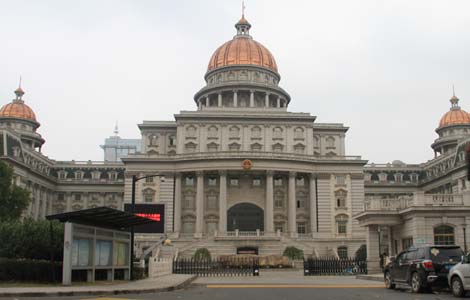 White House-like buildings in E China city
Copyright 1995 - 2010 . All rights reserved. The content (including but not limited to text, photo, multimedia information, etc) published in this site belongs to China Daily Information Co (CDIC). Without written authorization from CDIC, such content shall not be republished or used in any form. Note: Browsers with 1024*768 or higher resolution are suggested for this site.
License for publishing multimedia online 0108263 Registration Number: 20100000002731