 |
|
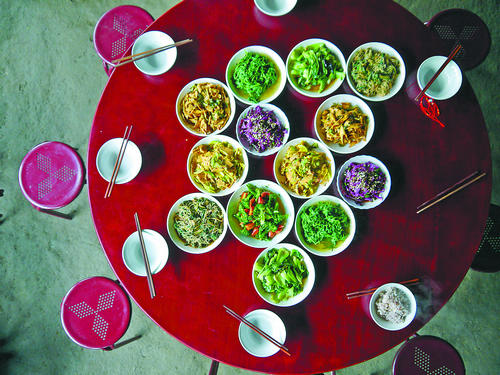
Slow Food in Beijing organizes regular activities around the country. Above: An organic lunch in Anlong Village, Sichuan province. [Photos provided to China Daily] |
Quit the queue at the Big M, forget about TV dinners, China has joined the fight against industrialized, heavily processed, pre-packaged food. Well, some in China, at least. Eric Jou sums up the situation in Beijing.
Pushing for more sustainable, healthy, organic food, and pushing away from an imported, urban fast-food culture is not easy in Beijing.
But recently, three events have at least signaled the start of the movement: The setting up of the Beijing chapter of Slow Food, the commemoration of Jamie Oliver's Food Revolution Day and the inclusion of a "Best Sustainable Restaurant" category in city guide magazine Time Out Beijing's annual food awards.
Kerstin Bergmann, a co-leader of the Slow Food Convivium in Beijing, says that since 2008, the demand for clean organic food in Beijing has been growing and that more people are interested in what they are putting into their mouths.
"I think there is a great demand. In my opinion, this really got triggered after 2008, after the milk scandal," says Bergmann, referring to a food scandal that got the nation up in arms because it affected children and babies, some of whom were permanently disabled as a result.
That year, many major milk producers in China were found to have added powdered melamine to dairy products, to boost "protein" content. The culprits have since been heavily punished, although traces of melamine are still occasionally found in milk - a proof that awareness and knowledge filter very slowly down to grassroots producers.
Originally from Italy, the Slow Food movement stands for three things - good clean food sold at a fair price for both consumer and producer and a push towards eating local, all of which is finding empathy in China.
Just as Bergmann says, food safety is a big concern among people living in Beijing.
Zhang Zhimin, a local legend of organic sustainable food here, says one of the biggest reasons why she started a farm was her own concern about food safety.
"I was getting sick from this chemical that was used in produce," says Zhang. "So I figured I would try to grow some of my own food."
Zhang started her farm, God's Grace Garden, in 2001. The original concept was to grow her own food, but she started giving away extra crops to friends and family. Zhang says her friends and family kept prompting her to start selling, telling her she could make money with her vegetables.
Unwilling to convert her project into a business, Zhang decided to turn her farm into a membership co-share model. Members pay monthly dues and get a share of the produce but are required to take an active role in production.
Dannan Hodge, the Jamie Oliver's Food Revolution ambassador in Beijing, also works with the Beijing farmer's market association.
"The organic revolution here is in its infancy stage but it's growing quite quickly. It's still predominantly marketed to locals, so part of what we're trying to do here is to bring in farmers and vendors capable of providing an English-speaking service to foreigners."
According to Sina Weibo, the Beijing farmers market association has over 300,000 fans.
"Several of our farmers were not farmers by trade," says Hodge. "They became worried about the safety of food so they started organic farms. It's very much a local push."
Hodge is also the co-founder of Highrise Homestead, a business dedicated to helping urban dwellers grow their own produce. She says signs of progress are evident, especially the last four years.
The main problem is spreading the message. Bergmann, Hodge, and Zhang all point out that the most important thing in getting people involved is education.
Zhang says that the push is held back by the easy convenience of fast food for the urban working population, and the addiction of the younger, more Western-influenced.
"The problem is the mindset and preconception. They think too much of the here and now. Producers think it takes too long to make money and consumers find it too expensive," Zhang says.
"In the past, people used to spend 90 percent of their income on food, but now it's become 9 percent on food.
"When they buy things like Apple iPhones, they are willing to spend. It's a problem of societal values, where people are concerned over trends and not their health," Zhang says.
 |
|
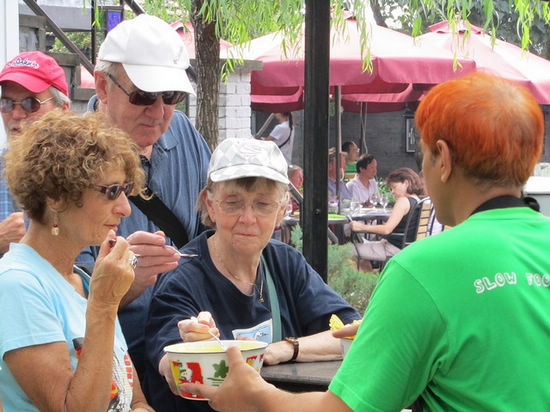
Guests are invited to sample some home-made ice cream, and learn how to make organic soybean milk. [Photos provided to China Daily] |
Bergmann feels the whole affordable argument is "complete bullocks".
"A really good example is in supermarkets everywhere in the world, you see pre-washed salad already cut. This pre-packed salad costs three, four, five times more than regular salad, and people buy it. So why do they buy it? Because it's convenient.
"This is why I don't think the argument that, organic is expensive, therefore people don't buy it, is true.
"People are willing to pay more when it's convenient."
To Bergmann, Zhang and Hodge, the most important step moving forward is to continue educating consumers and making them co-producers of their food, holding individuals accountable for what they eat.
To people who share the same passion as members of the Slow Food chapters or people who are just concerned about safe, clean and quality food, Bergmann says the ultimate thing to do is this:
"They should pay attention to where their food comes, just think about where it comes from, what's on their plate and how it got there."
Contact the writer at ericjou@chinadaily.com.cn.


Copyright 1995 - . All rights reserved. The content (including but not limited to text, photo, multimedia information, etc) published in this site belongs to China Daily Information Co (CDIC). Without written authorization from CDIC, such content shall not be republished or used in any form. Note: Browsers with 1024*768 or higher resolution are suggested for this site.
License for publishing multimedia online 0108263 Registration Number: 130349