|
|
|
 |
|
|
|||||||||
BEIJING - In 30 years, the Chinese people have gone from having barely enough to eat to worrying about spreading waistlines, leaving the healthcare system struggling to keep up with an exponential rise in "nobleman diseases" like diabetes.
The soaring cost of chronic disease could tax China's effort to offer basic healthcare to 1.4 billion people. Almost one out of every eight Chinese households was racked by catastrophic health expenses in 2011, according to a paper published in medical journal The Lancet.
Healthcare reform is needed to rebalance the economy, since Chinese salt away their savings in part because of fear of being wiped out by devastating illness.
But the burden of chronic illnesses could worsen as Chinese eat more and live longer. Diabetes, for instance, now afflicts nearly 10 percent of Chinese adults - roughly the same proportion as in the United States - up from 1 percent in 1980.
 |
|
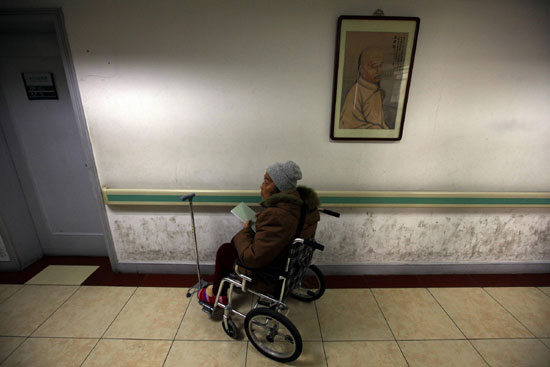
A diabetes patient sits in a wheelchair, under a drawing of an old Chinese medical scholar, as she waits in a corridor of the Guanganmen Chinese medicine Hospital to see diabetes specialist Doctor Tong Xiaolin in Beijing March 19, 2012.[Photo/Agencies] |
"In the last 20 years, diabetes has developed a lot, but it's only now showing up in the medical system," said Dr Tong Xiaolin, vice director of the Guanganmen Hospital in Beijing, who sees dozens of patients during Monday office hours.
"People are now just flooding into the system in real numbers. The next 10 years will be a real drain on the system."
Spending on diabetes reached $17 billion in China in 2011, a tiny amount compared with the $465 billion spent worldwide, according to a white paper from Singapore's Saw Swee Hock School of Public Health and the Harvard School of Public Health.
That represents about 5 percent of total healthcare spending in China, with some estimates rising to 13 percent.
In the United States, where costs have ballooned, diabetes accounts for about $1 in every $10 spent on healthcare, according to the American Diabetes Association. Spending on diabetes at US levels of $201 billion a year would swamp China's system, leaving it unable to tackle other priorities.
There are now about 92 million diabetics in China but that is expected to rise to 130 million by 2030.
"We were very surprised and couldn't believe how fast it grew," said Peking Union Medical College Hospital specialist Xiang Hongding, as he sipped coffee after a typical morning spent seeing 22 patients in four hours.
The rapid growth means diabetes often goes unrecognised until secondary symptoms appear, making treatment much harder.
Liu Yuxiang travels five hours to Beijing every month to see Dr Tong, and reckons she has spent 30,000 yuan ($4,700) on Chinese medicines to treat painful and swollen legs. Western drugs to control blood sugar cost her another 12,000 yuan a year, 80 percent of which is covered by insurance. ?
"If we didn't have a doctor in the family I would never have known. No one around us had any knowledge of it," said the cheerful 64-year-old, who suffered from years of thirst, fainting fits and hospitalisation before her daughter-in-law suggested she might have diabetes.
Many doctors, especially in the countryside, have no inkling that diabetes could be the underlying cause for a number of symptoms -- including blindness, numb or tingling legs, digestive disorders and circulatory problems.
"The patients don't know, and when they get to us they say the doctors didn't know."
Queueing for care
A nationwide insurance roll-out, begun three years ago, makes people more likely to see doctors and makes treatment much more affordable. Almost nine percent of people stayed in a hospital in 2011, from less than four percent in 2003, the study published in The Lancet showed. ?
Basic medicine to keep diabetes under control is relatively cheap in China, at about 2,000 yuan ($320) a year.
But treatment for a patient who has developed advanced symptoms could easily reach 18,000 yuan a year, roughly equal to the average yearly income of urban Chinese.
Common drugs for diabetes are covered by insurance, but equipment for at-home testing and monitoring of blood sugar levels - which can reach 400 yuan a month - is not. ? ? ?
Adding to the burden, Asians in their prime earning years of 30-50 are more likely to develop diabetes than Caucasians, according to the Saw Swee Hock white paper on diabetes.
"When I found out, my heart was very heavy. I worried I wouldn't be able to support my family. I was afraid I couldn't function in this economy," said patient Wang Yuanqing, father of an 8-year-old, whose diabetes weighs heavily on him even though he has kept it under control since his diagnosis a year ago.
Catching diabetes early could help drug makers like Novo Nordisk, the top seller of insulin in China, or Bayer , which markets a drug that helps reduce glucose absorption after meals. Both help educate on diabetes in China.
Traditional Chinese medicine developers could also benefit. Guanganmen Hospital's Tong Xiaolin has received more than 9 million yuan in government grants to study how Chinese medicine can offer lower-cost, effective treatment of diabetes complications.
"Traditional Chinese medicine has a real role to play in treating complications," he said, as patients trooped through his office. He consulted records handwritten in blue notebooks, while nurses prepared the next patient in line.
"Chinese medicine is very helpful in controlling nausea, or depression due to pain. Some patients are in such pain they can't sleep and consider suicide," Tong said.
Better education of doctors and patients, and standardising Chinese medicine dosages, could also reduce reliance on the "quack" medicine that proliferates in the teeming communities that ring China's mega-cities.
Even if diabetes treatment is normalised, doctors acknowledge that the announced government healthcare spending of nearly $175 billion through to 2015 is only the beginning.
The Ministry of Health has a pilot programme to cover some chronic diseases, which may be extended to dialysis, the treatment for kidney failure that can stem from diabetes.
"At the moment actually there is no real appreciation of how much medical reform will cost. But the nation is committed, even if the cost is high, to resolve the problem," said Xiang.
Wu Ying, iPad, Jeremy Lin, Valentine's Day, Real Name, Whitney Houston, Syria,Iranian issue, Sanyan tourism, Giving birth in Hong Kong, Cadmium spill, housing policy

|

|

|

|

|

|