|
|
|
 |
|
|
|||||||||
Changes to tax payment system to help the less developed regions
China will carry out further fiscal reforms this year to bolster domestic consumption and resolve regional disparity in economic development, Finance Minister Xie Xuren said on Sunday.
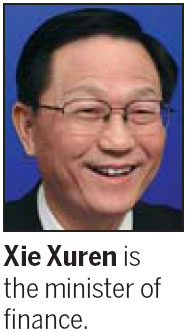
Xie said the country will improve the tax transfer payment system between local and central tax authorities to intensify support to local development, especially to less developed regions.
In 1993, China launched a tax system to gather some of the tax revenues of local authorities to the central governments, and reallocate those revenues to aid local economic and social development via transfer payments.
The tax revenue of the central government accounts for 49.5 percent of the total, while local authorities have 50.5 percent, according to Xie.
The payment to local government was in two forms - general payment and payments on particular items. General payments currently account for 52 percent of the total amount.
Xie said the system has helped tackle the regional disparity in fiscal power that comes from an unbalanced economic development, as it lifted the per capita fiscal revenue in western region to 97 percent to that of the eastern region via transfer payment, compared with 35 percent before reallocation.
Xie said the general payments would be increased in the future to allow local authorities to make more effective use of these revenues.
Meanwhile, "we will increase the supervision on the efficiency of the usage of tax transfer payment by local governments," he said.
As for tax reforms, Xie vowed to promote pilot reforms for replacing sales tax with value-added tax, levying resource taxes based on value rather than quantity, and collecting property taxes, all of which are currently on trial in a number of cities and industries.
"There are too many circling taxes (indirect taxes) in China's current tax system, and direct taxes have a relatively small share," Xie said, adding that the next step will be to increase the proportion of direct taxes in the system.
Common forms of indirect taxes refer to sales taxes and consumption taxes, while direct taxes are mostly personal and corporate income taxes.
Xie's remarks were echoed by Christine Lagarde, International Monetary Fund managing director, who said when addressing the China Development Forum 2012 that emerging economies need to increase social transfers or lower taxes to translate higher growth into better living standards for all.
China's overall fiscal revenue in 2011 surged 24.8 percent to exceed 10 trillion yuan ($1.58 trillion), which was widely criticized, because it grew much faster than national income did.
The National People's Congress recently approved China's 2012 government budget plan, which set a goal of fiscal expenditure at 12.4 trillion yuan, an increase of 14.1 percent from the previous year.
Meanwhile, fiscal revenue, including revenue transferred from the income of the previous year, was 11.6 trillion yuan.
With a target of fiscal deficit set at 800 billion yuan, 50 billion less than the actual deficit of the previous year, many doubted if the budget plan was in line with the "positive fiscal policy" pledged for this year.
But Chu Jianfang, chief economist with CITIC Securities, suggested the actual deficit would be much higher than the planned figure because the actual expenditure normally exceeds budget by 5 percent.
Chu predicted the growth rate of expenditure will be close to 20 percent this year and actual deficit to be 1.07 trillion yuan.
Wu Ying, iPad, Jeremy Lin, Valentine's Day, Real Name, Whitney Houston, Syria,Iranian issue, Sanyan tourism, Giving birth in Hong Kong, Cadmium spill, housing policy

|

|

|

|

|

|