Surveys reveal positive public attitudes
Updated: 2012-02-10 08:10
By Cheng Guangjin and Chen Weihua (China Daily)
|
|||||||||


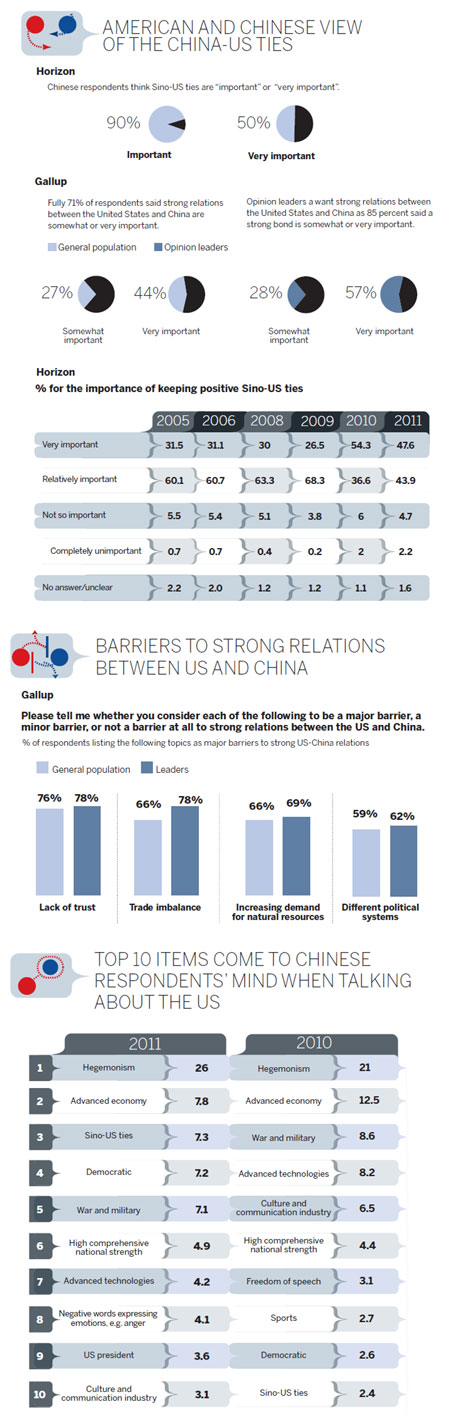
The China Daily-Gallup survey showed only 13 percent of American respondents said China is an ally of the US. Almost two-thirds said they view China as friendly but not an ally, while 23 percent said China was unfriendly or an enemy, it said.
"I am glad to see that most Americans are in favor of friendly ties with China, considering that both nations have neither a formal alliance nor alliances. But both nations are friendly and have common interests. It is these common interests that are more important," said Jerome Cohen, a law professor at New York University and a leading Western scholar on China's legal system.
"China is certainly not an enemy of the United States, and the US is not an enemy of China. But there are some people in both nations who think that the two countries are enemies or will become enemies. They are a minority. It is for the rest of us to prove that they are wrong," says Cohen.
Cohen feels that China's economic progress is a good thing. "We benefited from China's economic development. But we are a country that is increasingly divided. I think that's a dangerous situation. We have to educate our people more," he says.
Despite the desire for stronger relations, Americans see barriers to achieving that goal, such as a lack mutual trust, an imbalanced trade demand for oil supplies and different political institutions.
Nearly half of the general population and opinion leaders in the US agreed that China's currency was a factor for the US economic situation. Findings in the China Daily-Horizon survey showed more Chinese citizens think the two countries should share a common responsibility to solve their problems, which is an increase of nearly 10 percent from 2010.
Analysts said despite the differences between the two countries, which are likely to last for a long time, the polling data showed people on both sides recognize the importance of trying to get along with each other.
Chas Freeman, a US diplomat and interpreter for US president Richard Nixon during his ice-breaking visit to China in 1972, said the bilateral relationship, "strong and interdependent as it is, is tinged with a measure of suspicion, misapprehension, and mistrust".
There is broad recognition in both China and the US of economic interdependence, and most people in both countries also recognize that there are now few global problems that can be solved without cooperation, Freeman told China Daily.
But the "very complexity" of the relationship means that "a myriad of special interests are affected by it, and there are constantly many minor frictions", he said.
"This is entirely normal but, at any given moment, there is always something going on to agitate people and cause concern on one or both sides," he said.
"No one issue exists in a vacuum," said Clayton Dube, executive director of the US-China Institute of University of Southern California.
He told China Daily that protectionism and other economic disputes play out against a backdrop of images - confrontations in the South China Sea, commitments to nuclear non-proliferation, the treatment of individuals and ethnic groups and more.
"All these influence particular positions at particular times," said Dube, adding that the bilateral relationship in many aspects "is better then ever".
Dube said the key reason for disagreements is that the two countries are much more fully intertwined with each other and with other countries.
"Our perceived interests are not always aligned. Sometimes this is a matter of suspicion and insufficient communication. More often it's rooted in serious differences over policies and practices," Dube said.
Dube said it is ultimately in both countries' interests to expand and deepen cooperation wherever possible, but fundamental differences do exist and aren't likely to disappear anytime soon.
Freeman said despite all the difficulties, the two sides have "so far managed the necessary adjustments quite well".
"I am optimistic that this will continue to be the case. All the more so because, as the polling data shows, people on both sides recognize the importance of trying to get along with each other," Freeman said.
Zhang Yuwei and Kelly Chung Dawson contributed to this story.






Hot Topics
Kim Jong-il, Mengniu, train crash probe, Vaclav Havel, New Year, coast guard death, Internet security, Mekong River, Strait of Hormuz, economic work conference
Editor's Picks

|

|

|

|

|

|