Battle of words over the future of poetry
Updated: 2012-01-27 11:05
By Zhang Yuchen (China Daily)
|
|||||||||


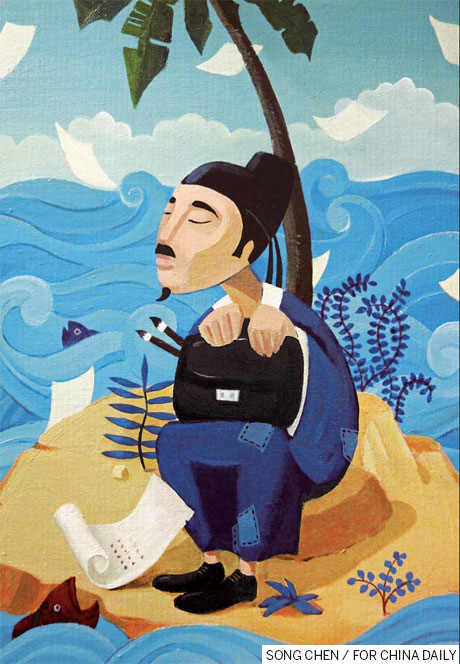
The ability to write verse may be a dying art in modern China but the Internet is providing lines of inspiration for a new generation. Zhang Yuchen reports.
It may mark a turning point for China's traditional publishing houses that they have no plans to publish the works of last year's winner of the Nobel Prize for Literature, Swedish poet Tomas Transtromer, despite having printed the collections of previous laureates. Some might argue that it is an indication the world is becoming more crude, more cynical and less appreciative of issues, such as nature, that the 80-year-old focuses on.
It certainly seems in some quarters that poetry has no hold on many people today. A survey in November showed poets are among the bottom three in a list of relationship partners in a country with about 3,000 years of history of writing poems.
"(Modern) poetry in China is dead," said Wolfgang Kubin, the German Sinologist, in a public lecture on Chinese modern poetry on Nov 24. He then contradicted himself in a carefully phrased way: "It is, however, still living. It lives at the edge of society unnoticed by the majority. Its readers are the few people who really appreciate good literature."
The young, it seems, are not among the latter faction. As older poets produce and are published less, and some have stopped altogether, some observers say no one is stepping into their shoes.
"I have yet to pay much attention to poets under 30, if that is the younger generation," Kubin said. Usually Chinese writers and scholars introduce works of literature to him and recommend they be translated. "It seems to me that I have not yet heard a voice that tried to convince me of the high quality of poets under 30," was his withering assessment.
The decline in China's poetry is marked elsewhere. "Poetry reading groups have got smaller as good poetry diminishes and the competition falls," said Xie Mian, deputy director of the New-style Poetry Research Institute of Peking University. "That is something new."

Many believe that the irrelevance, in today's world, of traditional motifs and a greater focus on the trivialities of daily life, plus the way language is changing, add to the poor outlook for the less prosaic forms of literature.
Most modern Chinese poets attracting attention are those who emerged in the 1980s, then aged in their 20s, such as Zhai Yongming, Zhang Zao (1962-2010) and Hai Zi (1964-1989). Their works are embedded with beautiful images, an enlightening spirit and perceptive thoughts relevant to the time that captured the imagination of the world when they were younger.
"In the 1980s, college students - even those majoring in mathematics - wrote and read poetry. However, few graduates and undergraduates studying Chinese literature are into poetry," said Ren Youqun, vice-president of East China Normal University.
Four college poet societies established in the 1980s became famous - the May 4 Literature Society at Peking University in Beijing, Fudan Poets Society at Fudan University in Shanghai, Innocence Poets Society at Jilin University in Northeast China, and Jiangnan Poet Society in Anhui province in East China.
In the 1980s the gathering of a poetry society would attract crowds of college students in and outside the biggest conference hall on campus, said Xiao Shui, a former president of Fudan Poets Society.
If anyone wanted to join Fudan Poets Society they had to sit a test for membership, according to Xiao. They had to write a poem on the spot after being given a set topic. Every year only 10 to 15 college students were admitted as official members. "Now students just need to fill in a form with their name and contact details to gain admission to the circle," he said. "But they rarely write anything or take part in activities."
Bei Dao, the pioneer of a new genre of Chinese poetry in the early 1980s, believes that college students and scholars who used to read poetry have lost their enthusiasm for it amid China's social transformation; now poetry only evokes nostalgia for them.








Hot Topics
Kim Jong-il, Mengniu, train crash probe, Vaclav Havel, New Year, coast guard death, Internet security, Mekong River, Strait of Hormuz, economic work conference
Editor's Picks

|

|

|

|

|

|