News
'Core interests' should be focus of talks: experts
By Lan Lan (China Daily)
Updated: 2011-05-10 07:18
 |
Large Medium Small |
|
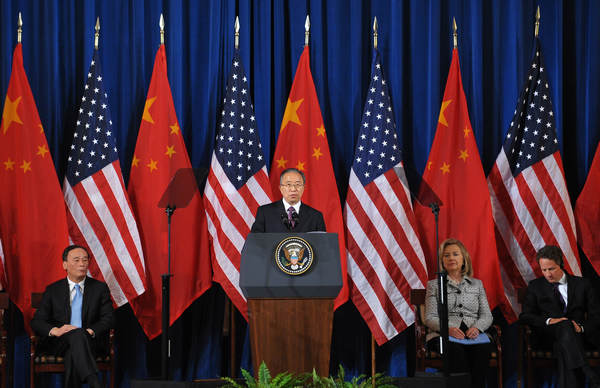 State Councilor Dai Bingguo speaks during the opening session of the third China-US Strategic and Economic Dialogue on Monday in the Sidney R. Yates Auditorium at the Department of the Interior in Washington. Looking on are Vice-Premier Wang Qishan (left), US Secretary of State Hillary Clinton (center right) and US Treasury Secretary Timothy Geithner (right). [Photo/Agencies] |
Beijing - Concrete results and fair treatment are the most important requirements for a successful third round of the China-US Strategic and Economic Dialogue (S&ED) that opened in Washington on Monday, experts say.
The dialogue, initiated by President Hu Jintao and his US counterpart Barack Obama during their first meeting in London on the sidelines of the G20 financial summit two years ago, has provided a channel for the world's two largest economies to enhance in-depth communication.


Song Hong, a senior researcher at the department of international trade with the Chinese Academy of Social Sciences, said China has moved more quickly than the US in realizing the commitments it made at the previous S&ED meetings.
"China has adopted relevant measures and delivered results in fulfilling its commitments, as discussed in the previous S&ED discussions. In comparison, we haven't seen concrete results on the US side," Song said.
|
 |
For example, at the first meeting in July 2009, the US agreed to facilitate its high-tech exports to China and to push for China's early market economy status. These agreements were repeated at the second meeting, but they are still up in the air.
China can automatically acquire the status by 2016, according to rules of the World Trade Organization.
Long Guoqiang, a senior fellow at the research department of foreign economic relations at the Development Research Center under the State Council, China's Cabinet, said the restrictions that the US has put on high-tech exports to China has harmed US companies as more orders are being won by European and Japanese companies.
"It's clear that the US has lost a large number of business opportunities to its rivals and it's a great pity for US companies," he said.
US security concerns have also blocked Chinese companies' investment in the US.
A host of Chinese companies, including Chinese telecom equipment maker Huawei, suffered setbacks to their overseas acquisition and merger plans because of security fears in the US.
The upcoming meeting has assumed strong significance as it is the first S&ED meeting after the two nations agreed to fine-tune bilateral ties as "a cooperative partnership based on mutual respect and mutual benefit" during President Hu's US visit in January.
The Chinese co-chairs, Vice-Premier Wang Qishan and State Councilor Dai Bingguo, will be joined at the meeting by US Secretary of State Hillary Clinton and Treasury Secretary Timothy Geithner, and a number of ministers and high-level officials from both sides will also attend.
"The bilateral relationship has returned to a positive track compared with the climate during last year's discussions," said Song Hong.
China was under great pressure during last year's S&ED meeting as the currency issue cast a shadow over bilateral ties.
"The prospects for future cooperation are quite tempting because new opportunities will emerge as both countries are adjusting their economic structure," Song said.
China will stick to its strategy of expanding internal demand and changing its investment- and export-oriented economy in the 12th Five-Year Plan (2011-2015) while the US is seeking to invest more and cut its budget deficits and borrow less from the rest of the world.
China will continue to open up because competition is the best way to push forward reform and improve people's livelihoods, said Commerce Minister Chen Deming.
"China has plans to further loosen restrictions on foreign investment, but developed countries also need to provide equal market access," Chen said.
In 2010, China's overseas direct investment was $59 billion, equal to only 60 percent of the foreign direct investment in China, according to the Ministry of Commerce.
China has also been the fastest-growing market for US exports and a strong supporter of Obama's plan to double US exports in the next five years. The two sides agreed on $45 billion in US export deals in January and these deals are expected to support some 235,000 jobs in the US.
China is also facing pressure to reduce its current-account surplus. The nation posted a trade deficit of $1.02 billion in the first three months of this year, the first quarterly deficit in seven years.
China's trade surplus will continue to decrease in 2011 and is likely to fall to $140 billion from $183.1 billion last year, according to a report from the Development Research Center, a think tank under the State Council.
The yuan's exchange rate has long been blamed as a cause of the trade deficit between the two countries and many in the US say it is in China's interests to allow the yuan's nominal exchange rate to appreciate more rapidly against the dollar.
The Chinese central bank allowed the yuan to be flexible again last June and officials said China will further increase the flexibility of the yuan's exchange rate.
However, T. J. Bond, chief economist at Merrill Lynch, Asia Pacific, said he disagreed that the yuan is massively undervalued and said the yuan might even be overvalued by July.
"Inflation in China is significantly higher than that in the US, the yuan has been appreciating more rapidly against the dollar on a real, inflation-adjusted basis, at a rate that, if sustained, would amount to more than 10 percent per year and that's pretty fast pace of real appreciation," Bond said.
Meanwhile, experts said it is unrealistic for the US to go back to the old path by boosting its exports through low-end labor-intensive manufacturing industries. Instead, the US should reduce trade imbalances between the two countries by lifting its controls on exports of high-tech products.