Great expectations from two sessions
By Li Xing (China Daily)
Updated: 2011-03-04 07:45

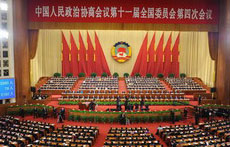
On Saturday morning in the Great Hall of the People, Premier Wen Jiabao will present an extensive plan for China's social and economic development in the coming five years.
The audience will include more than 5,000 Chinese lawmakers - deputies of the 11th National People's Congress (NPC) - and members of the top national advisory body, the 11th National Committee of the Chinese People's Political Consultative Conference (CPPCC).
As a member of the press, I will shuttle between the Great Hall of the People and hotels to get to know the NPC deputies' views, not only on the draft 12th Five-Year Plan (2011-2015), but also on a range of important national issues, from pending legislation and the national budget to developments in other top departments.
Although I have covered the annual NPC/CPPCC sessions as a reporter and editor for more than 20 years, I never know what to expect.
Among my most memorable moments over the years were my interviews with two non-Communist Party members, Feng Tiyun, the former vice-minister of supervision (1988-1998), and Hui Yongzheng, the former vice-chairman of the State Commission for Science and Technology (1990-1998).
Feng told me how he hunted down embezzlers, bribe-takers and other wrongdoers in government departments and in sectors such as foreign trade, finance, communications, transportation and customs.
Hui, meanwhile, was forthright about the problems China's research institutes had encountered in the course of reform in the early 1990s. He pointed out that their unwillingness to engage in long-term, basic scientific research projects was "affecting the current level of the country's scientific advancement and will also hinder future scientific and technological development in China".
Of course, great changes have taken place in the course of 20 years.
Back in 1990, China was still a poor country, with GDP totaling 1.74 trillion yuan, or 1,521 yuan per capita. When Premier Li Peng outlined China's economic plan, he talked about "quadrupling 1980's gross national product in terms of constant prices by 2000" and raising the people's living standards from "simply having enough food and clothing".
In those days, China was battling inflation, a shortage of government financing, and economic inefficiency. It was still cautiously feeling its way toward a market economy.
Today, China has become the world's second largest economy with per capita GDP reaching more than $4,000 last year, and will soon mark the 10th anniversary of its membership in the World Trade Organization.
Back in 1991, only eight China Daily reporters and photographers were accredited to cover the NPC and CPPCC annual sessions.
This year, we'll have 41 representatives, who will not only write stories and take photos for the print edition but also send news flashes, photos, and videos to the paper's website, blog space, and China Daily apps for mobile devices.
But despite China's economic expansion and social improvement, this is no time to get complacent.
As Premier Wen Jiabao is likely to make clear in his report, China must go through some painful restructuring and reforms to steer its economy onto a growth track that is stable, balanced, coordinated, and sustainable.
Initial interviews with NPC deputies and CPPCC members and a review of online discussions reveal a consensus that China must also bridge the income divide, improve the well-being of the people, and push forward innovation and scientific advancement, while continuing to fight corruption and rein in inflation.
As journalists, our job is to dig deeper to get more stories, better analysis, and above all more solutions to the multifaceted challenges China faces in its continuous pursuit of a prosperous society.
The outcome of the annual sessions will not only affect China's own economic transformation, social progress, and environment over the next five years; it will also have implications for the world economy and its ability to tackle climate change, among other things.
The author is assistant editor-in-chief of China Daily. E-mail: lixing@chinadaily.com.cn