Medicine man, Chinese needles
Updated: 2011-09-10 08:25
By Mike Peters (China Daily)
|
|||||||||||


|
 |
|
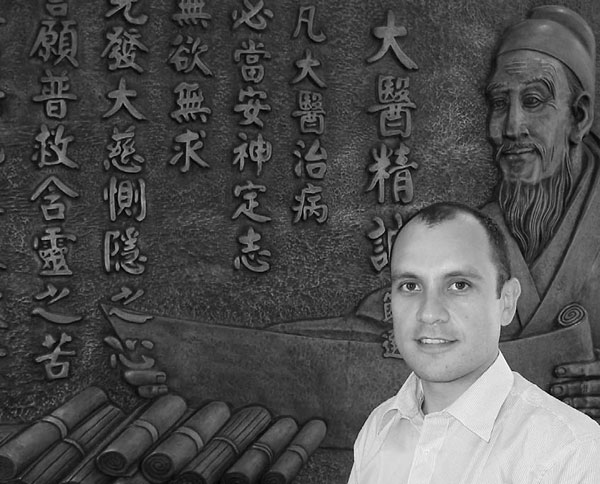
Mexican medicine man Roger Prida is following both his calling and his heart - wherever they may lead. Mike Peters / China Daily |
"You may not feel the needle going in," says Dr Roger Prida, "but once it's in, you've got to search for the energy layer. We've got to move the energy. If you don't feel it, you're not being helped."
Prida is talking about acupuncture, and how Westerners used to skin-deep pricking from practitioners at home may be in for a shock when they come to China. In traditional medicine here, the acupuncturist won't be shy about pushing a needle deeper, probing a muscle or a joint. That push to heal can hurt.
"Chinese have a tolerance of pain that is much higher than Westerners," he says, grinning. Patients on both sides of the world come to a clinic to restore health, says the young Mexican doctor who came to Beijing to study Chinese medicine four years ago.
"But at home, pain management can be as important as the cure. Here, getting to the cause of the disease is the goal, whatever it takes."
Acupuncturists in China accept that their Western patients have different expectations, and they ease their way into more aggressive treatments, and bigger needles. That balance mirrors the approach he will take as he heads home to Mexico City this month, where he will resume his practice with a deeper and - he hopes - more enlightened sense of the therapy.
"We learn a lot of techniques in the West, and we are trained to base them on the patient," he says. Will surgery leave a permanent scar? Could there be legal issues if the doctor pushes a treatment despite a patient's reservations?
"But in this sort of practice, some things are common across cultures," Prida says. Many patients have come to acupuncture because they've faced a lot of pain, and in the West maybe they have taken a lot of painkillers. So they can handle the pain of the treatment.
"For them, it's a small price to pay - they are willing for that trade off," he says.
Prida has spent the past four years in China - the first two in intensive language study so that he could follow the medical lectures in Chinese for the next two. His studies at the China Academy of Chinese Medical Sciences have been that short because he is already a trained physician; students who come to the program without medical training face five or six years of courses and observation.
As a Mexican, he's found some things to be familiar.
"I saw my grandmother doing cupping when I was a small boy - that's part of the old tradition in Mexico, too," he says. It's done a little differently - his grandmother heated coins to help pull bad energy from the body - but the principle is the same, and so are the trophy bruise marks afterward.
"We don't have all of the Chinese herbs at home, of course," he says, "so that has been interesting for me. China has a whole theory and classification of herbs. You have to know the context of an herb's use. You have to know how to use different flavors interact with the body - spicy, salty, bitter, acidic. And you have to know the herb's nature. For example, is it hot or cold?"
Many Mexican teachers came to China in the 1980s to study acupuncture and traditional medicine, says Prida, and studying under them ignited a passion to go deeper with his own learning. So he suspended his practice in the Mexican capital and came to China.
He has not been an oddity in his classes.
"There are about 30 foreign students at the campus where I mainly study, and about 400 at the other campus," he says. A few are Mexican or Spanish-speaking like him. Korean students comprise the biggest contingent.
Ivn Antonino Sosa, press officer for the Mexican embassy, says his country has been eager for such student exchanges with China for many years, since both countries have long traditions of indigenous medicine.
"There is actually a treaty-type mechanism for this," he says, which China has developed with a number of countries with centuries-old medicine.
Because traditional medicine is not institutionalized in places like Latin America in the same way it is in China, Sosa says most of the exchanges involve foreign students coming to China and not the other way around. Most medical students aren't prepared to take a raft deep into the Amazon jungle - as Sean Connery did in the film Medicine Man - to seek out the masters of ancient tropical medicine.
Prida has found the style of instruction to be different In China than at home.
"In China, the teacher of traditional medicine is like a god," he says, smiling.
"He's the top. In medical study here, we watch the master and there's not so much hands-on here for beginning students as there would be in the West."
Some of his foreign classmates have found the philosophical approach to medicine challenging.
"It's not just a matter of translation," he says. "Here you are dealing with things that are not measurable. So it can seem dogmatic, especially at first."
After his recent immersion in herbal medicine, acupuncture and massage, Prida will take the concepts of ying and yang, the Five Elements and the whole physicality of the human body home to pursue the "why" of disease in new ways.
But Mexico may not benefit for long. Prida has a girlfriend in Russia, just across the Chinese border, who has a similar medical practice. Prida is just back from a visit to Olga's hometown, and there is talk of setting up a clinic together, which would take this doctor's healing hands to yet a third country.
You can contact the writer at michaelpeters@chinadaily.com.cn.
- China's inflation eases to 6.2% in August
- 11 dead in C China ferry sinking
- World took a stand after 9/11: Locke
- Birth defects still a challenge
- Ministry: China to further facilitate investment
- State Council demands spill probe
- Little role of NATO in anti-terrorism
- Internet major source of rumors: poll


Hot Topics
President Hu Jintao sent festive greetings to teachers ahead of national Teachers' Day, which falls on September 10, during his visit to Beijing No. 80 High School on Friday.
Editor's Picks
|
|

|

|
|

|

