Foreign and Military Affairs
Unraveling mysteries behind Nixon's 1972 China visit
By Li Xing (China Daily)
Updated: 2011-06-24 08:34
 |
Large Medium Small |
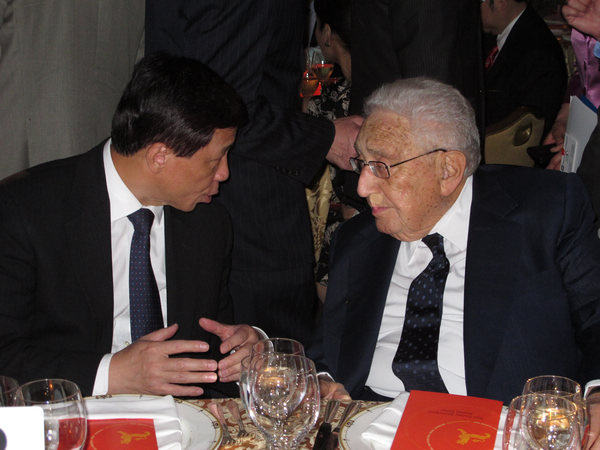 Zhang Yesui, China's ambassador to the US, talks with Henry Kissinger, former US secretary of state, before an Asia Society awards ceremony in Washington on June 15. Kissinger was given a lifetime achievement award by the non-profit organization. [Larry Lee / China Daily]
|
Kissinger's new book offers insights on how the ice was broken in Sino-US relations, reports Li Xing in Washington.
Henry Kissinger is scheduled to arrive in Beijing on Friday for a series of public and private meetings as a guest of the Chinese People's Institute of Foreign Affairs.He will discuss with his hosts his latest book, On China, which has been touted in the Chinese media and much coveted among the Chinese.
As he summarized after he received a lifetime achievement award from the Asia Society in Washington last week, he attempted to share with the readers his historic analysis of how the Chinese and Americans handle their problems and how "this translated itself into the actual interaction" between the United States and China.
The book "provides us with his insightful views on Sino-US relations over the past 40 years, including his meetings with four generations of Chinese leaders", Zhang Yesui, China's ambassador to the US, said during the Asia Society event.
A highlight of the trip will be his meeting with a celebrated party of old friends - and children of his old friends - to recall the memorable 48 hours he spent in Beijing in July 1971 on his secret mission to break the ice in China-US relations.
Among the many memoirs are some by a small circle of Chinese and Americans who worked to make the visit not only a success but also to initiate changes that have transformed the world. Numerous Chinese and American journalists have also come up with their accounts to unravel the "mysteries" surrounding the events that led to the secret trip and US President Richard M. Nixon's historic visit to China in February 1972.
In his new book, Kissinger, who was then Nixon's national security adviser and later secretary of state, recounts and reanalyzes the history-making moments, providing details of his talks with Premier Zhou Enlai.
Avid researchers can also delve into the now-declassified "eyes only" documents posted on www.gwu.edu or countless Chinese language volumes, such as Writings of Mao Zedong since 1949 and Chronicles of Zhou Enlai, from the Publishing House of Central Archives, a subsidiary of the Central Committee of the Communist Party of China.
But some questions always remain: Who should take the credit for the breakthrough? What juicy details were away from official documents? And, above all, what impact does this exciting moment 40 years ago have for the future China-US relations?
Credits go to . . .
Whoever recalls the days leading to Kissinger's Beijing trip invariably cites Nixon's article "Asia after Viet Nam", published in the October 1967 issue of Foreign Affairs magazine.
In the 15-page analysis of US Asian policy, Nixon many times cited Peking (Beijing) or Red China or Communist China as a "danger" or "threat" to Asia's future.
However, amid all the anti-China rhetoric, his statement that "taking the long view, we simply cannot afford to leave China forever outside the family of nations . . ." drew close attention from Mao and Chinese diplomats.
In China, what veteran diplomat Xiong Xianghui (1919-2005) called the prelude to China's opening up its relations with the US began with Mao assigning four marshals of the Chinese People's Liberation Army to study and discuss current international affairs in late spring 1969.
In his new book, Kissinger recognizes this "prelude".
The marshals were war veterans who had helped found the People's Republic - Chen Yi (1901-1972), Ye Jianying (1897-1986), Nie Rongzhen (1899-1992) and Xu Xiangqian (1901-1990). All had been suspended from their government and military duties for opposing the chaos and faction battles created by the extreme leftists in the first year of the "cultural revolution" (1966-1976).
Entering 1969, Nixon was sworn in as the 37th president of the US, telling the media that American policy toward China would not change unless China changed. While finding it increasingly difficult to continue the Vietnam War, Nixon kept sending more troops into the Southeast Asian country.
Meanwhile, Chinese-Soviet relations worsened. In addition to their deployment of a 1 million-strong force on the border, Soviet troops started skirmishes on China's Zhenbao Island on the border, killing and wounding Chinese soldiers.
According to Xiong, who was Zhou's longtime assistant, the four marshals at first were skeptical about their new assignment. But Zhou explained to them that Mao believed that any subjective analysis (in this case, of world affairs) must agree with objective reality, Xiong recalled in an article first published in a Party history archives magazine in 1992.
As reality changes in the world, subjective understanding and conclusion (of world affairs) must change accordingly, recalled Xiong, who was assigned by Zhou as one of the quartet's two assistants, helping with English language references and note taking.
Between June and September 1969, the four marshals held 16 meetings, totaling 48 hours, producing a series of analyses about the goings-on of the world and the "struggles" among the three major players in the world - China, the Soviet Union and the United States.
The prevailing belief within the Party then was that the US and the USSR were joining hands in dominating the world and that the US shifted its strategic objectives to Asia and to China. But Xiong said the four marshals overturned the belief by concluding that both the US and USSR would play the China card in their fight for dominance in Europe and the Middle East.
Since the Soviet Union posed a bigger threat to China, Chen Yi, vice-premier (1954-1972) as well as foreign minister since 1958, put forward what he considered "unconventional thoughts", that China could play the American card, Xiong said. After all, the US needed China's help as well in getting out of the Vietnam War.
Chen proposed that the two countries go beyond the established channel of ambassadorial meetings in Warsaw to open China-US dialogues between foreign ministers or even higher levels of officials and discuss the fundamental issues barring the normalization of the two countries' relations.
In his narrative, Xiong featured the courage and wisdom of the quartet, who had to wade through all types of political and media pronouncements from the three countries and fight off the danger of political persecution from the ultra-leftists within.