Foreign and Military Affairs
Premier Wen urges Japan to release captain
By Wu Jiao (chinadaily.com.cn)
Updated: 2010-09-22 09:15
 |
Large Medium Small |
| ?
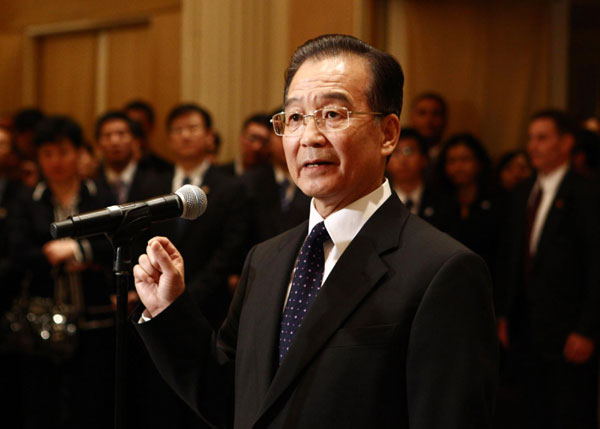 Chinese Premier Wen Jiabao speaks during a meeting with representatives of Chinese nationals and Chinese Americans in the United States on Tuesday, Sept. 21, 2010. Premier Wen urged Japan to release the illegally detained Chinese skipper immediately and unconditionally. [Photo/Xinhua] |
Meeting local Chinese in New York, Wen said Tuesday night China viewed the detention of the captain as illegal and unreasonable.
Wen is in the United States for two United Nations conferences and a series of bilateral and multilateral meetings.
Wen said the illegal and unreasonable detention severely harmed the crew members and their families, sparking anger of Chinese people both at home and abroad. He urged Japan to let the captain return immediately and unconditionally.
He said the Diaoyu Islands are part of China's sacred territory, and if Japan clings obstinately to its own course and insists on making one mistake after another, China will take further actions, and all the consequences should be born by the Japanese side.
Wen has personally facilitated the warming of a chilly Sino-Japanese relationship during the prime ministership of Junichiro Koizumi, who repeatedly visit the Yasukuni Shrine where class-A war criminals has been worshipped and soured relationships between the two countries.
The ties improved over the past few years through lots of hard work, but the momentum has now been ruined, and it is the Japanese that led to this situation, Wen said.
He urged Japan to correct its wrongdoings immediately and bring Sino-Japanese ties back on the right track, which is conducive not only to the interests of the two countries, but also to world peace and cooperation.
The flare-up began with a collision between the Chinese trawler and Japanese coast guard vessels in waters off the Diaoyu Islands on Sept 7.
The Japanese side illegally seized the Chinese trawler and fishermen. While 14 Chinese fishermen and the trawler returned home on Sept 13, the 47-year-old Chinese captain Zhan Qixiong was illegally held in Japan, despite protests by China. Zhan’s detention has been extended to Sept 29.
Beijing has since summoned the Japanese Ambassador to China, Uichiro Niwa, on six occasions to lodge strong protests at Japan’s actions.
China has taken countermeasures, including halting ministerial-level exchanges and meetings in other areas.
Tourism in Japan has also been affected as a number of Chinese citizens canceling their trips as a way to express their outrage toward that country.
The incident has also led to a public protest in China.
Forums on several major Chinese news portals, such as Sina.com.cn, have been overwhelmed with tens of thousands of messages saying the Diaoyu Islands have always been an integral part of China.
These messages call for Japan to immediately and unconditionally release Zhan, saying Chinese fishermen have rights to fish in the waters around the islands.
On the cultural front, an invitation to about 1,000 Japanese youths to the World Expo in Shanghai has been canceled and ticket sales have been suspended for concerts at the Expo site next month by Japanese pop band, SMAP.
In New York, Wen will attend the UN meeting of the Millennium Development Goals (MDGs) and the 65th session of the UN General Assembly.
He is also scheduled to meet US President Barack Obama on the sidelines of the UN meetings as ties between the two countries improve after months of tension.
However, Wen will not meet his Japanese counterpart because the atmosphere is “obviously not suitable”, Foreign Ministry spokeswoman Jiang Yu said on Tuesday.
“Given the current atmosphere, arranging a meeting clearly would be inappropriate,” she said. On the Japanese side, Tokyo’s governor Shintaro Ishihara said on Tuesday he would scrap a visit to Beijing, AFP reported.
On Tuesday, Japan called for the eradication of “narrow-minded and extreme nationalism” in both countries, Kyodo News Agency reported.
“For the peace and development of East Asia and the Asia-Pacific, we want to use all available means of communication to ask that this be resolved without the situation escalating,” Japanese Chief Cabinet Secretary Yoshito Sengoku told a news conference.
Analysts believe Japan’s moves have unveiled its real intentions.
“Japanese media reports have mainly focused on the protests from China but have ignored the fact that it was Japan that caused the problem,” Feng Zhaokui, former deputy chief of the Institute of Japan Studies at the Chinese Academy of Social Sciences, told China Daily.
“So the Japanese people are not familiar with the cause of the event.
“It is quite normal that Chinese citizens express anger toward Japan, because the Diaoyu Islands are, without doubt, an integral part of Chinese territory. Japan calling to avoid so-called nationalism, in essence, reflects Japan’s own nationalism.
“The current cabinet under Naoto Kan’s leadership is more hostile toward China, in which the hawkish Maehara Seiji, Japanese foreign minister and former transport minister, plays a very important role.”
Analysts also agree it is up to Japan to decide the future of the relationship.
“Ahead lie two scenarios. One is further deterioration of the relationship, turning from one of mutual benefit to one of strategic contention,” Liu Jiangyong, a senior scholar of Japan studies at Tsinghua University, told the Singapore-based zaobao.com.
“The other is based on long-term interests.
“How to avoid the escalation of tensions and properly settle the dispute has now become crucial.” Feng said it could be the importance of economic ties that brings Japan to its senses.
“China and Japan are highly interdependent especially in trade. Every Japanese person is benefiting from the intertwined economic ties. When Japan’s miscalculation genuinely hurts the interests of its own citizens, Tokyo will consider a retreat on this issue,” Feng said.
Experts said Wen’s presence in New York embodies China’s support for the role of the UN and reflects its determination to deal with global threats and challenges through collective efforts.
The MDGs summit aims to ensure that global poverty is reduced by half by 2015. As leader of the world largest developing country, whose commitment to the MDGs carries global significance, Wen is expected to elaborate on China’s strategy in attaining the UN’s anti-poverty goals and announce further measures to be taken by China to achieve them.
Li Baodong, permanent representative of China to the UN, said Wen will expound upon China’s domestic and foreign policies as well as the international situation in his address to the assembly.
Wen will reiterate that China will unswervingly take a path of peaceful development and adhere to the reform and opening-up policy, Li told reporters last week.
Experts also said the meetings are an important diplomatic activity that will strengthen the role of the UN. This year marks the 65th anniversary of the establishment of the organization, yet it faces a variety of problems and challenges.
Jin Canrong, professor at Beijing-based Renmin University of China, said the UN is struggling to meet its ambitious goal of worldwide poverty reduction. But China has given the world body its full support to help it maintain international security and common development, he said.
Zheng Qirong, vice-president of the China Foreign Affairs University, agreed that Wen’s aim in attending the conference is to promote and strengthen the central role of the UN, especially in international affairs.
Wen is set to meet Obama on the sidelines of the general assembly on Thursday.
Ties between Beijing and Washington have been tested in recent months over trade issues as well as a US naval drill with the Republic of Korea. Obama on Monday again urged China to increase the value of its currency.
Though the two countries have had difficulties in the past, experts believe that bilateral exchanges will be beneficial.
Niu Xinchun, a scholar on US studies at the China Institutes of Contemporary International Relations, said that both sides sought better relations.
“Sino-US relations deteriorated over the past several months but the coming meeting shows that both sides are willing to sit down to talk to improve ties.”
Qin Jize, He Wei, Zhou Wa, Wang Haishan and AFP contributed to this story.