Economy
High trade surplus 'likely to remain'
By Ding Qingfen (China Daily)
Updated: 2010-08-11 07:07
 |
Large Medium Small |
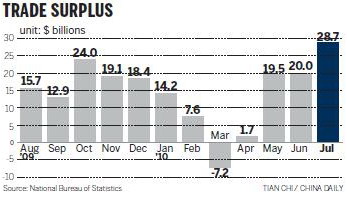
BEIJING - The country's high trade surplus will likely remain for the rest of the year as domestic demand continues to shrink from government attempts to curb the property bubble, Chinese analysts have said.


In July, exports grew to $145.5 billion and imports increased to $116.8 billion.
The higher trade surplus "was mainly driven by the larger-than-expected slowdown in imports", said Nomura Global Economics in a note on Tuesday.
Growth in imports fell to 22.7 percent, from 34.1 percent in June, although China's imports from the United States and European Union reached the highest since February, rising by 33 percent for US imports and 34 percent for EU imports year-on-year, Customs figures showed.
Despite the strong growth of imports in auto, grain, mechanical and electrical products, imports of industrial goods, including crude oil, iron ore, copper and finished steel products, all fell.
These reflected "weakening commodity prices, shutdown of inefficient and heavily polluting producers, and flooding which caused weak manufacturing activity", Nomura said.
As government policies on curbing real estate speculation continue and commodity prices are expected to stay low, the country's imports of "most industrial materials" will continue to shrink, said Yan Jinny, an economist from Standard Chartered Shanghai.
Trade surplus will stand at above $20 billion in the coming months, she said.
Li Jian, a senior researcher of the Academy of International Trade and Economic Cooperation affiliated to the Ministry of Commerce, agreed.
"In the rest of the year, the trade surplus is very likely to range from $20 billion to $25 billion," Li said.
"China's export growth has stayed surprisingly resilient, as the European debt woes are yet to exert negative impact on the demand for the nation's goods. We will have to wait to see the real impact until September when Christmas orders are made," Yan said.
For the rest of the year, slowdown in export growth will continue but it will be moderate, as China's exporters are shifting more focus onto Asian and emerging markets from the US and EU, Yan said.
Exports to South Korea and Singapore accelerated to 40.3 percent and 11.2 percent in July, from 37.4 percent and 8.4 percent in June, Customs figures showed.
Analysts said China must also be prepared for a fresh round of international pressure led by the US to raise the value of the yuan, as the US and EU will possibly "launch more trade remedy cases against China" in the second half of the year.
A number of analysts worry that the large surplus will give developed nations such as the US a good excuse to further pressurize China on its trade policies.
"Anti-dumping and anti-subsidy cases against China, especially from the US, will grow in the second half," said He Weiwen, deputy director of the China Institute for Open Economy of the University of International Business and Economics.
Over the weekend, the US said in its preliminary ruling that it will impose anti-dumping duties as high as 429 percent on imports of drill pipe used for oil wells from China.
Yan from Standard Chartered said "a sizable trade surplus means that the Chinese government has less justification to interrupt the appreciation of its currency".
A number of trade experts have called on the Chinese government to launch more policies to stimulate imports, especially high-tech and valued-added products, to balance the foreign trade and to fend off the criticisms.
Last weekend, the Ministry of Finance, together with four other ministries, released a policy on remitting import value-added tax and import tax on selected high-tech products, which analysts said is a sign that China is taking imports seriously.
 主站蜘蛛池模板:
国产成人精品第一区二区|
久久一日本综合色鬼综合色
|
成人嫩草研究院久久久精品|
99在线视频免费观看|
女高中生强奷系列在线播放|
精品亚洲国产成人蜜臀av|
91老熟女老女人国产老|
宅男噜噜噜66网站高清|
狠狠色丁香婷婷综合潮喷
|
免费人成视频在线视频电影|
无码无套少妇毛多18pxxxx|
特级做a爰片毛片免费看无码|
日本极品少妇videossexhd|
国产成人AV男人的天堂|
久久婷婷丁香五月综合五|
国产精品乱子伦xxxx|
国产超碰无码最新上传|
奇米四色7777中文字幕|
国产色视频一区二区三区|
加勒比在线中文字幕一区二区|
亚洲欧洲日韩久久狠狠爱|
国产成人亚洲综合图区|
blued视频免费观看片|
久久夜色精品亚洲国产av|
在线天堂中文新版www|
国产色无码专区在线观看|
成码无人AV片在线电影网站|
欧美变态另类zozo|
国产一级av在线播放|
亚洲国产成人无码网站大全|
日本无码欧美一区精品久久|
国产极品嫩模在线观看91|
久久久久久人妻一区二区无码Av|
国产一区在线观看不卡|
中文字幕少妇人妻视频|
国产精品呻吟一区二区三区
|
你懂的视频在线一区二区|
国产成AV人片久青草影院|
67194熟妇人妻欧美日韩|
四虎国产精品免费久久|
亚洲中文在线精品国产|
主站蜘蛛池模板:
国产成人精品第一区二区|
久久一日本综合色鬼综合色
|
成人嫩草研究院久久久精品|
99在线视频免费观看|
女高中生强奷系列在线播放|
精品亚洲国产成人蜜臀av|
91老熟女老女人国产老|
宅男噜噜噜66网站高清|
狠狠色丁香婷婷综合潮喷
|
免费人成视频在线视频电影|
无码无套少妇毛多18pxxxx|
特级做a爰片毛片免费看无码|
日本极品少妇videossexhd|
国产成人AV男人的天堂|
久久婷婷丁香五月综合五|
国产精品乱子伦xxxx|
国产超碰无码最新上传|
奇米四色7777中文字幕|
国产色视频一区二区三区|
加勒比在线中文字幕一区二区|
亚洲欧洲日韩久久狠狠爱|
国产成人亚洲综合图区|
blued视频免费观看片|
久久夜色精品亚洲国产av|
在线天堂中文新版www|
国产色无码专区在线观看|
成码无人AV片在线电影网站|
欧美变态另类zozo|
国产一级av在线播放|
亚洲国产成人无码网站大全|
日本无码欧美一区精品久久|
国产极品嫩模在线观看91|
久久久久久人妻一区二区无码Av|
国产一区在线观看不卡|
中文字幕少妇人妻视频|
国产精品呻吟一区二区三区
|
你懂的视频在线一区二区|
国产成AV人片久青草影院|
67194熟妇人妻欧美日韩|
四虎国产精品免费久久|
亚洲中文在线精品国产|