Economy
Currency move to boost stocks
By Lu Jianxin and Edmund Klamann (Chian Daily)
Updated: 2010-06-22 08:08
 |
Large Medium Small |
SHANGHAI - China's decision to end the yuan's nearly two-year peg against the dollar will boost its stock market heavyweights, as it heralds a long-term yuan appreciation based on robust productivity growth and aids an economic adjustment towards less reliance on exports.
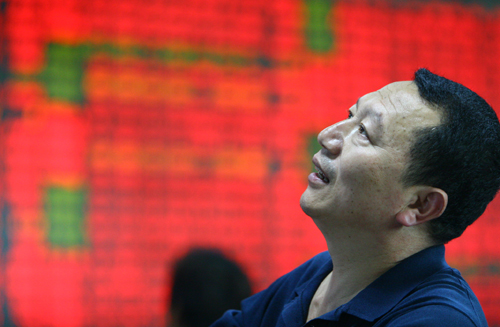 An investor watches share price movement at a brokerage in Fuyang, Anhui province. Some brokerages and fund managers are getting more bullish on China's stocks. An Xin / for China Daily |
All major sectors in China's stock market - from airlines and banks to property and investment firms - are set to gain in the short or long term. Assets of Chinese companies, almost exclusively denominated in yuan, stand to appreciate along with the value of the currency.


But that may not be bad news for the economy as the country adjusts its economic mix to become less reliant on exports, which typically accounted for two-thirds of gross domestic product until the peak of the global financial crisis in 2008.
Exporters are no longer the mainstream stock market sector and the impact of losses in such stocks will have only a limited impact on the overall market.
"The yuan's appreciation is an indisputable trend in the long run, and it will be a great boost to China's stock market by helping to improve China's economic structure," said Cao Xuefeng, a senior analyst at Western Securities in Chengdu.
"Weak global economies and China's rising costs of labor mean China will no longer be able to rely on exports as its engine for growth. Consequently, domestically focused companies, such as banks and investment firms, will be favored."
Shares in China's top three airlines - Air China, China Eastern and China Southern - are expected to rise in the short term due to cost reductions, as their main operating costs are aircraft purchases overseas.
Large-caps
Banks, such as Industrial and Commercial Bank of China, the world's biggest by assets, are seen rising in the medium term as their huge volume of yuan assets will appreciate in line with the rise in the currency.
Land and property stocks will benefit from expectations of yuan appreciation in the long run.
The yuan reform could therefore be a pleasant surprise for overseas companies, such as Standard Chartered Bank, which plans to tie up with Agricultural Bank of China as China's third-largest bank prepares for an initial public equity offer in Shanghai and Hong Kong this month.
Other winning sectors include heavy importers of raw materials, such as paper makers, and investment firms, which will get a boost from government moves to boost domestic consumption to compensate for the smaller portion of exports in the economy.
But the boost to the stock market will likely be gradual, as China will control the pace of appreciation in the near term to deter speculative "hot money" inflows betting on the yuan's rise.
The spot yuan rate is expected to move in narrow daily ranges of at most 50 pips in the coming weeks, if not months. That will still be much larger than movements of one or two pips a day since July 2008, when China repegged the yuan to the dollar to soften the impact of the global financial crisis on its economy.
Cumulatively, the yuan can be expected to appreciate 3 percent in about six months and 5 to 6 percent in a year, in line with the progress of China's economic growth. These levels are not enough to push the value of major Chinese companies, such as banks, sharply higher during those periods.
The Chinese stock market's benchmark Shanghai Composite Index, which has moved in a narrow range between 2,500 and 2,600 points since the start of this month, may not be able to break out of that band soon. Sentiment has been weakened by official steps to cool the property market and worries that the eurozone debt crisis will slow the economic recovery.
"The initial impact of the yuan reform will be limited as everybody in this market knows the process will be gradual," said Qian Qimin, an analyst at Shenyin & Wanguo Securities in Shanghai.
"The market will largely move in line with developments in other factors, such as the government's property cooling steps, until yuan appreciation has reached a degree where it has a big enough impact on the overall economy."