Society
Many relics in Yushu to be rebuilt by locals
By Lin Shujuan (China Daily)
Updated: 2010-05-28 06:56
 |
Large Medium Small |
|
|
BEIJING - Religious and ethnic considerations must be taken into account in the restoration of cultural relics damaged in the April 14 earthquake in a predominantly Tibetan-populated area bordering Qinghai and Sichuan provinces, the country's top relics protection authority said on Thursday.
Five national-level and 23 provincial-level cultural relic sites were shattered during the powerful 7.1 magnitude earthquake, Guan Qiang, deputy director of the department of cultural heritage conservation at the State Administration of Cultural Heritage (SACH), said at a briefing in Beijing.
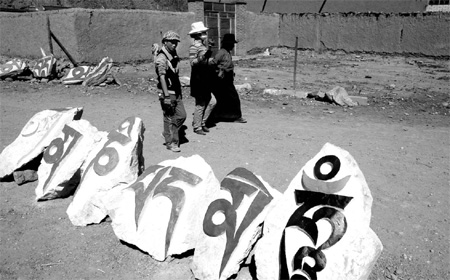
Most of them are monasteries and other religious places like the Gyana mani stone mound in Sengza village, near the epicenter of Gyegu township in Yushu county, Qinghai province.
"This makes religious and ethnic considerations a must for their restoration," Guan said.
The 300-year-old Gyana Mani mound, the largest of its kind in the world before the earthquake reduced it to a chaotic tangle of rubble and colored sutra streamers, is now on top of the government's priority list for cultural relic restoration, according to Guan.
Over the past month, a team of 14 experts led by SACH officials has been working on a reconstruction plan for the sacred mound, which covers about 20,942 square meters, Guan said.
Hou Weidong, chief engineer of the Chinese Academy of Cultural Heritage and head of the 14-man team, said they aim to "restore everything to almost what it looked like before the quake".
For centuries, the sacred mound has been part of daily life in Sengze village. Before the earthquake, it was a four-gate compound comprising a row of white pagodas, a sanctuary, and at the center, seven heaps of two billion stones carved with sutra texts and Buddha images.
Tibetans consider rocks from the mountains of the Qinghai-Tibetan Plateau sacred and stones with sutra scripts even more so.
Before the quake, local Tibetans visited the site every day, managing it and protecting it. They earned a living by engraving and selling the stones.
"The locals can't live without the mound, so we'll work closely with them to make sure they like every detail of the restoration plan," Hou said.
For example, officials learned they can't use a backhoe to reorganize the Mani stone heaps, Hou said.
"We consulted the locals and we will have to do it by hand," he said.
Lu Zhou, a member of the expert team and an architecture professor from Tsinghua University, said he has been encouraged with how the post-quake restoration is being carried out.
"Despite the fact that the earthquake leveled many monasteries, it is heartening to see that the culture and traditions those monasteries embody are still alive in the daily lives of local Tibetans," Lu said. "That means it is entirely possible to restore those monasteries to what they were, citing local wisdom and skills."
The Chinese government is providing aid to locals who will use their traditional temple building skills to become the main working force in the restoration effort, Guan said.
"In this way, they (the locals) also earn money from the restoration," Guan said.
Yushu, a predominantly Tibetan-populated area on the 4,000-meter high plateau, is home to four national-level cultural relic sites and a number of less prominent heritage sites. Many were severely damaged in the quake, which killed at least 2,200 people and left more than 100,000 homeless.