Government and Policy
Xinjiang to receive massive input
By CUI JIA (China Daily)
Updated: 2010-03-15 06:57
 |
Large Medium Small |
|
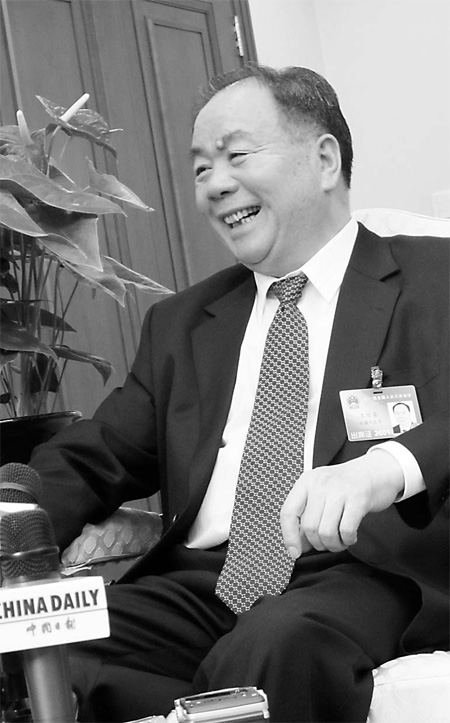 Wang Lequan, Party secretary of the Xinjiang Uygur autonomous region, receives an exclusive interview with China Daily on Saturday.[Provided to China Daily] |
Party chief: Region will also focus on self-reliance to develop economy
BEIJING: A detailed and massive investment plan will be introduced in a bid to boost Xinjiang's economy during the upcoming central government's working conference on issues affecting Xinjiang this May, though the region's development will not entirely rely on it, a senior official said on Saturday.
"Xinjiang needs to be self-reliant in its development, because it is the key to maintaining Xinjiang's social stability. We welcome the central government's aid, but we cannot just rely on it," Wang Lequan, Party secretary of the Xinjiang Uygur autonomous region, told China Daily during an exclusive interview.
The region's development should not simply rely on a "blood transfusion" from the central government. It must use this assistance to create a "blood-producing system" of its own, he said.
Xinjiang should not merely sit and wait for financial assistance and preferential policies from the central government. The region's development depends on it generating its own, Wang explained
Premier Wen Jiabao said earlier that the central government would formulate and implement policies for the economic and social development of Xinjiang, Tibet and Tibetan ethnic areas during his annual work report at the National People's Congress.
"We can see the central government's determination to help Xinjiang - a region that has recently been under attacks by separatists - maintain long-term stability through economic development and improving people's living standards," he added.
The social situation can only become stable when the problem of people's livelihood is solved and economic development is the solution, the Party chief emphasized.
Last year, Urumqi, capital of the region, experienced a riot on July 5, which left 197 dead and 1,700 injured. Overseas separatists were believed to have organized the riot.
Wang said it is not about how much money will be invested in Xinjiang. What is really important is that the plan can boost people's confidence and clear their doubts about investing in the region.
He predicted that investment in fixed assets will "jump sharply" after the plan is released as a result of initial investment from the central government and from State-owned enterprises, which are encouraged to engage in business in Xinjiang to "realize fast-paced economic development".
The central government has already paired up a number of municipalities and provinces with different parts of Xinjiang to provide the latter with large sums of capital, technology and talent. These have played an important role in the region's development, according to Wang.
"All those supports are external factors and we cannot merely depend on that, as I found some local officials are doing," Wang said. "We have to decide what we should do and what will be of the greatest benefit. We also have to be prepared before assistance arrives. There is no time to waste."
The central government's plan is also designed to help the local economy catch up with the eastern coastal provinces.
Wang said that although Xinjiang is the most distant region from the east coast, it has the advantages of opening up to the west.
The far west autonomous region shares borders with Russia, Mongolia, India, Pakistan, Afghanistan, Kazakhstan, Kyrgyzstan and Tajikistan.
"Xinjiang should be receptive to increased trade. At the moment, many ports on its border countries have yet to open up, " said Zhao Xia, president of Baosteel Group Xinjiang Bayi Steel, the biggest steel maker in Xinjiang.
If an ethnic minority region like Xinjiang is underdeveloped compared to other areas, it could easily be used by separatists to instigate unrest, he added.