Society
Mystery surrounds the fatal shooting in Guizhou
By He Na and Zhang Yuchen (China Daily)
Updated: 2010-01-29 07:21
 |
Large Medium Small |

Questions over legality of fatal shooting by police chief highlights need for China to launch independent inquiries, report He Na and Zhang Yuchen
Mystery still surrounds the events that led to the fatal shooting this month of two unarmed men by a small town police chief in Guizhou province. The local community disputes the official line that the men were killed as they attempted a drunken assault, with some eyewitnesses claiming the officer shot them in cold blood.
Following the investigation by authorities in Pogong town that exonerated Zhang Lei, the town's deputy police chief and the man who pulled the trigger, the Ministry of Public Security decided to send its own team to probe the case.
 |
|
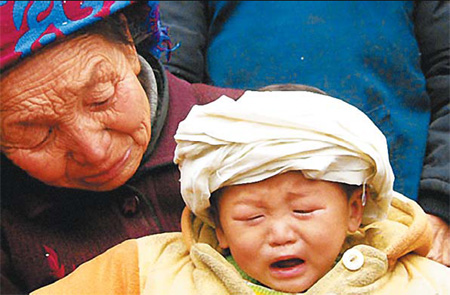
The mother and son of Guo Yongzhi mourn at his funeral on Jan 14. Guo was shot and killed along with his cousin by a police offi cer in Guizhou province. Courtesy of Chengdu Commercial News |
Many legal experts, however, have called for the independent inquiries to investigate every case in which a suspect is hurt or killed by security officials.
On Jan 12, cousins Guo Yonghua, 33, and Guo Yongzhi, 44, were reportedly involved in a fight on the streets of Pogong township, part of Guanling Buyi and Miao autonomous county. Witnesses called the police and, shortly after, Zhang and another officer arrived. It is not clear what happened before the police chief shot the men dead, but at press briefings on Jan 13 and 18, local government officials each time said Zhang opened fire when the men attempted to grab his gun.
The villagers were "in a state of excitement and would not listen to reason", said Ran Taiyou, deputy head of Anshun public security bureau. Police said Zhang fired two warning shots - one into the air, one into the ground - prior to the killings but the men ignored him. All 51 people "relevant to the case" interviewed by detectives supported the account, authorities said at the second briefing.
Autopsy reports showed Guo Yongzhi was shot twice, in the right thigh and in the head. Guo Yonghua died after taking a single bullet to the head. Both men were drunk at the time of the incident, with tests showing they had more than 230 mg of alcohol per 100 ml of blood, the local public security bureau reported. The legal driving limit is 20 mg per 100 ml.
However, media reports have contradicted the official version of events. "There was no fight between Zhang and the two dead men, no physical contact at all," according to an anonymous eyewitness quoted by Wuhan Evening News on Jan 17.
In an interview with Xinkuaibao, a daily newspaper based in Guangdong province, Guo Yongwen, the brother of Guo Yongzhi, said he was at the shooting and recalled Zhang ordered the cousins to go to the station.
"They refused and I was pushed to the ground by another police officer. As I stood up, I heard the gunshots," he was quoted as saying.
"My brother and my cousin were both shot to the ground. Yongzhi raised himself on his elbows and said, 'Don't shoot, take me to the emergency clinic'. But Zhang just shouted, 'I will shoot whoever helps him', and then shot Yongzhi again," Guo Yongwen told Xinkuaibao.
Suspicions were also raised when the township government paid the families of the dead men 350,000 yuan ($50,000) the day after the shooting. The money came from the local authority's poverty-alleviation fund, according to a Xinhua News Agency report on Jan 18.
"Why did the government pay compensation if they think the men assaulted a police officer?" said Xu Jianguo, a Beijing-based lawyer.
Wu Xin, chief executive of the Pogong township government, signed the compensation deal on the condition the families buried the bodies by Jan 17 and "did not ask for any further compensation", Xinkuaibao reported.
Officials with the government refused to comment on the issue when contacted by China Daily.
Results of the investigation into the case by officials in Anshun were revealed on Jan 17. But lawyers representing the families of the dead men have called for the deputy police chief to face criminal charges.
Zhang, who was promoted to deputy police chief in March 2008, and the police officer who was assisting him on Jan 12 were suspended from their duties and placed under surveillance during the investigation, local officials told China Daily.
"The critical point is that two shots were fired at Guo Yongzhi," said Xu Jianguo, a Beijing-based attorney. "If the first shot to Guo Yongzhi's right leg incapacitated him, it was not necessary to shoot him a second time in the head. Was it really necessary for Zhang to open fire and kill some who was unarmed at such a short distance?"
Police officers should only use weapons to prevent
illegal acts and should stop using a weapon once a suspect is incapacitated, according to the country's Police Equipment and Weapons Regulations.
The Ministry of Public Security is yet to publish the findings of its inquiry and a spokesman was unavailable to comment on its progress yesterday. Investigations by a special team set up by the Guizhou Committee of the Commission of Politics and Law of the Communist Party of China on Jan 22 are also still ongoing.
However, even the results of these actions are unlikely to be taken as truth by the public, according to legal experts who said China needs transparent inquiries totally independent from all levels of government to restore trust in the findings of such investigations.
In China, police departments of equal or higher level usually carry out initial investigations into complaints about procedure. "But it is like a father investigating his son," said Yu Wanlan, a criminal lawyer at the Beijing Boru Law Firm. "It is hard for the public to believe these probes are impartial."
"An independent investigation should be launched whenever any government department comes under scrutiny," said Mo Shaoping, director of the Beijing Mo Shaoping Law Firm. "An independent external investigation team could solve problems a lot better."
"In the current system, the public is rarely kept informed of procedural details or updates," said Yang Weidong, professor of administrative law at the Chinese Academy of Governance in Beijing. "Quite often cases end with nothing conclusive or settled, and the public rarely gets the truth they are looking for.
"In the West, an independent inquiry clarifies the facts and finds the flaws in the administration of the government. Independent inquiries are aimed at improving performance and preventing repeats of problems. Because we don't have such a system in place, similar cases of police officers shooting suspects have occurred many times in recent years."
A senior police officer in Poyang, Jiangxi province, was investigated for ordering the fatal shooting of a road worker in 2008. No outcome was ever released to the public.
A similar incident also happened in Guangzhou in November 2007, when police shot and killed a well-known neurosurgeon as he resisted attempts to check his "suspicious car". The victim's family disputed the findings of an inquiry team comprising of officials from the municipal Party committee, prosecution service and police force. They failed in a bid to have the case reviewed by higher authorities.
The current system has yielded some success, however. Police officer Ji Zhongchun shot a man three times during a brawl in Mengzi county, Yunnan province, last February. He was off duty at the time and was sentenced to death - suspended for two years - by the Yunnan People's Supreme Court in December.
Abuses of power were reportedly widespread in China in the 1980s but experts agree the situation is moving in a positive direction. But the misuse of weapons by officers is still a problem, said Yang.
Chen Youxi, a lawyer with the Capital Equity Legal Group in Zhejiang province, agreed and said: "The police need to be more effectively regulated to limit their use of weapons."
Establishing independent inquiries into possible abuses of power offers China the perfect opportunity to "complete its transformation from a society ruled by authority to one ruled by law", said Wang Yongjie, associate professor of East China University of Political Science and Law.
"Independent inquiries offer transparent justice," he said. "The public needs to know the truth, which is hard to get from one-sided investigations or media reporting. A stable and convincing inquiry system is acceptable to a public seeking the truth."
Experts suggested putting such investigations into the hands of people's congresses, which would mean procuratorate and prosecution offices could carry out independent inquiries into cases like the one in Guizhou to ensure impartiality.
The deputies of all local people's congresses, as well as the National People's Congress, the country's top legislative body, are elected every five years and are independent. People's congresses and their standing committees have the right to supervise the work of governments, courts and procuratorates.
"People's congresses could take over the whole process of the inquiry, from choosing the members and supervising the investigation," said Wang.
However, setting up a concise system for independent investigation is not a quick process.
"It's still too early to talk about how to establish such a system - China is a long way off - but only by doing this will the credibility of the results of investigations improve," said Wang. "The police must know they cannot play the game and be the referee at the same time."
(China Daily 01/29/2010 page7)