Society
51 children suffer lead poisoning
By Qian Yanfeng and Wei Tian (China Daily)
Updated: 2010-01-06 07:36
 |
Large Medium Small |
Latest incident follows string of similar cases found last year
SHANGHAI: At least 51 children in East China's Jiangsu province were found to have excessive levels of lead in their blood, the latest lead poisoning scandal after a string of such cases last year, sounding new alarms for heavy metal pollution in China.
Medical checks for 110 children younger than 16 in Dafeng, Jiangsu, showed 51 tested positive for high lead levels, said Dafeng's municipal government on its website yesterday.
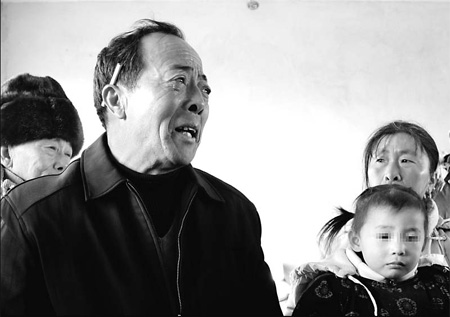 A villager cries over his grandchild's suffering from lead poisoning in this recent photo. [Li Gen] |
Dafeng Shengxiang Power Supply Co Ltd, a lead-acid battery manufacturer, was held responsible for the poisoning. The company is located less than 100 meters away from the Hekou village where residents started to complain of anorexia and vomiting among their children since August last year. The company has been ordered to stop production and relocate.
Local authorities said they will step up screening and launch free health checks for all children younger than 16, send those diagnosed with high lead levels to Shanghai for medical treatment, and provide guidance for the nutrition of children with lower lead levels to remove the toxin.
But such promises failed to appease angry villagers.
Guo Linyu, mother of a 4-year-old boy whose blood lead level reached 364 mg per liter, told China Daily yesterday that the government only paid for the medical treatment of her son without offering nutrition subsidies. The family also demanded compensation for the damage but was told by the government to turn to the battery company for solutions.
"But I heard the company had already paid a certain amount of compensation to the government," she said.
"Doctors told me the normal lead content in blood ranges from 0 to 100 mg per liter, and my son suffered from severe poisoning. That means his fertility and intellectual development in the future might be affected," said the mother over the phone, between sobs.
She said despite more than 60 days' treatment, the boy still felt acute pain in his body and his eyes looked dull.
Lead is widely known to pose more risk to children than adults because their bodies easily absorb and retain lead. Excessive amounts of lead can harm the nervous and reproductive systems and cause high blood pressure and anemia. In severe cases, it can lead to convulsions, coma and even death.


In August last year, more than 1,350 children in Wenping of Hunan, the biggest refined-lead producing province in the country, suffered excessive lead levels due to pollution from the Wugang Manganese Smelting Plant. And in Fengxiang of Shaanxi, 851 children tested positive for lead poisoning by a local smelter. Both companies were said to have contributed a lot to the local tax income.
An official surnamed Zhang from Dafeng municipal environmental protection bureau told China Daily that many parts of the country lack environmental supervision over smelters and battery producers since they are not considered "as high-polluting as chemical plants".
"That's why we do not conduct frequent safety checks on them. In fact we only do that once or twice in a year. It was not until October last year, when the residents protested, that we came to realize the severity of the situation," he said.
But according to guidelines on the prevention and treatment of lead poisoning in children issued by the Ministry of Health in 2006, children in areas with high risks of lead contamination should be regularly screened for possible high blood-lead concentrations.
Zhang also said in the local government's bid to attract investment, they did not pay enough attention to environmental rules.
Local media earlier quoted an executive from Shengxiang as saying that the company did advise local authorities to keep a safe distance of 1,500 to 2,000 meters from any residential area when choosing the factory site. But the officials told them not to worry about that.
Zhong Guohua, lawyer for the company's manager Cheng Qihua, said that the company "respects the penalty from the local government and is willing to assume responsibility for the poisoning."
Lead poisoning cases last year
December, 2009
Qingyuan, Guangdong province
Twenty-five children were confirmed to have excessive levels of lead in their blood due to pollution from a nearby storage battery company in the Qingyuan Economic Development Zone. A few adults were also diagnosed with abnormally high lead levels.
September, 2009
Shanghang, Fujian province
Two medical agencies tested 287 children younger than 14 years of age and found 121 of them had excessive levels of lead in their blood. 120 children had lead levels between 100 and 200 mg per liter of blood and one child had 218 mg/l.
August, 2009
Fengxiang, Shaanxi province
A total of 851 children tested positive for high levels of lead in Fengxiang county. About 1,000 people are to be relocated in the wake of the poisoning. Dongling Lead and Zinc Smelting Factory was held responsible for the incident.
August, 2009
Wugang, Hunan province
By Aug 23, an examination conducted by the Wugang government showed that more than 1,300 out of 1,958 children tested had excessive lead content. The boss of the company responsible was a deputy to the local people's congress.
August, 2009
Kunming, Yunnan province
As many as 200 out of 1,000 children given routine blood tests between June and August had excessive levels of lead, which local authorities said had been caused by car exhaust emissions and had no direct link with industrial pollutants.