|
|

2009 SCO & BRIC Summits > Opinion
|
BRIC building road to global economic recoveryBy Liu Junhong (China Daily)
Updated: 2009-06-18 07:52 All eyes are focused on the first BRIC (Brazil, Russia, India and China) summit in Yekaterinburg, Russia, because it could give rise to a new world economic order as opposed to the ailing global order represented by G8, which meets next month. The financial tsunami that originated in the US has shattered the global economy. Though experts say BRIC will lead the global economic growth in the 21st century, the four countries have not escaped the financial tsunami either. But the BRIC economies seem to have emerged out of the crisis earlier than the US and other economies. The stock markets in the four countries rebounded by 40 to 70 percent between February and early June, creating hope in the global market. Domestic demand in China and India is increasing because of their huge populations. Sale of home appliances in the two Asian economies accounts for a quarter of the world total. China's automobile sales rose by 15 percent in May and could cross 10 million units this year. Goldman Sachs has forecast that domestic demands in China and India will increase by 9.8 percent and 6.1 percent, higher than their GDP growth of 8.3 percent and 5.8 percent. The rapid recovery of BRIC is helping global capital to flow back into emerging markets, and stimulating the rebound of resources and assets prices. Invigorated by the recovery of BRIC, the once sluggish capital markets of the US, the European Union and Japan have started to rally. That recently prompted the Organization of Economic Cooperation and Development (OECD) and the International Monetary Fund (IMF) to correct their forecast to upward on global economic growth this year. Goldman Sachs was the first to suggest the BRIC grouping. Its 2001 world economy report said the economic outputs and the stock market values of the four countries would catch up with those of the developed nations' by 2039 and become the center of world economic growth. Since then, global investors have been favoring emerging markets. IMF figures show the BRIC economies, with an average annual growth rate of 10.7 percent between 2006 and 2008, have emerged as major contributors to the global economy. In June last year, major emerging economies issued their own declaration on climate change at the G8 summit in Hokkaido, Japan. Since then voices of the BRIC countries have become stronger on the global stage. After the financial crisis, leaders of BRIC countries have attended G20 summits, worked with their developed nations' counterparts to reform the global financial system, and tried to build a new, more fair and rational world order.
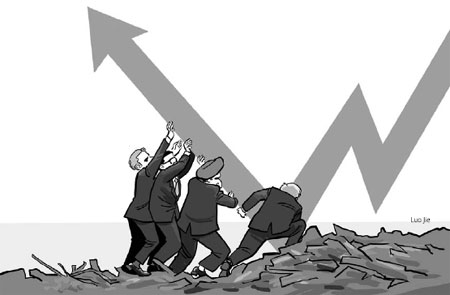 Interestingly, the BRIC summit immediately follows the Shanghai Cooperation Organization (SCO) summit in Yekaterinburg, indicating more and closer interactions on economic and security issues among leaders of the emerging markets. By reaching agreements, coordinating policies and strengthening cooperation, the emerging countries will lead the world out of the economic crisis. From a geopolitical perspective, the BRIC economies, spread over Eurasia and circling the Pacific and the Indian oceans, occupy a strategic economic position. They possess 26 percent of the world's landmass and 42 percent of the global population. Brazil and Russia are abundant in natural resources, while China and India are the two most populous countries. Thus they have the resources and the market both. The four economies offer exemplary development models, too. China's 30 years of rapid economic development has stunned the world, and it is still growing at a fast pace despite the global economic downturn. Since Manmohan Singh was re-elected prime minister, India has intensified its economic reforms, attracted more foreign investment, and achieved steady economic growth, balancing its exports and domestic demand. And though Brazil and Russia are yet to emerge out of the economic crisis, the two countries' governments have drawn up new economic plans to do away with their dependence on exports of resources, and instead optimize the industrial structure. Cooperation among the BRIC economies will help devise a mutually complementary and beneficial new growth model that can become the formula of economic recovery for the developing world. Since the financial crisis began, the four economies have been trying to softly steer the international currency system toward a multi-polar ground, and have been ready to take on global responsibilities. But the international community is worried that the BRIC summit might challenge the hegemony of the dollar. Recently when China, Russia and Brazil promised to buy IMF bonds, some developed countries did not view it as a contribution to the IMF and aid to economies shattered by the economic crisis but as a challenge to the dollar's hegemony. Since IMF bonds are denominated with special drawing rights (or SDR), using a basket of currencies including the dollar, euro, yen and the pound to buy them is seen as a way of cutting dollar reserves. The dollar, however, has 44 percent weight in the basket of currencies determining the SDR value. Even if the IMF bonds are SDR-denominated, the main component is still the dollar, and hence buying them will not cause the dollar to suffer. The US Treasury bonds dwarf the scale of the IMF bonds, too. China, Brazil and Russia have promised to buy $70 billion worth of IMF bonds, compared with $900 billion of newly issued US Treasury bonds. Besides, the SDR is not a real currency in circulation. It is only a unit of account. When the IMF pays back the interests and debts, it has to convert the SDR into currencies in circulation such as the dollar. In fact, it is the very reason why the US is not too worried about the BRIC economies buying IMF bonds. The BRIC summit is not aimed at challenging the dollar. Instead, its aim is to strengthen cooperation, build consensus, and coordinate policies. That's why the developed countries should cooperate sincerely with the emerging economies to create a fair and rational new world order. The author is a researcher with China Institute of Contemporary International Relations. (China Daily 06/18/2009 page9) |
       |
主站蜘蛛池模板: 国产精品免费AⅤ片在线观看 | 少妇人妻av毛片在线看| 99久久激情国产精品| 强行糟蹋人妻hd中文| 亚洲一区二区三区av激情| 亚洲av优女天堂熟女久久| 国产AV国片精品有毛| 亚洲综合91社区精品福利| 久久久精品国产精品久久| 欧美一区二区自偷自拍视频| 蜜臀av无码一区二区三区| 人妻少妇伦在线无码专区视频| 国产精品高清视亚洲精品| 亚洲高潮喷水无码AV电影| 国产在线无码不卡播放| 日本在线视频网站www色下载 | 99久久99久久精品免费看蜜桃| 亚洲精品久久久久久婷婷| 国产三级自拍视频在线| 亚洲精品成人福利网站| 国产mv在线天堂mv免费观看| 伊人久久久av老熟妇色| 欧美 日韩 国产 成人 在线观看| 高潮迭起av乳颜射后入| 国产亚洲精久久久久久久91| 国产人成午夜免费看| 日本亚洲中文字幕不卡| 欧美亚洲日本国产综合在线美利坚 | 婷婷久久香蕉五月综合加勒比 | 国产成人午夜福利在线观看| 国产精品午夜无码AV天美传媒 | 国产精品一区二区久久精品无码| 亚洲精品无码永久在线观看| 精品视频不卡免费观看| 国产免费一区二区三区在线观看| 亚洲天堂亚洲天堂亚洲天堂| 人人人澡人人肉久久精品| 年日韩激情国产自偷亚洲| 亚洲中文久久久精品无码| 高颜值午夜福利在线观看| 亚洲国产成人久久77|