CHINA> National

|
CHINA> National
|
|
Miles to go for 3G to make profits
By Li Fei (China Daily)
Updated: 2009-06-08 08:38
Li You, a 29-year-old doctor working in Beijing, only started noticing the advertisements when they began to appear more frequently - as posters on buses, on billboards and as commercials on TV.
"Actually, I am getting a little fed up at the mention of 3G. The '3G' word has been tossed around in the media and public domain for years," she said. "I just cannot understand why it is attracting so much media attention," Li said. "May be, I am not that tech-savvy after all." Li may not understand why her resentment is so strong, but chances are it may only grow in the days ahead as the battle for subscribers heats up and the country's top three telecom operators vie for potential 3G users like Li. In fact, the fight has only just begun.
China Mobile, the world's largest mobile phone carrier in terms of the number of users, earlier this year received a license to deploy its 3G network based on TD-SCDMA, a homegrown 3G standard. Its smaller rivals got licenses based on two other widely adopted standards - China Unicom received one for the WCDMA, while China Telecom was issued one based on the CDMA2000 standard. The rollout of 3G services and the telecom industry restructuring last year under which all three telecom companies are set to become full service operators, are part of the government's efforts to redraw the telecom industry landscape, which is currently dominated by China Mobile.
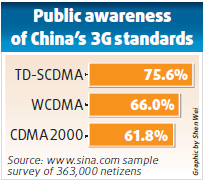
The 3G licenses issued earlier this year was also part of the government's efforts to stimulate domestic demand, since 3G is expected to attract investment worth hundreds of billions. This will be mainly for network deployment and related projects and will come at a time when investment and consumption are badly needed to prop up the economy. "The 3G rollout is expected to usher in 1 trillion yuan worth of investment and consumption in three years. This includes 400 billion yuan by telecom carriers to deploy their networks, some 400 billion yuan consumers are likely to spend on handsets, netbooks and other terminals, and 200 billion yuan on video and other 3G services," said Xi Guohua, vice-minister of Industry and Information Technology, at an industry forum last month. Analysts, however, said that while the introduction of 3G services may immediately boost investment and spending, it may not be that effective in changing the industry landscape in the short term. Although the three carriers have all announced huge investment plans to build their networks, which incidentally is also a big shot in the arm for telecom equipment makers such as Nokia Siemens Networks, the move is likely to drag down their profitability numbers. China Mobile, for example, has earmarked 375.4 billion yuan, chiefly to expand its 3G infrastructure from 2009 to 2011. This is significantly higher than the 136.3 billion yuan it spent in 2008. China Telecom, a fixed-line operator before last year's industry restructuring, will spend 47 billion yuan this year to deploy or upgrade its mobile phone network, which it acquired from China Unicom during the restructuring process, its Chairman Wang Xiaochu said earlier. "The huge capital expenditure will weigh heavily on telecom operators and curtail their returns on investment," said Wang Jinjin, head of Asian telecom research at Swiss bank UBS. Wang said the economic downturn, which may have led to cuts in customer spending, which along with the huge investment in network expansion intensifying competition as a result of the industry restructuring, together mean China's telecom industry will see a downtrend despite the 3G rollout, a cycle, she said would last at least for another year or two. "Global experience shows that 3G has not been very helpful in driving carriers' business growth," Wang said. Analysts also said it would take several years for 3G services to become popular and reach a critical mass of customers. Only then can it start generating profits for the telecom carriers, they said. Telecom carriers must also lower the cost of 3G services and develop innovative applications on the new platform to help the business really take off, they said. Developing 'killer application' key to 3G business growth According to an online survey by sina.com, the largest portal in China, although 59 percent of 363,000 respondents said they would "ultimately become a 3G subscriber" in the future, nearly half said the cost was simply "too high" to make them switch. In addition to the high cost of services and the need to buy a new handset, 17.5 percent of the respondents said the limited number of 3G applications was the third key reason why they would not rush to be a part of 3G services, the survey found. "Developing killer applications (such as text messaging in the 2G era) is critical to spur the 3G business as people are still used to and satisfied with the dominant voice and text messaging services available now," said Chen Jinqiao, deputy chief engineer of the China Academy of Telecommunication Research, a think-tank affiliated to the Ministry of Industry and Information Technology (MIIT), the telecom regulator. "This is the only way that the 3G business can really take off," Chen said, predicting it would take at least five years for 3G to become widely accepted in China. And the rollout of the services, seen by many as a good chance for the country's two smaller carriers China Unicom and China Telecom to catch up with their much bigger rival China Mobile, is also unlikely to change the industry landscape considerably. The new services, analysts said, gave China Unicom and China Telecom more of a competitive edge even as it disadvantaged China Mobile in the 3G era. China Unicom, currently the second biggest mobile carrier, was granted the most popular WCDMA standard, a move that analysts said gave it the edge competing with its two rivals. China Telecom, the country's biggest fixed-line phone carrier, could cross-sell its mobile services to its existing fixed-line user base, and therefore, can offer a differentiated product mix, analysts said. China Mobile, on the other hand, would face increasing competition, and may see its customer addition rate drop, they said. China Mobile added 88 million users in 2008, more than the 80 million the company expected. But its customer additions may drop by 25 percent to 66 million this year as China Telecom and China Unicom start 3G services, Tim Smart, an analyst at Macquarie Group, wrote in a research report. Starting this year, the revenue growth at China Unicom and China Telecom is likely to pick up pace as a result of the 3G rollout, said Fang Lu, a telecom industry analyst at Shenyin & Wanguo Securities. "Their revenue growth rate will be close to that of China Mobile by 2013," Fang said. Revenue growth at China Unicom, China Telecom and China Mobile is expected to reach 3.19 percent, 1.54 percent and 11.24 percent this year, respectively. It is likely to hit 7.59 percent, 8.62 percent and 8.83 percent, respectively in 2013, Fang predicted. Even though it is at a disadvantage in the 3G era, China Mobile, which had 463.9 million subscribers at the end of January, or about 70 percent of the market share, will continue to hold on to its dominant position in the industry in the near future. China Mobile, analysts said, has the advantage of a much larger customer base and deeper pockets to subsidize handset purchases if it chose to do so. "As long as the regulator does not issue any drastic asymmetric regulation against China Mobile, its dominant position will not be challenged in the next three years as China Unicom and China Telecom will still be largely involved in their internal integration tasks," said Zheng Ping, a researcher with the Research Institute of Communications Policy at MIIT's China Academy of Telecommunication Research. "Its position will nevertheless be weakened after the restructuring and the rollout of 3G, but it will take a much longer time to fundamentally change the industry landscape," Zheng said. UBS's Wang said she expected the ultimate market make up to be one where China Mobile held 60 percent of the market share with China Unicom taking 30 percent and China Telecom 10 percent, or where China Mobile commanded 60 percent of the market, with China Unicom and China Telecom each taking 20 percent share. At the moment, however, the pressing task before all three carriers is to convince people like Li to subscribe to 3G services. Only that will see their huge investment in 3G services actually helping to generate revenue and profits. "For the time being, I have no interest in, and imperative to try 3G; voice and text messaging are more than adequate for me," Li, the doctor from Beijing, said. |
主站蜘蛛池模板: 青青国产揄拍视频| 国产成人免费永久在线平台| 天堂v亚洲国产v第一次| www插插插无码免费视频网站| 国产乱啊有帅gv小太正| 亚洲专区在线观看第三页| 91精品国产色综合久久不| 亚洲国产日韩欧美一区二区三区 | 秋霞电影网| 欧美日本激情| 色吊丝二区三区中文字幕| 亚洲高清国产拍精品5G| 9久久伊人精品综合| 久久人妻av一区二区三区| 成全看免费观看完整版| 国产精品污一区二区三区| 国内不卡不区二区三区| 国产97人人超碰CAO蜜芽PROM| 天天摸日日添狠狠添婷婷| 亚洲AV无码久久精品日韩| 亚洲一级特黄大片在线播放| 亚洲免费人成在线视频观看| 亚洲精品va| 久久精品不卡一区二区| 天天插天天干天天操| 欧美性猛交xxxx乱大交丰满| 亚洲一区 日韩精品 中文字幕| 日韩一卡二卡三卡四卡五卡| 免费特黄夫妻生活片| 精品国产久一区二区三区| 最新的国产成人精品2020| 亚洲中文字幕人成影院| 国产成人无码A区在线观| 亚洲精品一区国产精品| 国产高清免费午夜在线视频| 久久人妻无码一区二区三区av| 四虎成人精品永久网站| 狠狠噜天天噜日日噜无码| 美女无遮挡免费视频网站| 国产va免费精品观看| 亚洲精品在线二区三区|