CHINA> Focus

|
CHINA> Focus
|
|
Putting the skids under street racing
By Wang Hongyi (China Daily)
Updated: 2009-05-28 11:50
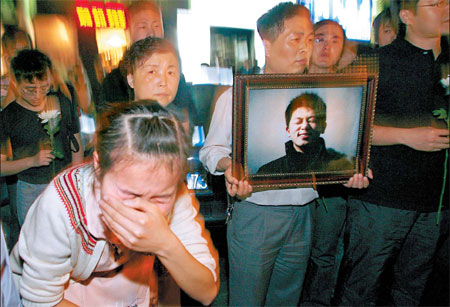 With the help of blockbuster movies and ultra-realistic online video games, drift racing has never been more popular among China's youth. But the tragic death of a promising student this month has highlighted the dangers when obsession shifts from the screen to the streets. Tan Zhuo, 25, was killed on May 7. He was crossing a road in the usually tranquil city of Hangzhou, Zhejiang province, when he was hit and thrown 5 m into the air by a speeding Mitsubishi Evo.
As Hu is from a wealthy family, the public demanded the government do something to end the abuse of what they called "rich boys' toys". Tighter laws on the control of high-performance cars or vehicles with souped-up engines have already been imposed. But following the death of Tan and several similar tragedies in recent months, the question must be what are the deep-rooted desires that push young people into risking their lives, and the lives of others, by street racing? In the case of Hu, the local traffic police also came under harsh criticism for their initial report, which contradicted eyewitness reports and stated the Mitsubishi had only been traveling at 70 km per hour when it hit Tan.
A week later, Hangzhou police made a public apology, admitting the first report had been based on statements from Hu's two friends at the scene, while spokesman Zheng Xiansheng confirmed forensic studies had proved he was driving between 84 and 101 km per hour on a street where the legal limit was 50. Hu's Mitsubishi had been refitted to reach faster speeds and his engine, exhaust system and tires had all been modified, he said, adding: "We are convinced Hu, who was speeding, violated traffic rules and was fully responsible for the accident." Hu Bin was arrested for speeding and vehicular manslaughter, which carries a maximum seven-year prison sentence, and was successfully sued for 1.13 million yuan ($165,000) in compensation by Tan's family last week. A study by the international Injury Prevention Journal last year showed the number of road traffic deaths in China has soared 95 percent in two decades. It found deaths rose from 3.9 per 100,000 people to 7.6 between 1985 and 2005, while the number of cars on the nation's road soared nine-fold. It is estimated 100,000 are killed in traffic accidents in China a year - 274 a day - with speeding and drink-driving topping the list of reported causes. But these shocking figures seem to have little, if any, impact on a Chinese youth hooked on racing games and movies. "Street racing is competitive, just like basketball: You're nervous and excited and you want to win," said student Zhao Bin, 19, who admitted he often plays 3D racing games and watches online videos posted by street racers boasting of their accomplishments. "I have a dream that one day I'll own my own racing car and can enjoy racing through the roads," he added. Mu Di, 27, is a racing fan and modified his vehicle four years ago after seeing Initial D, a Japanese movie about drift racing on Tokyo's streets. "At that time, I couldn't find a car I liked because the models I admired were too expensive. So my friend and I clubbed together about 100,000 yuan to buy a Tianjin Xiali 2000," he recalled. "We soon had it modified to improve its looks and performance, getting the speed up to 170 km per hour. "Driving that fast was the wildest excitement I have ever had, but on reflection it was such a dangerous thing to do." Amateur driver Ling Feng has been racing for four years. He said: "In China, people's understanding of racing is still very shallow due to a lack of correct education and guidance. I've never raced on a public highway or street, that's a grossly immoral act.
"Racing stars in movies like 2 Fast 2 Furious or Initial D give bad impressions to young people, who may easily emulate the fictional and unrealistic racing portrayed in the movie." Meanwhile, volunteer psychologist Yu Chi said most street racers in China were in transition from childhood to adulthood and usually had a feeling of "invincibility". "Hu Bin is a typical example," he added. "He demonstrates the absence of inner-family education common among wealthy families. "In a material-abundant environment, children become more and more impulsive, unable to exercise restraint and patience, and are prone to temptation." |
主站蜘蛛池模板: 国产精品无码久久久久久| 亚洲一区二区三区最新| 国产午夜亚洲精品国产成人| 日韩精品久久久肉伦网站| 国产成人精品亚洲午夜| 老子午夜精品无码| 亚洲欧美日韩成人综合网| 国产在线观看播放av| 久久久久久久久无码精品亚洲日韩 | 韩国一级毛片中文字幕| 色综合久久久久综合体桃花网| 色婷婷久久综合中文久久一本 | 亚洲AVAV天堂AV在线网阿V| 国产目拍亚洲精品一区二区 | 国产超碰无码最新上传| 国产精品国产三级国产试看| 成人深夜福利av在线| 久久精品国产99国产精品严洲 | 97国产成人无码精品久久久| 国产一级毛片高清完整视频版| 国产亚洲欧美在线人成aaaa| 亚洲人成电影在线天堂色| 在线观看肉片av网站免费| caoporn成人免费公开| 久久亚洲精精品中文字幕| 精品国产中文字幕在线| 国产剧情福利AV一区二区| 国产亚洲一区二区三区成人| 99精品国产在热久久婷婷| 国产一级特黄高清大片一| 内地自拍三级在线观看| 狠狠躁天天躁中文字幕无码 | 18岁日韩内射颜射午夜久久成人| 无码h片在线观看网站| 亚洲精品无码你懂的网站| 国产99久久亚洲综合精品西瓜tv| 国产精品鲁鲁鲁| 色8久久人人97超碰香蕉987 | 国产老熟女狂叫对白| 国产对白老熟女正在播放| 中文日韩亚洲欧美字幕|



