CHINA> Travel

|
CHINA> Travel
|
|
Mazar worship, a common practice for divine favors
(China Daily)
Updated: 2009-05-12 17:26
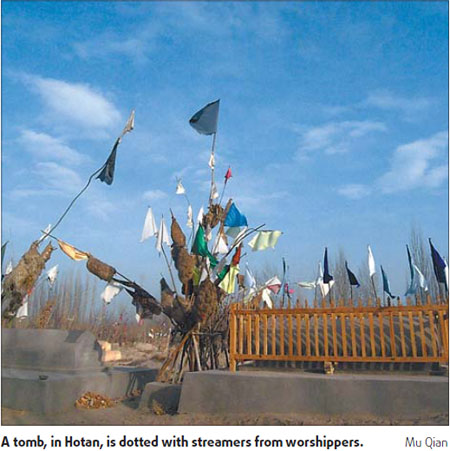 The Uygur word "mazar" is borrowed from Arabic language. Literally meaning "a place for visit", it usually refers to the tombs of Islamic saints or famous people. Several hundred of these tombs, mythical or real, are scattered around the deserts and oases of Xinjiang, especially in the southern and eastern parts. Mazars in Xinjiang can be divided into two kinds: related or unrelated to Islam. The first kind include tombs of people who contributed to the spread of Islam in Xinjiang and the other kind includes mazars of famous scholars. Mazar worshipping is a common practice in Xinjiang. Uygur people worship mazars on certain or uncertain dates, in the hope of getting blessing for good harvests, health, the birth of children, and so on. However, worshipping mazars actually contradicts doctrines of Islam, which directs that no one is the object of worship but Allah, and asking prophets to satisfy any need or to cure any disease are polytheistic actions forbidden by Allah. Still, mazar worshipping is found not only in Xinjiang, but also in many Islamic countries, such as Pakistan, Afghanistan and Iran. Scholars believe such behavior is related to the idea of "saints" in various religions before Islam and the practice of the Shia and Sufi sects of Islam. Important mazars in Xinjiang: Sutuk Boghra Khan Mazar Sutuk Boghra Khan (?-955) is the first khan converted to Islam in Xinjiang, and his mazar, located in Artux, capital city of the Kezilesu Kirgiz autonomous prefecture, is the earliest Islamic mausoleum in Xinjiang. First built upon the khan's death, the mazar has been rebuilt many times in history, the most recent one in 1950. Now the mazar occupies an area of about 10,000 sq m, consisting of the gate, walls, courtyard and grave chamber. To the east of the mazar are a mosque, lecture room and dormitory, and to the south is an orchard of fig, grape, peach and pear. The Sutuk Boghra Khan Mazar enjoys a high reputation among Muslims in Xinjiang and Central Asian countries, and the local government has listed it as a cultural relic under key protection. Ordam Mazar The Ordam Mazar is situated in a remote desert in Kashgar prefecture, yet it is one of the most influential mazars in Xinjiang. The Ordam Mazar is the tomb of Ali Arslan Khan (?-998), a grandson of Sutuk Boghra Khan and a martyr who died leading a jihad against the Buddhist kingdom of Yutian. It is said that Ali Arslan Khan moved his palace to the battleground when fighting with Buddhists of Yutian in AD 998. On the 10th day of the Muharram month in the Islamic calendar, the Buddhists made a sneak attack and killed Ali Arslan Khan while he was praying. Since then, this date has become a festival for people to commemorate the martyr. Mahmud al-Kashghari Mazar Mahmud al-Kashgari (1008-1105) was a Uygur scholar and lexicographer of Turkic languages from Kashgar. He studied the Turkic dialects of his time and wrote in 1072 Compendium of the Language of the Turks, the first comprehensive dictionary of Turkic languages. The dictionary contains specimens of old Turkic poetry in the typical form of quatrains, representing all the principal genres: epic, pastoral, didactic, lyric and elegiac. The mazar is located 47.5 km away from the city of Kashgar, in the Upal township of Shufu county. Surrounded by trees and springs, it has become a famous tourism attraction. An ancient tree before the mazar is said to have grown from Mahmud al-Kashghari's walking stick. Parents often bring their children to visit the mazar, hoping that their children will be blessed with knowledgeable and wise minds. Imam Jaffar Sadik Mazar This mazar, located in the Minfeng county of Hotan area, is dedicated to Imam Jaffar, the 6th of the 12 imams of Shiism, although he died in AD 765 in Medina and was never in Xinjiang. Similar mazars of the other 11 imams can also be found in Hotan area. Built on a big sand hill, the mazar is dotted with numerous streamers from worshippers. Every year from August to September, Muslims from all over Xinjiang, as well as Gansu and Ningxia, come to pay pilgrimage at the mazar. |
主站蜘蛛池模板: 国产永久免费高清在线观看| 国产四虎永久免费观看| 好男人在线视频观看高清视频| 五月综合网亚洲乱妇久久| VA在线看国产免费| 色妞色视频一区二区三区四区| 日本高清视频网站www| 国产亚洲欧美日韩在线看片| 国产精品一区二区三区麻豆| 久久精品国产亚洲AⅤ无码| 亚洲午夜亚洲精品国产成人| 国产高清午夜人成在线观看,| 四虎精品国产AV二区| 人妻中文字幕精品一页| 欧美极品色午夜在线视频| 97欧美精品系列一区二区| 欧洲熟妇色xxxxx| 中文字幕亚洲综合小综合| 亚洲成av人片天堂网老年人| 国产69久久精品成人看| 国产精品老年自拍视频| 久久久av男人的天堂| 精品国产福利一区二区在线| 亚洲一区二区三区人妻天堂 | 亚洲av永久无码精品水牛影视| 伊人无码一区二区三区| 亚洲国产在一区二区三区| 黑人玩弄漂亮少妇高潮大叫| 亚洲精品三区二区一区一| 国产一级在线观看www色| 91精品国产色综合久久不| 97色伦97色伦国产| 国产成人久久综合第一区| 制服丝袜国产精品| 亚洲人成网站在线观看播放不卡| 亚洲综合无码一区二区| 亚洲国产美女精品久久久| 日本熟妇色xxxxx日本免费看| 国产成人免费高清激情视频| 日韩在线播放中文字幕| 国产成人A在线视频免费|
