CHINA> Photo

|
CHINA> Photo
|
|
Legend of the Seven Saints
(China Daily)
Updated: 2009-05-12 17:25
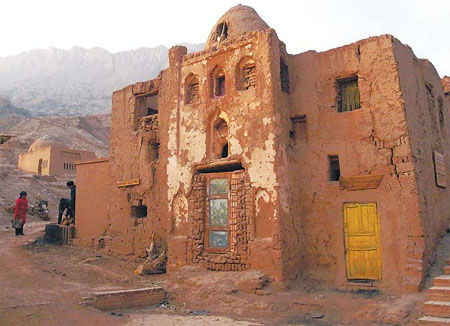
Tuyugou is not a name that is familiar to tourists. Visitors to the popular city of Turpan are often ignorant of this small place tucked in a mountain valley some 50 km away. However, Tuyugou has a rich religious history that few other places in China can match. Named after the Uygur word tuyuq or "not passable", Tuyugou is a township in Shanshan county of Turpan prefecture. The Mazar village or "Tomb Village", the center of Tuyugou, lies in a valley of the Mountain of Fire (Huoyan Shan). Muslims from all over Xinjiang, Northwest China's Gansu province and Ningxia Hui autonomous region, and even other countries like Uzbekistan, Pakistan and Turkey come here to visit the Al-Sahab Kahfi Mazar or "tomb of saints in the cave". "Some even believe that visiting the Al-Sahab Kahfi Mazar twice equals one Haj," says 34-year-old Jappar Hamut from Shanshan. Located in a mountainside just outside the Mazar village, the Al-Sahab Kahfi Mazar is a small cave with an extended domed room that serves as a prayer hall. On the walls are inscribed the 18th chapter of the Koran, The Cave. It tells the story of a group of young men who sought refuge in a cave as they fled the pagans. Local people believe this is the cave of the Al-Sahab Kahfi Mazar. One such believer is 66-year-old Izizbul Imin Haji, sheikh of the mazar. Izizbul belongs to the eighth generation of his family that has been guarding the Al-Sahab Kahfi Mazar for more than 300 years. According to Izizbul, about 2,000 years ago, seven sons of the King of Yemen wondered about the origins of the sun, moon, sky and everything on earth. They decided to go out and seek the answer. When they arrived at Dakianus (old name of Gaochang), the King of Dakianus asked what they were looking for. When they told him, he said, "I'm the creator of the world", and invited them to stay in his palace. After a few days, the seven young men found that the king was not the creator of the world, but a corrupt ruler. When the king realized that his true nature was known, he decided to kill the young men, who ran away. On the road, they met a shepherd, who wanted to follow them to look for the creator of the world. He sent his sheep back home, but his dog decided to follow its master. Together they arrived at the cave. The dog guarded the entrance, while the others slept for what they thought was three or four hours. When they got up and went out to buy food, the vendor wouldn't accept their coins. Only then did they find out that they had slept for 309 years. A record in the Koran seems to match the legend of the Al-Sahab Kahfi Mazar perfectly. The story goes that after their death, the seven young men were buried at where today's Al-Sahab Kahfi Mazar stands. In Chinese the Al-Sahab Kahfi Mazar is called "Qi Xian Fen", or "Tomb of the Seven Saints". Izizbul says that during the "cultural revolution" (1966-76), many mazars were destroyed, but a dog kept guard at the Al-Sahab Kahfi Mazar, preventing the "red guards" from getting close to it. In Izizbul's possession is a stick which is said to have belonged to the shepherd, 2,000 years ago. Pilgrims at the Al-Sahab Kahfi Mazar believe the stick has the power to cure problems such as lumbago and backache, and they often ask Izizbul to beat their body gently with the stick after praying at the mazar. While a visit to the Al-Sahab Kahfi Mazar is believed to cure diseases, there is another place in Tuyugou which locals believe can invite illnesses. "Uygur people never go there. We believe those caves are inhabited by the devil," says Ziwithan Kadir, a 58-year-old woman resident of Tuyugou. "They are not for Muslims." Ziwithan is referring to what is known as the "Thousand-Buddha Caves of Tuyugou", a group of caves with Buddhist frescoes about 1 km from the mazar. Before Uygur people converted to Islam, Buddhism used to be dominant in Xinjiang, and around today's "Thousand-Buddha Caves of Tuyugou" there used to be a famous Buddhist temple called Dinggu Temple. After the Uygurs converted to Islam, Dinggu Temple and the caves with frescoes were forsaken. The residents no longer understood where those frescoes came from and became afraid of them. "People are afraid to pass that area alone," says Mamat Rajap, a guard at the "Thousand-Buddha Caves of Tuyugou". Mamat says that 15 years ago he too was afraid - till he learnt about the history of the caves. "Some people say that I shouldn't guard Buddhist caves, but I tell them that these are cultural relics of the Uygur people." According to archaeological studies, the sculpting of the "Thousand-Buddha Cave of Tuyugou" started in the Western Jin Dynasty (AD 265-420), and continued for more than 1,000 years. |
主站蜘蛛池模板: 少妇乳大丰满在线播放| 好好热好好热日韩精品 | 9久9久热精品视频在线观看| 中文字幕日韩精品亚洲一区 | 97se亚洲国产综合在线| 久久99精品中文字幕| 国产精品高清中文字幕| 青青草原国产精品啪啪视频| 老司机性色福利精品视频| 国内精品伊人久久久久影院对白| 国产精品无码AV中文| 国产高清在线不卡一区| 911国产自产精选| 国产黄色一级片在线观看| 国产18禁黄网站禁片免费视频| 欧美黑人性暴力猛交喷水| 高清无码爆乳潮喷在线观看| 有码无码中文字幕国产精品 | 中文字幕亚洲无线码一区女同| 国产视色精品亚洲一区二区| 国产对白熟女受不了了| 日韩一区精品视频一区二区| 无套内谢极品少妇视频| 久久国产免费直播| 亚洲一区二区三区人妻天堂| 亚洲图片自拍偷图区| 奇米影视7777久久精品| 久久99国产精品尤物| 国产成人自拍小视频在线| 色偷偷天堂av狠狠狠在| 国产亚洲欧洲AⅤ综合一区| 日韩精品成人区中文字幕| 久久国产精99精产国高潮| 裸体女人亚洲精品一区| 美女禁区a级全片免费观看| 天天躁日日躁狠狠躁一级毛片| 日韩一区二区三区水蜜桃| 国产成人精品久久一区二| 五月综合激情婷婷六月| 秋霞电影院午夜无码免费视频| 国产va欧美va在线观看|