CHINA> National

|
CHINA> National
|
|
Some home truths about Dalai Lama
By Zheng Dui (China Daily)
Updated: 2009-04-04 11:13 How can there be a "Tibet issue" and, if there is one, what is its nature? These two points have to be clarified for a person to understand the ulterior motives of the Dalai Lama when he gave a speech recently. First, there has been no such a thing as "independent Tibet" since the Yuan Dynasty (1271-1368) established its suzerainty over the region. It was the invasion of Tibet by British forces in the late 19th century that made Tibetan sovereignty an issue. When the British forces withdrew after waging two wars, they tried to create an "independent Tibet" by convening the Simla Convention.
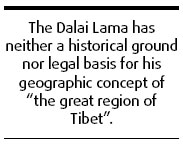
Second, the way the Dalai Lama spoke about the treaty he signed with the central government in 1951 was aimed at creating the impression that Tibet was an independent country before 1951. Why else did he not mention that the region has been part of China since the Yuan Dynasty? And when the Dalai Lama mentioned the "Tibet issue", he was apparently referring to his "meaningful autonomy of "the great region of Tibet", which he said was an appropriate resolution of the issue after he abandoned his "Tibet independence" pursuit. But has he really given up his dream of an "independent Tibet"? An analysis of his concept of "the great region of Tibet" and "meaningful autonomy" makes his rhetoric game clear. "The great region of Tibet" the Dalai Lama refers to includes parts of the Tibet autonomous region's neighboring areas, which would add up to one-fourth of China's entire land mass.
The autonomy Tibet enjoys over its affairs has been conducive to economic growth and social progress of the region. It's true, Tibetan culture has suffered over the past few decades, including cultural relics being vandalized during the "cultural revolution" (1966-76). But then the cultures of other provinces and regions suffered the same fate during that period. Thus it would be erroneous to say that Tibetan culture was singled out for destruction. On the contrary, the central and Tibetan autonomous region governments have made every effort to preserve material and non-material Tibetan culture. The "meaningful autonomy" the Dalai Lama has been talking about in recent years is meaningful only to him and a handful of his followers. "Meaningful autonomy" is nothing but a new term for "Tibet independence". And the Dalai Lama and his followers changed their strategy, and began seeking "meaningful" or "real autonomy" only after their call for "Tibet independence" failed to get the support of Tibetans and the international community. What goes against any reasoning is his accusation that the central government is trying to assimilate Tibetans and other ethnic groups by building highways, airports and railways in Tibet. Tibet's natural environment and local way of life have suffered, too, because of these infrastructure constructions, he says. Can anybody deny that improved infrastructure has contributed to the remarkable progress of the region and greatly improved the living standards of Tibetans? Or, does the Dalai Lama mean to say that Tibetans have no right to share the fruits of material civilization and the progress that science and technology have brought about in the past century? In his recent speech, he said that he hoped the friendship between Tibetans and their Han counterparts would be promoted. But how can such friendship develop without modern transport and infrastructure facilities? His self-contradiction reveals his true nature: Tibetans should be isolated, left to live in poverty and ignorance and that there should be no contact between Tibetans and their Han brothers and sisters. Haven't Tibetans and Hans learned from and influenced each other in every sphere of life? And doesn't such a thing happen in every country that is home to more than one ethnic group By saying that the economic development and social progress in Tibet is aimed at assimilating Tibetans and Hans, he intends to create a schism between Tibetans and Hans. In his speech, he also said that his first wish as a religious figure was to do good deeds. Is this what he is actually doing by trying to foment trouble in Tibet? The author is director of the China Tibetology Research Center's religious institute. |
主站蜘蛛池模板: 国产精品亚洲色婷婷99久久精品| 国产av中文字幕精品| 欧美人与动欧交视频| 亚洲色精品88色婷婷七月丁香| av色国产色拍| 又爽又黄又无遮挡网站| 无人去码一码二码三码区| 国产午夜福利精品久久不卡| 97视频精品全国免费观看| 国内久久人妻风流av免费| 资源新版在线天堂偷自拍| 噜噜久久噜噜久久鬼88| 九九在线精品国产| 国产裸体美女视频全黄| 米奇亚洲国产精品思久久| 国产18禁黄网站禁片免费视频| 国产精品自拍自在线播放| 日本久久99成人网站| 饥渴少妇高潮正在播放| 国内久久久久久久久久| 四虎影视一区二区精品| 伊人激情av一区二区三区| 亚洲大尺度无码专区尤物| 国产a级三级三级三级| 亚洲无码久久久久| 国产精品99区一区二区三| 亚洲精品乱码在线观看| 国产精品成人自产拍在线| 在线观看亚洲欧美日本| 久久波多野结衣av| 国产精品av免费观看| 伊人久久大香线蕉网av| 18禁网站免费无遮挡无码中文| 久久久久久人妻一区二区无码Av | 国产精品久久无码不卡黑寡妇| 中文字幕乱码熟妇五十中出| 国产精品一区二区AV| 午夜免费无码福利视频麻豆| 97在线视频人妻无码| 深夜精品免费在线观看| 中国熟妇毛多多裸交视频|