CHINA> National

|
CHINA> National
|
|
China eyes independent nuclear power projects
(Xinhua)
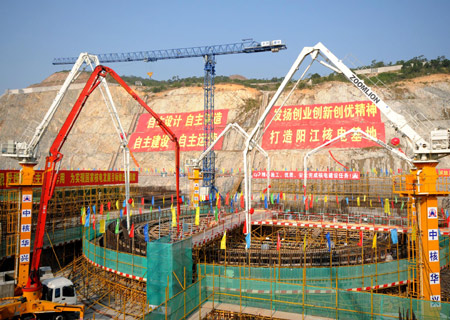
Updated: 2009-02-18 21:23 HAIKOU -- China can rely on and will promote the use of its own technologies in developing nuclear power projects, a senior energy official said Wednesday.
The proportion of domestic technologies and equipment used in the country's nuclear power projects should be required to reach a certain level, said Zhang Guobao, head of the National Energy Administration (NEA), at an NEA work conference here Wednesday.
China has 11 nuclear power reactors in operation, all using second generation technologies comprising mainly pressurized water reactors, but also including boiling and heavy water reactors. Three of these use domestic technologies, four use French designs, two use Canadian designs and the other two Russian. The country has another 22 nuclear reactors under construction and 20 of them apply CPR-1000, the China-developed second-generation technology. "China has made major breakthroughs in the research and development of some key nuclear power equipment," said Zhang. "The country can fully rely on its own technologies to support nuclear power development in the next two to three decades." The third-generation technology, which uses light water reactors, is the latest and is considered safer and more efficient than previous designs. Four nuclear power reactors in China, whose construction is scheduled to begin in 2009 and 2010, will use the third-generation technology designed by the US firm Westinghouse. China has highlighted technological innovation as a way of improving its industrial competitiveness and boosting the economy in the face of the global financial crisis. The State Council, or the Cabinet, unveiled a support plan for machinery manufacturing industries early this month, encouraging the use of self-developed key technologies and equipment in major projects. Zhang told the meeting that developing nuclear power is crucial to adjusting China's energy structure, saying advancing the development and use of independent technologies will significantly serve that purpose. About 70 percent of China's electricity comes from thermal power stations. Coal burning has become a major source of carbon dioxide emissions. The government has set a target for installed nuclear power capacity of 40 million kilowatts by 2020, which will need an estimated investment of 450 billion yuan (US$66.2 billion). The capacity totals 9.1 million kilowatts at present, or 1.1 percent of the country's total installed electricity generation capacity. "We'll further adjust our plan to develop nuclear power and strive for a quite big increase in the share of nuclear power generation," said Zhang, without giving details. Last year, he told Xinhua that the installed nuclear power capacity could reach 60 million kilowatts by 2020. Meanwhile, industry insiders say the absence of a standard system for domestic nuclear power equipment and a lack of funds is hampering China's bid to support home-developed technologies. "The lack of a technical standard system will hinder the promotion of domestic nuclear power equipment and raw materials," said Zheng Dongshan, vice president of the China Guangdong Nuclear Power Group. Zhang said the government aimed to establish a standard system for nuclear power technologies and equipment within five years. |
||||||
主站蜘蛛池模板: 中文字幕v亚洲ⅴv天堂| 成人又黄又爽又色的视频| 2021久久精品国产99国产| 中文字幕人妻色偷偷久久| 99热久久这里只有精品| 久久这里只精品国产2| 国产在线精品国偷产拍| 伊人色在线视频| 亚洲中文字幕日产无码成人片| 国产精品高潮呻吟av久久无吗| 少妇高潮水多太爽了动态图| 久久亚洲国产精品一区二区| 蜜臀av一区二区三区精品| 农村老熟妇乱子伦视频| 亚洲欧美人成人让影院| 精品无码午夜福利理论片| 日韩精品一区二区三区四区视频| 日韩中文字幕亚洲精品| 国产成熟妇女性视频电影| 成人国产一区二区三区精品| h无码精品动漫在线观看| 免费人成年激情视频在线观看| 欧美日韩综合网| AV最新高清无码专区| 理论片午午伦夜理片久久| 日本乱人伦AⅤ精品| 开心一区二区三区激情| 老子午夜精品无码| 日本福利一区二区精品| 国产亚洲欧洲综合5388| 九九热在线观看精品视频| 国精产品999国精产品视频| 一区二区三区四区亚洲自拍| jizz国产免费观看| 国产黄色三级三级看三级| 免费乱理伦片在线观看| 久久88香港三级台湾三级播放| 久久久久亚洲AV成人片一区| 毛片亚洲AV无码精品国产午夜| 亚洲精品天天影视综合网| 亚洲情综合五月天|