CHINA> News

|
CHINA> News
|
|
Fortifying homes for the future
By Lei Xiaoxun (China Daily)
Updated: 2009-01-23 07:36
URUMQI: Sharing handmade delicacies among family members, peppered with memorable moments retold in the warmth of home - Spring Festival is not a traditional celebration for the ethnic Uygur community in Nuermaimaiti Mamuti's village, but residents still have reason to revel in a new year. Mamuti's six-member family lives in Qiaka village in Layika county of Hotan prefecture, one of the least developed areas in southern Xinjiang Uygur autonomous region and where earthquakes happen often. But this is the second year the family is firmly reuniting in Mamuti's 41-sq-m home of brick, cement and steel. His new home is part of a pioneering scheme to build houses that can withstand earthquakes in Xinjiang. The building project itself is being seen as an example for quake reconstruction in Sichuan province, where a May 12 tremor last year left more than 69,000 people confirmed dead, 17,900 missing, 374,000 injured and about 7.8 million houses leveled. Mamuti's family used to live in a hut made of adobe clay and grass, low-cost building material that has traditionally been used in rural Xinjiang. The only structures that could bear any significant weight were the wooden frames that reinforced parts of the clay. Natural light would enter into homes via small windows and cracks on the roofs and walls.
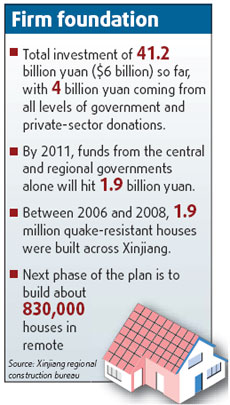
While farmers there depended on rain to nourish their crops, Mamuti said families would dread downpours because "there would be a lot of mending" to do on their walls at home after each storm. The Uygur's old home was typical of traditional dwellings in the region's farming areas. Poverty and underdevelopment only aggravated the housing problems faced by many families such as Mamuti's. Xinjiang, especially its southern and western areas, is located on geographical fault lines where earthquakes happen frequently, said Gao Guoying, a researcher with the earthquake prediction center of Xinjiang's seismic bureau. Several strong earthquakes have hit Xinjiang in recent years. On Feb 24, 2003, a powerful quake jolted Bacu county of Jiashi, killing 260. Gao said post-quake research has identified building collapse as one of the main reasons for casualties in the tremors, with many poorly constructed houses designed without any quake-resistant features toppling first. People in such homes in poverty-stricken areas were constantly vulnerable to natural disasters such as quakes and snowstorms, said Abudureyimu Balati, a resident in Hotan prefecture. Strong quakes occur about once every two years in Xinjiang. It is difficult to predict when exactly quakes will hit, so quake-resistant buildings are considered the best ways to cope with the temblors. In 2004, the Xinjiang regional government initiated a quake-resistant housing project. Small homes like those of Mamuti and his fellow villagers were reconstructed in 2006, with government subsidies and construction allocated according to the level of poverty of each household. "The cost of the reconstruction of my house, including building material and labor, was about 10,000 yuan ($1,463). The government offered me 2,000 yuan ($293) and I came up with 8,000 yuan ($1,170)," Mamuti said. More than 70 percent of households in Mamuti's village now live in new quake-resistant houses. In addition to financial assistance, local authorities have introduced a slew of measures to speed up building, such as free housing design and quality supervision. Mamuti also cashed in on the building boom, opening a small construction material factory. The annual income of his family has also seen a sixfold increase, from about 10,000 yuan ($1,463) in 2006 to 70,000 ($10,240) last year. "It was unimaginable in the past, that life could be as good as it is now," Mamuti said. The project to build quake-resistant homes started in the Hotan, Kashgar and Kezilesu Kirgiz prefectures, the three most underdeveloped areas of Xinjiang. The scheme is now being extended throughout Xinjiang, the authorities said. Between 2006 and last year, 1.9 million quake-resistant houses were built across Xinjiang, said Xu Guohua, Party secretary of the Xinjiang regional construction bureau. About 8.36 million people like Mamuti have reportedly moved into the new homes. Xu said the project counts as one of the most important to improve the lives of the people in the region, where ethnic minorities account for about 60 percent of its total population. The amount of government subsidies for the building project varies according to each area's economic and living conditions, he said. Homes rebuilt with government subsidies are usually able to afford their share of the building costs, Xu said. The government is working out measures to help families who are too poor to pay for their share of the building costs. "Many of them will not be asked to share the costs. The government will take full charge of the building", said Ren Miaoji, an official from the Xinjiang earthquake resistant building office. The varied quake-resistant designs in Xinjiang are meant to be economical and pragmatic for residents, said Zhou Tiegang, a professor from the Xi'an University of Architecture and Technology and a specialist in assessing quake-resistant architecture in Xinjiang. In some instances when reconstruction of quake-resistant homes are partial, Zhou said new design and building material such as plaster and mix are used to reinforce the strength of the building to preserve the traditional building material such as wooded frames. "With such designs, the buildings are as strong as those built with bricks but cost a lot less", Zhou said, adding that these pragmatic and economical designs may be shared in Sichuan, especially in quake-hit Aba prefecture and Wenchuan county. Similarly, the construction standard for the quake-resistant building project was set according to the different geological situations in each area, Ren Miaoji said. The building process, from buying material to house design and onsite work, is also under close government supervision. "All these are aimed at ensuring standardized quality for every house," Ren said. Latest figures from the Xinjiang regional construction bureau show that the total investment for the project has reached 41.2 billion yuan ($6 billion) starting from 2004, among which 4 billion yuan ($585 million) came from all levels of governments as well as private-sector donations. Local companies have reportedly volunteered to partner with several villages to help them carry out rebuilding, while individuals have also offered assistance, Ren said. Both Xu and Ren said the next phase of the plan is to build about 830,000 houses for those living in remote or poverty-stricken areas. The latest quake-resistant building project has achieved noticeable success. On Feb 15, 2005, a quake measuring 6.2 on the Richter scale hit Wushen county of the Aksu area. Quake researcher Gao Guoying said all the houses that collapsed in the tremor were old ones, while new houses built in 2004 with quake-resistant designs and material remained largely intact. Last year, two strong quakes also hit Xinjiang. One tremor measuring 7.3 struck Yutan county on March 21 and a 6.8 quake hit Wuqia county on Oct 5. But not a single quake-resistant home collapsed in the two quakes and no casualties were reported, officials said. "In sharp contrast, the death toll in the neighboring county of Kyrgyzstan exceeded 60 and many buildings were reportedly leveled by the same quake on Oct 5," Gao said. But Ren and his colleagues still have a lot to do. After the May 12 Sichuan quake last year, the Xinjiang Party committee and government immediately set up a team to thoroughly check the housing conditions in their region. Xinjiang's government work report released on Jan 7 also said the authorities would spend 660 million yuan ($97 million) to rebuild 660,000 sq m covering dangerous school buildings in the region this year. "We will do our best to ensure people are prepared and protected from quakes as much as possible," Ren said. Zhu Zhe contributed to the story (China Daily 01/23/2009 page7) |
主站蜘蛛池模板: 久久久WWW成人免费精品| 国产一区二区三区在线看| 国产精品美女久久久久久麻豆| 老少配老妇老熟女中文普通话| 欧美国产精品啪啪| 国产成人最新三级在线视频| 久久精品国产亚洲av麻豆甜| 激情综合网激情激情五月天| 91中文字幕一区二区| 成 人免费va视频| 中国毛片网| 国产精品人成视频免费国产| 国产国产成人精品久久蜜| 国产资源精品中文字幕| 男女xx00xx的视频免费观看| 亚洲欧美色αv在线影视| 国产乱码精品一区二区三上| 2019国产精品青青草原| 人妻少妇久久久久久97人妻| 农村国产毛片一区二区三区女| 蜜芽久久人人超碰爱香蕉| 婷婷久久香蕉五月综合加勒比| 搡bbbb搡bbb搡| 人妻熟妇乱又伦精品无码专区| 少妇被粗大的猛烈进出免费视频| 视频一区二区三区四区不卡| 亚洲人成小说网站色在线 | 免费吃奶摸下激烈视频| 亚洲色精品VR一区二区三区| 国产成人高清亚洲综合| 免费国产综合色在线精品| 九九久久亚洲精品美国国内| 国产精品福利一区二区久久| 久久综合精品国产一区二区三区无码 | 亚洲国产成人精品区综合| 农村熟女大胆露脸自拍| 婷婷综合亚洲| 韩国美女福利视频在线观看| 麻豆精品久久精品色综合| 午夜DY888国产精品影院| 亚洲国产欧美中文丝袜日韩|