CHINA> National

|
CHINA> National
|
|
Growth rate of forex reserve falls
By Wang Xu (China Daily)
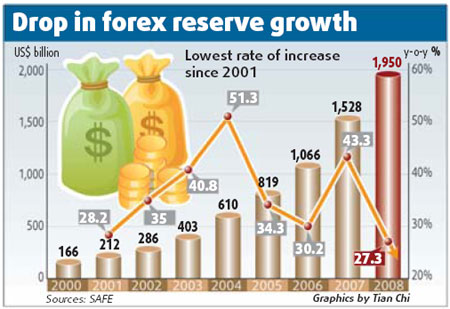
Updated: 2009-01-14 07:32 The country's foreign exchange (forex) reserve increased by $417.8 billion last year, $44.1 billion less than in 2007, the People's Bank of China (PBOC) said Tuesday.
The central bank also said the supply of money and loan growth picked up in December, reflecting the government's effort to boost the economy through proactive fiscal and moderately loose monetary policies. The country's forex reserve increased by less than $45 billion in the fourth quarter to $1.95 trillion by the end of 2008, a PBOC report said. The reserve growth slowed over the months last year. The total reserve was up 27.34 percent over 2007, the lowest rate since 2001. The growth rate from January to September was 32.92 percent and that from January to June 35.37 percent. The fall in the growth rate is the result of a shrinking trade surplus and a possible slowdown in the inflow of "hot money", analysts said. But despite the slowing of the reserve growth for the whole of last year, the monthly reserve for December increased $61.3 billion, up $30 billion year-on-year, the PBOC said. The fourth quarter's reserve, though, dropped compared to the same period in 2007. Guo Tianyong, a Central University of Finance and Economics professor, said expectations that the yuan would weaken and extraction of capital from the domestic market to help stabilize the supply of capital in the West were major factors that caused a year-on-year drop in the fourth quarter reserve. December saw a sharp rise in the reserve as the Central Economic Work Conference vowed early that month to keep the yuan stable - at a reasonable and balanced level - he said. That reversed expectations of a weaker yuan. The government has been worried over "hot money" being brought into the country by businesses and individuals speculating on the continuous rise of the yuan. It fears that it would create asset bubbles and increase the pressure for the yuan's revaluation, making the domestic financial system vulnerable. The flow of "hot money" into the country, however, began to dry up after some developed countries de-leveraged their financial markets to overcome the global financial crisis, the analysts said. Money supply As the money supply picked up in December, M2, which includes cash and all types of deposits and indicates overall liquidity in the financial system, increased 17.8 percent year-on-year. It had risen 14.8 percent in November. Banks extended 772 billion yuan in new loans in December, compared to 476.9 billion yuan in November. That helped the annual loan growth to accelerate to 18.76 percent in December, up 2.66 percentage points year-on-year. The annual growth of money supply including cash in circulation and demand deposits, or M1, was 9.06 percent in December compared to a 6.8 percent in November. The growth suggests the recent aggressive cuts in banks' reserve requirement ratios have helped improve liquidity, said Jing Ulrich, chairman of China equities at JPMorgan. The PBOC has cut interest rates five times, totaling 2.16 percentage points, since September. It has reduced the amount of deposit that lenders have to set aside to boost liquidity, too. Earlier, policymakers said the government would try to ensure a 17 percent M2 growth this year despite the economic slowdown. The moves, the analysts said, are expected to encourage banks to issue new loans, which are crucial for the government to deliver the $586-billion stimulus package. But some economists fear that increased lending could lead to a spurt in bad loans because returns from infrastructure projects are less predictable than what they were a decade ago. Ten years ago, the government began building a wide network of highways and other infrastructure as part of its fight against the Asian financial crisis. "The boost to the economy is obvious in the short term," said Ha Jiming, an economist with China International Capital Corporation. "But we need to keep an eye on the risk for lenders."
(China Daily 01/14/2009 page1) |
主站蜘蛛池模板: 午夜福利国产精品视频| 日本在线 | 中文| 欧美人与动牲猛交A欧美精品| 亚欧成人精品一区二区乱| 91中文字幕一区二区| 久久人妻少妇嫩草av无码专区| 67194熟妇在线观看线路| 人妻影音先锋啪啪AV资源| 日韩一区二区三区水蜜桃| 亚洲另类丝袜综合网| 国产成人精品三级在线影院| 一区二区三区国产在线网站视频| 草莓视频成人| 人妻丰满熟妇AV无码区APP| 护士被两个病人伦奷日出白浆| 日本视频一两二两三区| 国产亚洲av日韩精品熟女| 久久精品国产亚洲精品色婷婷| 不卡一区二区三区在线视频| 日本一高清二区视频久二区| 亚洲中文字幕日产无码成人片 | 九九热在线视频精品免费| 高清自拍亚洲精品二区| 国产精品自在线拍国产手机版| 中日韩黄色基地一二三区| 99热久久这里只有精品| 亚洲人成小说网站色在线| 精品久久人人做爽综合| www国产亚洲精品久久网站| 青青国产揄拍视频| 国产精品久久久久久无毒不卡 | 国产成人免费手机在线观看视频| 亚洲色无码中文字幕手机在线 | 国产不卡免费一区二区| 国产女人高潮视频在线观看| 成全高清在线播放电视剧| 无码人妻丰满熟妇区视频| 四房播色综合久久婷婷| 国产360激情盗摄全集| 最新精品露脸国产在线| 亚洲大尺度无码专区尤物|