|
|
Debates prove nation on democracy path
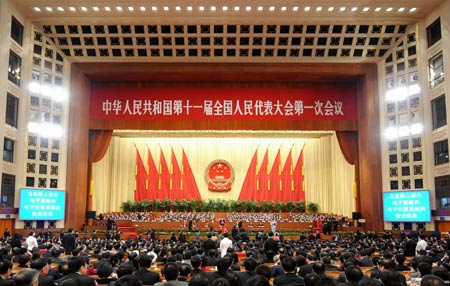
By Qin Xiaoying (China Daily) Updated: 2008-03-17 07:05 The plenary sessions of the National People's Congress (NPC) and the Chinese People's Political Consultative Conference (CPPCC) are two important meetings following the 17th National Congress of the Communist Party of China last year. As widely known, the significance of these two meetings lies in succession: the re-election of the NPC, CPPCC and State Council's top officials. Beijing is drawing particular attention from around the world also because the NPC is expected to approve a plan to reorganize the State Council. For me, however, that is not the only reason I am following the two conferences with great interest. The way I see it, some "side views", "highlights" and even slight changes happening in the Great Hall of the People reflect one way or another the progress China is making today toward democracy.
For example, a CPPCC member, representing the business community proposed three measures aimed at helping the rich and sparked heated debate nationwide. Zhang Yin, a successful self-made entrepreneur, and one of the richest women in China, suggested that labor-intensive enterprises should not have to sign open-ended employment contracts; lower the progressive tax rate of people whose monthly salary exceeds 100,000 yuan ($14,084) from 45 percent to 30 percent; and enterprises should be encouraged to import advanced and energy-efficient equipment, through a grace period of five to seven years before they are subject to import duties and value-added tax. There is little doubt her proposals were seen as relatively self-serving and did not sit too well with the public, deputies and members because they neglected the interests of the common people. Whether Zhang's proposals are right or not, the fact that a CPPCC member was able to speak on behalf of her social strata was a kind of "breakthrough". Whether NPC deputies and CPPCC members should be allowed to represent people like them and speak for their needs is a major issue the two national conferences must resolve. Is it not contradictory to emphasize that the deputies come from "all walks of life" but make no mention of their specific interests in their legislative bills? On the other hand, how should the national meetings determine which bills are fair and how should the various departments of the State Council respond to them if they are community-specific? We can expect the NPC and CPPCC to face many issues like this as they push forward democracy. Another CPPCC member's proposals were also met with strong opposition regarding the use of taxpayers' money. Sun Shuyi, from Shandong province, called on the central government to speed up the construction of Jining city - hometown of Confucius and Mencius - into an icon of Chinese culture and provide tens of billions of yuan in financial support for the project. CPPCC members who strongly questioned or opposed Sun's suggestion raised basically two counter points: Beijing is already an icon of Chinese culture, do we need a second one? As taxpayers we oppose any attempt to waste our money on construction projects in the name of culture. This writer is not passing judgment on whether an iconic city of Chinese culture should be built. What interests me here is the remarkable importance the NPC deputies and CPPCC members attach to the way national funds are used. Even more significant is that such concern does not stem only from national awareness but also from the viewpoint of taxpayers. It is an illustration of the rights taxpayers should have. Under today's democratic system, the rights of taxpayers and their responsibilities is an integral part of civil rights and responsibilities. Protecting taxpayers' rights to know and supervise State finance and budgets should be a matter of course like the protection of civil rights. This writer believes the concerns of deputies and members for taxpayers' rights will no doubt help advance the openness and democratization of and scientific approach to the deliberations and approval of the State budget and final State accounts. It will also help improve and micro-organize deliberations on the government's budget by NPC deputies at various levels, while fundamentally enhancing the overall quality of government revenue and spending assessments. In other words, those who do not care about protecting taxpayers' rights cannot be trusted with practicing democratic power on behalf of the public; and those who do not know enough about deliberations and approval of finance and taxes cannot be counted on to protect the general public's fundamental interests. Another "highlight" of the NPC and CPPCC plenary sessions was reflected in some deputies "picking on" government departments charged with providing public services. For example, take the issue of including Peking Opera in the music curriculum of primary and secondary schools, the Ministry of Education had already taken the decision to try it out in 10 cities and provinces beginning this spring. Much to the surprise of government officials, 42 cultural heavy weights, including no other than veteran Peking Opera star Mei Baojiu, son of the late Peking Opera legend Mei Lanfang, submitted a proposal at the CPPCC session demanding an immediate rethink of the move. The relevant officials at first brushed off the proposal, but were soon criticized by some CPPCC members. From this episode we can see the NPC deputies and CPPCC members not only expect government agencies to provide public services but do it thoughtfully, carefully, scientifically and satisfactorily. In other words, the debates at the two national conferences prove the Chinese society is full of dynamics, and even the small highlights indicate the progress of democracy in China. The author is a researcher with China Foundation for International and Strategic Studies (China Daily 03/17/2008 page4) |
|