Popular Premier Wen to serve another five years
(Xinhua)
Updated: 2008-03-16 22:09
BEIJING -- He was seen in SARS wards and AIDS-stricken villages. He visited four provinces in nine days during the past winter weather disaster, bowing to families of deceased heroes and apologizing to millions stranded at railway stations.
He spent Lunar New Year holidays with coal miners, dined with AIDS patients and stood behind migrant laborers demanding their wages in arrears.
While helping China to achieve double-digit GDP growth for five consecutive years, he has lived up to his motto, "The most important issue under the sun is to care for the well-being of the people."
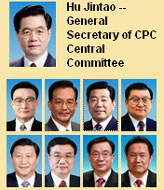
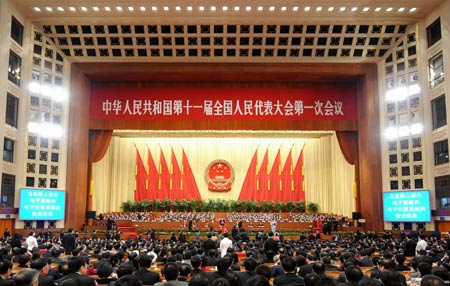
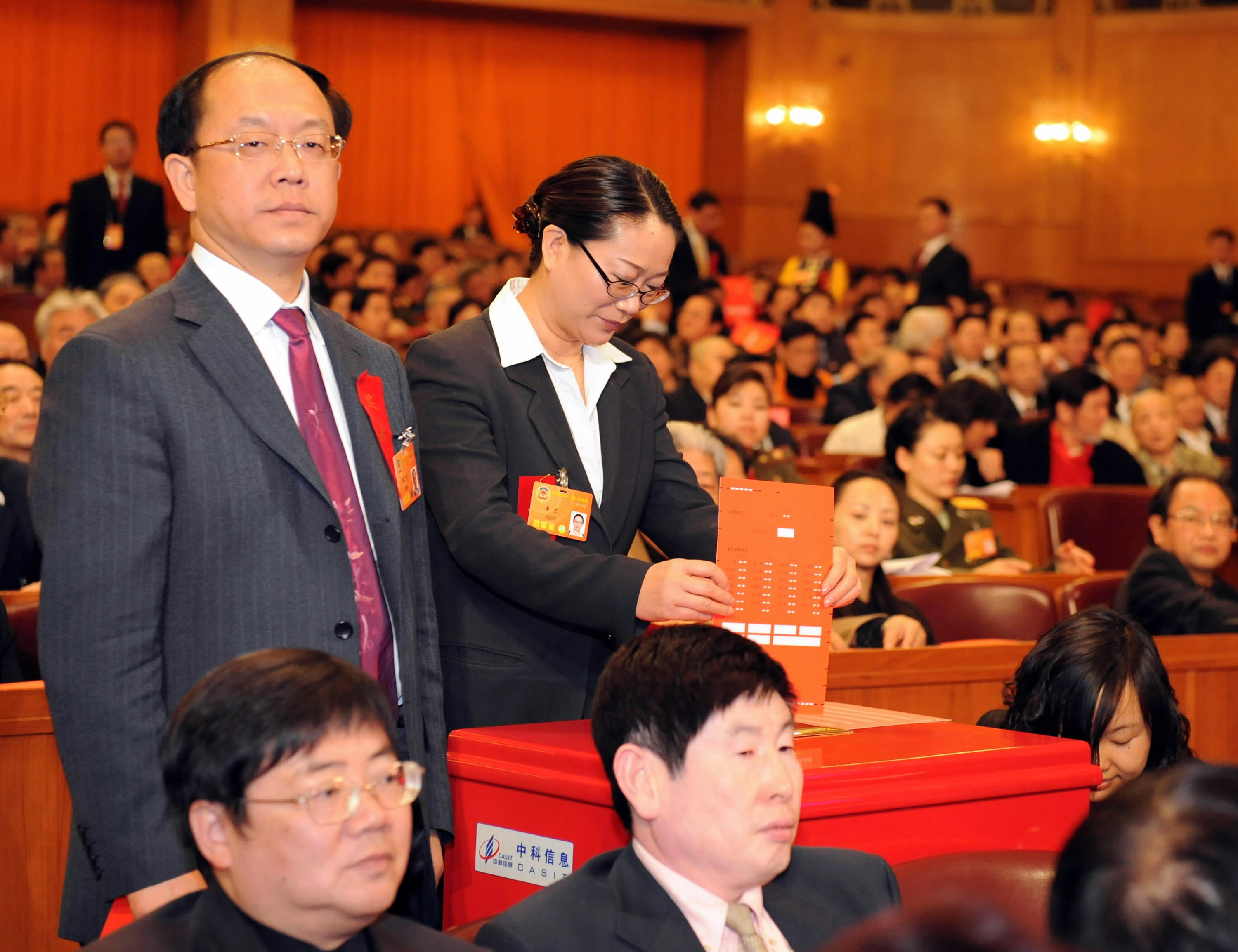
Wen Jiabao, the 65-year-old Chinese premier, has gained much popularity since he first took office in March 2003. He was approved by the parliament on Sunday to be premier of the State Council, the Chinese cabinet, for another five-year term.
His own poem, "Looking up at the Starry Sky", probably can best describe his feelings at the start of his second term, "Eternal fervidity sets on blaze and gives off spring thunder in my heart."
CONFRONTING NATIONAL WOES
Throughout his first tenure as premier, Wen stood in the vanguard to confront every disaster, visiting dreadful hospitals during the SARS outbreak in 2003, and trekking slippery roads to oversee relief work when the worst snow and ice storm in 50 years battered central, southern and eastern China earlier this year.
He has visited most of the country's 2,800-odd counties, wearing his homely jacket and sneakers and chatting with farmers, miners and migrant workers.
He once invited about a dozen grain farmers, rural teachers, coal miners, migrant workers and community doctors to Zhongnanhai, the leadership compound usually off-limits to commoners, to hear their comments on state affairs and government policies.
"He faces problems squarely," a netizen wrote of the premier on the website of China Central Television.
Since becoming premier in March 2003, Wen has underscored the well-being of the people, particularly those in the underdeveloped western regions. He has led the government in a strenuous campaign to provide equal education, medical care and other social security coverage for the country's 730 million farmers.
For five years, his government work reports to the annual parliamentary session were full of inspiring new policies aimed at improving the livelihood of the people, and led to the agricultural tax exemption and direct subsidies to grain farmers.
Wen, whose own parents were teachers, underscored time and again the importance of education, and facilitated the exemption of tuition and miscellaneous fees for primary and middle school students in the rural areas, as well as for students of six leading teachers' universities across the country.
This year, he further promised nine years of free compulsory education in both urban and rural areas.
Trained as a geologist, Wen is cool-headed and steadfast, and confronts the nation's woes with the persistence of an avid prospector, and the precision of a professor.
"It's hard to be premier of the world's most populous nation," Wen said on several occasions. "A trivial issue becomes a big one when multiplied by 1.3 billion, and an astronomical figure becomes minute when divided by 1.3 billion."
GEARING ECONOMIC GROWTH
In his first tenure as premier, Wen's government led China to become the world's fourth largest economy after the United States, Japan and Germany, blending effective macroeconomic regulation with a newly-installed market economy mechanism.
He pushed ahead reforms in the financial sector, including the shareholding reforms and listing of three leading state-owned commercial banks -- the Industrial and Commercial Bank of China (ICBC), Bank of China (BOC) and China Construction Bank (CCB).
The three banks now rank second, sixth and seventh in the world respectively in terms of market capitalization, according to a top 100 bank list published by the Boston Consulting Group last year.
In the spring of 2005, Wen led the nation to stand firm against growing international pressure for a swift revaluation of the Chinese currency yuan, stressing that China's foreign exchange reforms must be carried out in the country's own initiative and in a "controllable and progressive" manner.
In July 2005, the central bank "unexpectedly" ended the peg of the yuan to the US dollar, adopting a new exchange rate regime. The shift was hailed by economists worldwide as "momentous".
Wen led the country to cut energy consumption, reduce emission and eliminate backward production capacity. These efforts began to pay off last year, when China reported, for the first time in years, a reduction in both chemical oxygen demand (COD) and the total emission of sulfur dioxide, by 3.14 percent and 4.66 percent respectively from the previous year.
Facing global economic slowdown and the severest inflationary pressure in the recent decade, Wen said the country needs to maintain the appropriate pace, focus and intensity of macroeconomic regulation to sustain steady and fast economic development and avoid drastic fluctuations in the economy.
"The current price hikes and increasing inflationary pressures are the biggest concern of the people," he said in his government work report to the ongoing parliamentary session. "One major task for macroeconomic regulation this year is to prevent the overall price level from rising rapidly."
CLEAN, SERVICE-ORIENTED GOVERNMENT
Born in 1942 in north China's port city Tianjin, Wen worked in the northwestern Gansu Province for 14 years before he was moved to the Ministry of Geology and Mineral Resources in Beijing in 1982. Beginning 1985, he worked for eight years at the General Office of the Communist Party of China (CPC) Central Committee, serving as its deputy director and then director.
Wen became China's youngest vice-premier in 1998, overseeing agricultural and rural affairs, economic planning and finance.
He was elected into the Standing Committee of the Political Bureau of the CPC Central Committee in 2002, and was reelected into the nine-member top decision-making body in 2007.
An ideal government, as Wen sees it, should "perform duties in compliance with law, and be open, transparent, practical, efficient, clean and upright." In his government work report to the parliament in 2005, he targeted at building "a service-oriented government."
His whirlwind overseas visits were always short and busy. He visited seven African countries within seven days in 2006. His five-day Euroasia tour last November took him to four countries, plus a meeting with his counterparts from other members of the Shanghai Cooperation Organization.
In an "ice melting" visit to Japan last April, Wen chatted with the broad masses of Japanese and practiced baseball with students from Ritsumeikan University, trotting onto the field in a No. 35 jersey -- for the 35th anniversary of the normalization of Sino-Japanese diplomatic relations.
A man of integrity, Wen detests corruption. "All corrupt officials should be brought to justice and penalized severely in accordance with the law, no matter who they are, in what areas they are, or what high ranks they hold," he said at a press conference right after the parliamentary session in March last year.
Wen's annual press conference, televised live every year since 2003, is one of the most expected events for Chinese TV viewers. The premier would answer each question with sincerity, prudence and a smack of affection, and would occasionally turn to poetry.
"Even a foot of cloth can be stitched up; even a kilo of millet can be ground. How can two blood brothers not make up?" Wen said of relations across the Taiwan Straits at a press conference in 2005, quoting lines from Shi Ji, or Records of Chinese History, written more than 2,000 years ago.