|
|
Welcome to the Green Hall of the People
By Fu Jing (China Daily) Updated: 2008-03-05 07:30
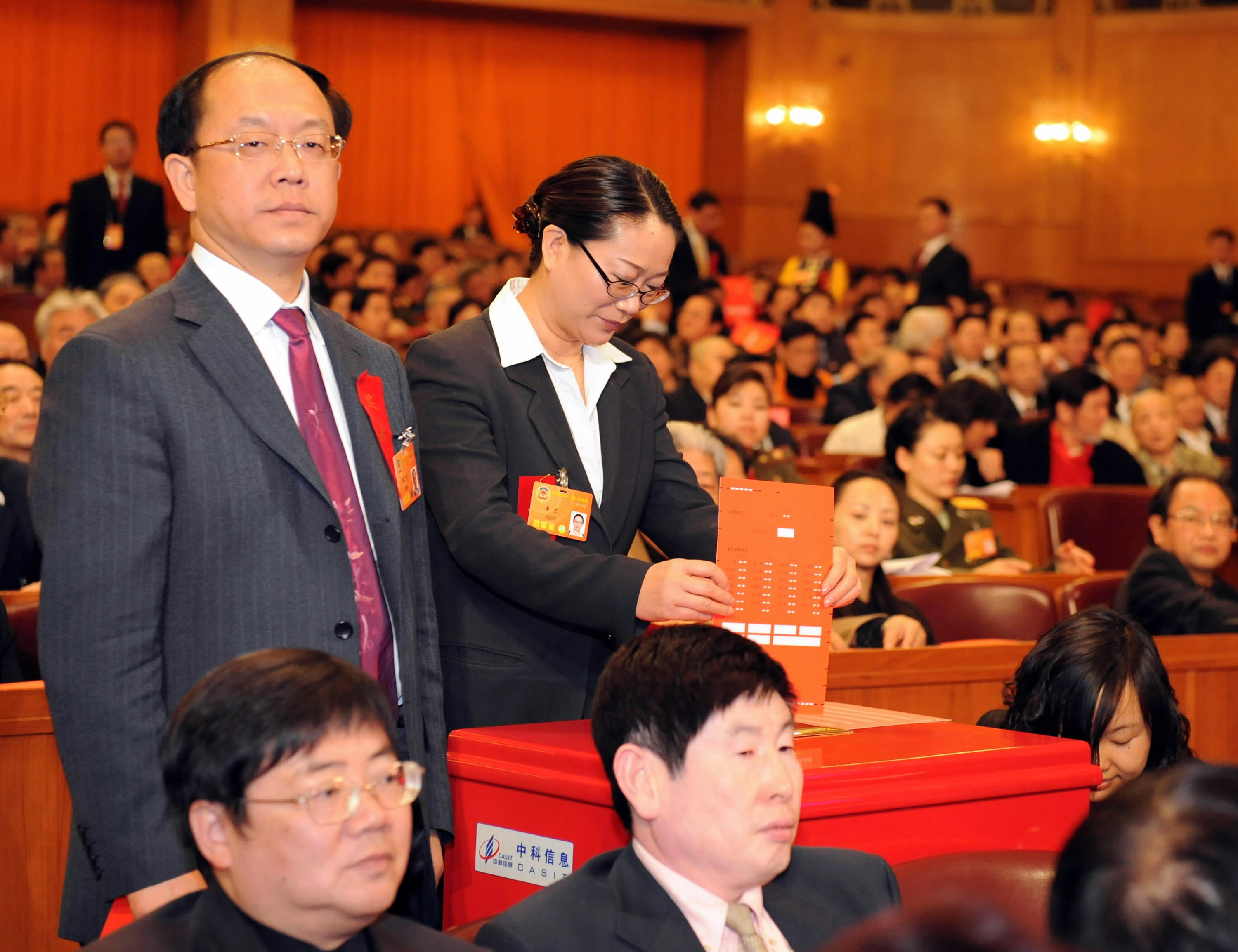
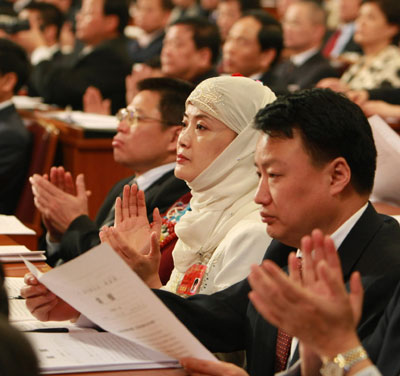
National legislators and political advisors meeting in the Great Hall of the People to reshuffle the country's cabinet and review the government's performance may not be aware of it. But the parliament building's administration bureau has taken all possible steps to ensure they leave behind as small a carbon footprint as possible. We'll explain what carbon footprint is later. First, let's take a look at the green arrangements in the 10,000-seat parliamentary building in Beijing. Twelve ventilators in the ceiling will be opened to let in fresh air while the 2,987 National People's Congress (NPC) deputies and 2,237 Chinese People's Political Consultative Conference (CPPCC) members meet for the most important annual political gathering. "Fresh air, together with air conditioners, can create a comfortable condition indoors," says Wang Xudong, deputy head of the administration bureau's air-conditioning center. "It will help meet the goal of making the Great Hall of the People a green building," and make the "two sessions" as environmentally friendly as possible. The parliament building, completed in 1959, is on the western side of Tian'anmen Square. So gigantic is its size and complex its structure that electricity charges would run into astronomical figures if the interiors are to be kept comfortable for the delegates only through air conditioners, bulbs and tubes. And cooling and heating charges could easily account for one-third of the electricity bill. But fortunately that will not be the case, for the administration has set up a computerized system underground to calculate how long the air conditioners should run and how much fresh air be allowed inside. This will be done by counting the number of participants, the area of the rooms or halls they are using, the length of a meeting and the weather. Among Wang's everyday responsibility is collecting data and devising individual heating and cooling schemes for each conference room or hall. He can sit in the command center and easily monitor the weather from the big screen there. "It's difficult to say how much energy we'll save in one room, but we have already achieved big success for the long term," he says. The parliament building cut down its total electricity consumption by 13 percent in 2006 and 8 percent last year from the 2005 level. This means it's three years ahead of the country's five-year goal of cutting energy consumption per GDP unit by 20 percent during the 11th Five-Year Plan (2006-10). Letting in fresh air is just one of the steps taken by the administration to cut the carbon footprint of NPC deputies and CPPCC members. Light controllers, with the help of cameras scattered in the building, will tell operators when to switch on or off the bulbs and tubes. Engineers have worked for years to design a gradual lighting-up system in the building. Take the 10,000-seat auditorium for example. The wall and ceiling lights and those directly above the stage will be turned on as attendants, participants and State leaders began walking in. The final lighting up will be done 20 minutes before the official opening of every group activity. Earlier all the lights used to be turned on half an hour before the opening. After the end of a meeting, the command center will switch off the lights gradually, in the order of the participants' departure. The lights above the stage will be the first to be switched off because leaders sitting there are usually the first to leave. Next to be switched off will be the ceiling and wall lights. "This will help us reduce energy consumption a lot," says administration bureau engineer Xiong Wei. The amount of energy the building can consume can be gauged from the fact that 1,000 kW of electricity is needed every hour to light up all its lights. That's why natural light will be allowed to flow in through the massive windows during daytime when NPC deputies hold group discussions in different conference rooms. Apart from the auditorium and the State banquet halls, there are separate conference rooms for each province, municipality and autonomous region in the three-section building. Those who are still wondering what carbon footprint is all about, here are some clues. Carbon footprint is the direct effect our actions and lifestyle have on the environment in terms of greenhouse gas (such as carbon dioxide) emissions. The biggest contributors to our footprint are probably our travel needs and electricity demands at home and place of work. All our actions, including our diet and the clothes we wear, however, have a direct or indirect impact on the environment. Cars, buses and planes burn gasoline and our homes use a significant part of our personal electricity needs that generally comes from fossil fuel-burning power plants. All these actions contribute to accelerating global warming and climate change. Which in short means the less energy we consume, the smaller our carbon footprint will be. That is exactly why "we're not only asking the NPC deputies and CPPCC members to save electricity, but also trying our best to conserve it ourselves", says administration bureau senior engineer Bai Fu'an. Bai's administration has 1,000 staff who are trained to be energy-efficient and save power. Though it's difficult to single out any one of the staff for his or her exemplary efforts because each one makes a significant contribution, Zhang Yan deserves a special mention. The young waitress works in the guest room of the Great Hall of the People's southern section, where China's top legislators hold talks with their foreign counterparts. As if out of instinct, the first thing she does after a meeting ends is switch off the lights and air conditioners. Only after she opens the curtain and lets in natural light do she and her colleagues start cleaning the room. "We've been trained to pay special attention to the environment," says Zhang. "We always clean the rooms in natural light. That saves a lot of energy." Since it can take about an hour to clean and do up a room, that's a lot of energy saved. Zhang's green concern is the result of the massive campaign launched by the government in 2005, a year after she was appointed. Its aim is to educate public servants about the importance of saving energy because they are the biggest single group of consumers. A Beijing municipal government survey in 2004 shows the per capita water and electricity consumption of civil servants in the capital is 3-7 times more than that of ordinary residents. The nearly 7 million public servants reportedly account for about 5 percent of the country's annual electricity consumption - which is enough to meet the needs of 780 million farmers. Bai and his colleagues realize what that means, and have been trying to save as much energy as possible and be super efficient in the use of electricity. They have installed energy saving bulbs and tubes in the offices of the national legislature's top leaders. The leaders, on their part, loosen their ties, or don't put them on at all, for most of the internal discussions so that the air conditioners can be run at or above 26 C in summer. The curtain, too, is opened to let in natural light to minimize the use of bulbs and tubes. Boards with "Please walk upstairs to keep fit and save energy" adorn the walls beside the lifts. The staff have been advised to leave their cars at home and walk or take public transport to and from work. And the temperatures in their offices are kept at or above 26 C in summer and 20 C in winter to save electricity. "Technology and public awareness are equally important in saving energy," says Bai. "It's a long-term task that calls for more than a one-off measure." And only collective effort can help us achieve the 2010 energy saving target set by the government. (China Daily 03/05/2008 page8) |
|