CHINA> Focus

|
CHINA> Focus
|
|
Mending medical care on the ground
By Tan Yingzi (China Daily)
Updated: 2008-12-04 07:50 When 45-year-old Wang Xiuzhi fractured her knees working in the fields, she was faced with the daunting option of traveling at least three hours by bus to hospitals in the city. Treatment there was guaranteed to be expensive for farmers like her.
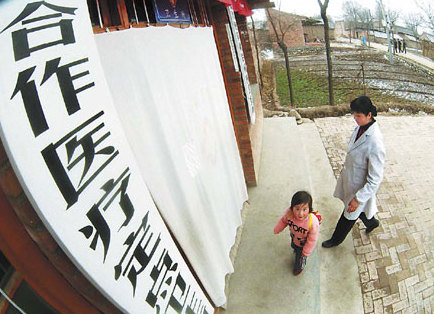
So she decided to undergo an operation in Yangli township near her village instead. "It's now much more convenient to be treated near my home," Wang told China Daily last month. "We don't want to visit the big hospitals in the city because they are really far away and more expensive." Wang's choice would not have been so obvious in the past. Farmers in the country's rural areas usually seek medical treatment at small village clinics, which are often equipped to deal with simple ailments such as fevers and cuts. "Barefoot doctors" with rudimentary medical knowledge were the only ones at hand to treat patients. The village clinics, part of a healthcare system set up in the 1950s, have proven to be successful in providing basic healthcare in the country's poverty-stricken areas. But in recent years, poor pay and lack of social insurance have driven away many village doctors, making it even harder for farmers to get basic medical care. If the farmers got very sick, they had to go to township clinics or the hospitals in the city. Yangli township's clinic, built in 1956, used to be poorly equipped and could only provide simple medical treatment. Villagers such as Wang with serious fractures would have probably received inadequate treatment at such town clinics.
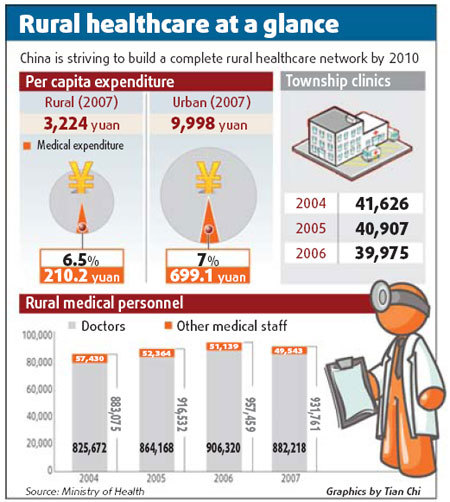
A government initiative to improve medical facilities in rural areas is changing all that. Last year, the local authorities poured 13 million yuan ($1.9 million) to build a new and fully equipped clinic for the town, which covers 52 villages and 580,000 people. Under a cooperation agreement, dozens of medical professionals from the Laicheng People's Hospital have also been regularly stationed at the clinic to help improve its management and medical treatment. Wang saved time and money at the clinic, undergoing a 12-day medical treatment costing 2,743 yuan. "This kind of treatment will cost at least 5,000 yuan at the big hospitals in the city," said Wei Lanjie, the deputy director of the local clinic. "According to our new rural cooperative medical scheme, funds will cover 45 percent of patients' medical expenses if they are hospitalized in the town clinic, compared with 36 percent for the same treatment in the city hospital." Under current policy, the country's urban areas receive 80 percent of medical resources. This leaves 800 million farmers, the majority of the 1.3 billion population, with huge challenges in accessing adequate health and medical facilities, former health minister Gao Qiang said at a national conference on hospital development in 2006. The uneven allocation of medical resources between those in the urban and rural areas was one of the biggest obstacles for carrying out medical reform, he said. A national health and medical reform draft released on Oct 14 sought to solicit public opinion to improve healthcare, with one major area aimed at providing equal medical services to rural and urban residents. It called for the building up of a village-town-county medical service network in rural areas and encouraged local governments in a number of wealthy regions to take innovative measures to improve rural medical facilities. To help rural residents access more medical resources, Laiwu, a well-off city in Shandong, recently embarked on rural medical reform and introduced a cooperation system among city hospitals and township clinics.
Since last October, the Yangli township clinic has been working with the Laicheng People's Hospital, with the hospital investing more than 700,000 yuan on facilities for the clinic and sending medical professionals to help in the project. Under their profit allocation agreement, the hospital stands to get 20 percent from the Yangli clinic's revenue. "It is a win-win business for both the hospital and the clinic," Kang Xibao, the Laicheng People's Hospital director, told China Daily. "The clinic has doubled its business in the past 10 months and the hospital is expecting to earn more than 400,000 yuan from the clinic by the end of this year," Kang said. To date, 19 township clinics in Laiwu have formed similar cooperation arrangements with the hospitals in the city. Encouraged by the success of the scheme, local authorities also decided to expand the project to village clinics that are said to urgently require medical personnel and equipment. The township clinics are encouraged to take over the village clinics in order to improve the grassroots medical units. The Yangli township clinic has taken over all the 39 village clinics in the town, hiring medical school graduates to work in the villages, upgrading the facilities and consolidating the management system. The village doctors say they now enjoy decent salaries and endowment insurance. All of them have earned qualifications to work at the village clinics. "Our clinic is much more modern now," said Lu Shiju, a veteran barefoot doctor from the Yifeng village clinic who has received the requisite qualification to treat patients. "We have seven doctors on a 24-hour shift. We also have a computer and can access the Internet, so we can keep the patients' medical information in the database." |
主站蜘蛛池模板: 久久综合精品国产一区二区三区无 | 久久精品国产自清天天线| 丰满人妻被黑人猛烈进入| 五月婷婷激情视频俺也去淫| 无码人妻一区二区三区av| 国产在线观看播放av| а√天堂在线| av色国产色拍| 欧美精品v| 蜜臀av一区二区精品字幕| 国产乱码精品一区二区三| 日日猛噜噜狠狠扒开双腿小说 | 午夜高清福利在线观看| 一本久道综合色婷婷五月| 偷拍久久大胆的黄片视频| 欧美人成精品网站播放| 久久这里只精品热免费99| 久久人人97超碰爱香蕉| 日本欧美大码a在线观看| 午夜A理论片在线播放| 久久WWW免费人成看片入口| 国产一区二区高清不卡| 国产成人高清精品免费5388 | 日本亲近相奷中文字幕| 无码国产精成人午夜视频一区二区| 九九热在线免费播放视频| 欧美成人看片一区二区| 国产成人综合久久亚洲精品| 中国少妇人妻xxxxx| 日本不卡码一区二区三区| 91久久精品美女高潮不断| 香蕉久久久久久久av网站| 在线看片免费不卡人成视频| 国产一级片内射在线视频| 18禁在线一区二区三区| 妺妺窝人体色WWW看人体| 成人无码午夜在线观看| 少妇午夜福利一区二区三区| 国产成人综合95精品视频| 国产福利在线观看一区二区| 另类 专区 欧美 制服|