CHINA> Regional

|
CHINA> Regional
|
|
Tibet moving on climate change threat
By Sun Xiaohua (China Daily)
Updated: 2008-10-07 07:42
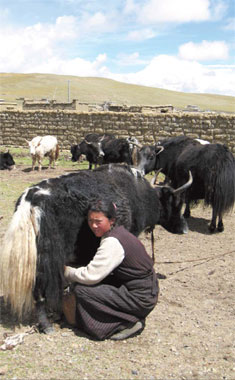
For Tibetan yak herder Bugye, the grassland in Nagqu prefecture, Lhoma county is much greener this year. "The animals have more fresh grass, especially this summer," Bugye, 68, said, watching over his herd of 70 yaks and 200 sheep grazing under blue sky and bright sunshine this early autumn. The rainy season came a month earlier and lasted longer. Herdsmen like Bugye, who endured a severe drought last year, were very pleased. But it is proving to be a mixed blessing. Scientists consider this kind of weather fluctuation testimony of global warming and worry that herders will face more extreme weather conditions and degradation of the grassland in coming years. An immediate consequence is that herders now face a severe shortage this winter of what is traditionally used for heating fuel- dried yak dung. With the prolonged rainy season, Bugye and other herding families have had trouble getting yak dung dried this year. Each the size of an adult man's palm, dried yak dung is an indispensable fuel for herders in using cooking and heating during chilly winters. The problem is so severe that the government of Tibet autonomous region is coming to their aid. Local meteorologists are tasked to keep a close monitor on weather in coming days, especially precipitation. Bugye earns more than 40,000 yuan($5,840) a year selling his yaks and sheep. He and his nine-member family of three generations are well-off. They live in a brick house and use solar power, in addition to electricity from a power grid. Even so, Bugye's family needs at least 7,000 pieces of the dried dung to get through the winter. For other nomadic families who live in tents, the need is greater. It is estimated that some 420,000 people living in Nagqu prefecture burn at least 2 million of dried yak dung one year.
"If the rain continues, it will result in a severe shortage of fuel for herders," said Tenzin Dondrup, deputy director of the Tibet Meteorological Bureau. Winter on the Qinghai-Tibet plateau is particularly cold. What makes Tenzin even more worried is that there will be more snowstorms this winter. In past years, such as in 1998, more rainfall in the spring and summer has meant more snowstorms in winter, he said. "I am very nervous about heavy snowstorms hitting the plateau this coming winter, especially when the herders have not prepared enough fuel, such as dried yak dung," he added. According to the figures from Tibet Meteorological Bureau, the temperature on the plateau has risen 0.25 C every decade, about three times the global rate of temperature rising. In Nagqu, the annual average temperature has risen by 0.6-1.5 C over the past 40 years. Annual precipitation has doubled from 78mm to 150mm over the same period, according to local weather records. With an average altitude of 4,500m above sea level, Nagqu in northern Tibet is dubbed "the ridge of the roof of the world". Covering 446,000 sq km, the prefecture accounts for 37 percent of the autonomous region's territory. Nagqu has the largest pastoral area, and the highest productivity in the region. Breeding livestock accounts for 70 percent of the prefecture's gross domestic product, and more than 90 percent of Nagqu residents make a living at it. It accounts for one-third of the region's animal husbandry. But a chilly winter with fuel shortages and snowstorms are not the only consequences of global warming in this region. Flooding has also become a major threat. After the Arctic and Antarctic, the Qinghai-Tibet plateau has the third largest number of glaciers. However, in the past 50 years, 82 percent of the plateau's glaciers have melted. The plateau has lost 10 percent of its permafrost layer in the past decade, according to the Chinese Academy of Sciences.
With the increased snow and glacier melt, the water levels of some 117 lakes in Nagqu alone have been rising. The water level of Tibet's second biggest lake, the Serling Co Lake, has risen 20 cm a year since 1997. At present, its water surface area reaches about 1,620 sq km. Compared with the coverage in 1997, the lake has expanded 5km to the west, 18km to the north, 23km to the southwest and 3km to the south. Since the 1990s, rising water levels in lakes have submerged 106,667 hectares of pastureland as well as more than 3,000 livestock pens in total. Nearly 1,400 households in Nagqu had to rebuild their homes. More than 1,000 households, or nearly 6,000 people, are still living under the threat of flooding. "In winter, water seeped into our house and around the stove and froze," said Penpa Tashi from Namarche county in Nagqu. "When summer came and the ice melted, the stink of yak dung filled the house. Because of the flooding, our house might collapse at any time, so we have to move." Nagqu prefecture deputy chief Gyaltsen Wangdrak has kept a close eye on the weather changes, accumulating data on how much damage the extreme weather fluctuations have caused to both the local economy and the herders over the past decade. In 2003, Gyaltsen met Lin Erda, a senior researcher of the Chinese Academy of Agricultural Sciences. They pooled together a 1.3 million yuan fund - with 800,000 yuan from Lin and 500,000 from the local Nagqu government - to study the long-term effects of global warming on Nagqu's grasslands. Over the course of 12 months, they mapped the degradation of grassland in Nagqu with remote sensing technology. The map showed that nearly half of Nagqu's alpine grassland had degraded. The affected area covers about 20 million hectares, with 10 percent, or 4 million hectares, seriously degraded. Based on this information, the prefecture started two experiments in Amdo county at the foot of Tanggula Mountain to restore seriously degraded grassland through sprinkler irrigation and reseeding. The goal is to quadruple the amount of grass from 600 kg to 2,400 kg per hectare. The prefecture has also leased from local herders some 33 hectares of healthy grassland and 20 sheep at 15,000 yuan a year to study how much grass an animal needs annually. Through this research, Gyaltsen and scientists are hoping to come up with more scientific figures on how to raise livestock on alpine grassland. "It will take many years to complete the experiments," Gyaltsen said. "But we have to persist. All the people living on the plateau face unprecedented changes from global warming. No one knows how to deal with it. "We have to blaze a trail."  (China Daily 10/07/2008 page7) |
主站蜘蛛池模板: 国产农村激情免费专区| 国产精品乱码人妻一区二区三区| 亚洲妓女综合网995久久| 妺妺窝人体色www聚色窝韩国| 国产在线午夜不卡精品影院| 国产高清看片日韩欧美久久| 裸体女人亚洲精品一区| 国产精品福利一区二区久久| 忘忧草影视| 夜夜躁狠狠躁日日躁2021| 亚洲国产精品成人一区二区在线| jizzjizz日本高潮喷水| 色成年激情久久综合国产| 国厂精品114福利电影免费| 夜夜嗨av一区二区三区| 久久久这里只有精品10| 一区二区精品久久蜜精品| 亚洲综合精品中文字幕| 日韩欧美一卡2卡3卡4卡无卡免费2020| 无码人妻一区二区三区兔费| 中文字幕在线精品国产| 久久久久成人精品无码中文字幕| 无码国模国产在线观看免费| 亚洲人成亚洲人成在线观看| 在线播放国产精品三级网| 国产精品亚欧美一区二区三区| 成人午夜福利一区二区四区| 国99久9在线 | 免费| 国产日韩精品一区在线不卡| 米奇777超碰欧美日韩亚洲| 国产欧美日韩精品丝袜高跟鞋 | 日韩一区精品视频一区二区| 亚洲成人av一区免费看| 国产精品自线在线播放| 亚洲国产精品成人av网| 亚洲V天堂V手机在线 | 人妻系列中文字幕精品| 亚洲欧美成人久久综合中文网| 国产一区国产精品自拍| 亚洲国产五月综合网| 99久久精品免费看国产|