CHINA> News

|
CHINA> News
|
|
Feeding children after formula scare
By Wu Jiao (China Daily)
Updated: 2008-09-24 07:46
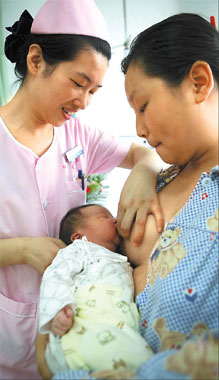
New mother Fei Hong has an additional chore every workday. Every two hours, she goes into the bathroom at work with a breast pump to get a bottle of breast milk, which she then sends through an express delivery service to feed her baby back at home. Fei, 32, was planning to feed her 5-month-old girl baby formula when she returned to work after four months of maternity leave. But that is no longer a consideration. Fei is not the only young parent who has to figure out how best to feed her baby in the wake of the ongoing tainted baby formula scandal that has implicated almost all major domestic brands of powdered or fresh milk. The widespread contamination with the chemical melamine has caused the death of four babies and sickened 53,000 so far. Breast-feeding is the most traditional way, and it is what mothers turn to by instinct. However breast-feeding has lost popularity among many young mothers because of changing lifestyles and lack of awareness of the benefits of breast milk. Ninety percent of young mothers are healthy enough to breast-feed, but those who do has dropped to 70 percent in China. The rate is even lower with young urban mothers. In Shanghai, only 50 percent breast-feed their babies for no more than three months, according to local health authorities. "Young mothers these days face huge pressures, and they often don't have sufficient milk of their own. As a result, the proportion of children in our country who are fed baby formula is quite big," Chinese Health Minister Chen Zhu said at a news conference last week. An overestimation of the health benefits of dairy products, coupled with heavy advertising hyping baby formula by some dairy companies in recent years, have also contributed to the decrease in the number of young mothers breast-feeding their babies. Until recently, dairy foods have been a rarity in the traditional Chinese diet. The Chinese, like many other Asians, are also more prone to lactose intolerance. Even after the founding of New China, supplies of fresh milk and milk powder were limited to major metropolises. Consumption of dairy products was a sign of wealth.
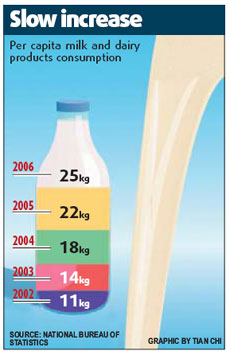
When China began reforms at the end of the 1970s, a host of studies revealed that Japanese teenagers, long considered shorter than their Chinese peers, were now of the same height. A study by Professor Ji Chengye of Beijing Medical University showed that by the late 1990s, the majority of Chinese teenagers were 1.47-1.7 cm shorter on average than their Japanese peers. This was attributed to consumption of dairy products as experts pointed out that milk with animal protein is more nutritious than soymilk with only vegetable protein. By 2005, annual dairy consumption per capita in China was still only 22 kg, according to the National Bureau of Statistics, as compared to 268 kg on average in Western countries, 64 kg in Japan and 50.9 kg on average in developing countries. However, consumption of baby formula has increased dramatically in the past few years, largely due to heavy advertising. Many young Chinese parents have placed their faith in the promises of companies that their products provide all the minerals needed for "wisdom and robustness". One young mother, Fang Caiying, a villager in Anqing, Anhui province, said she began to mix her breast milk with baby formula when her son was four months old. "It was to boost his nutrition. It was not because I don't have enough breast milk," Wu said when asked why she switched to baby formula. "I felt I couldn't provide him with enough nutrition myself and formula would be better than breast milk." "The advertisement said the formula has many minerals that the baby needs," she said. "I have great confidence in these products, even if they cost extra," Fang said. According to the UN Children's Fund (UNICEF), breast-feeding is the best choice for infants, and no baby formula can replace mother's milk. Mother's milk boosts the immune system and can dramatically reduce infant deaths in developing countries by 1 million babies a year. In the United States, the percentage of mothers who breast-feed their babies has reached 74 percent, the highest level on record. Dai Yaohua, a Chinese consultant with the World Health Organization (WHO), said it is best to breast-feed for six months and then add other foods and whole milk. According to experts, parents should stop feeding baby formula and introduce whole milk around the time of a baby's first birthday.
However, many people in China lack knowledge in this respect. Surveys by health authorities show that up to 45 percent of women, like Fang, have no idea that breast milk is the best choice for their kids and might resort to baby formula. Dai called for promotion of breast-feeding and for companies to provide breast-feeding rooms or flexible work hours to help young mothers. Many parents are now turning to foreign brands of baby formula, but the price is holding back many middle- and low-income families. A 900-g package of Nestle baby formula costs about 178 yuan ($26). A 400-g bag of Sanlu, the first brand found contaminated by melamine, sold for about 18 yuan. For Fang Caiying, Sanlu was a brand she could afford. Her family earns less than 3,000 yuan per year as farmers. "Sanlu was already the best I could afford for my daughter," Fang said. Some parents are turning back to traditional ways. Gao Jinyun, a 53-year-old grandmother in the Jiangsu provincial capital of Nanjing, feeds her 9-month-old granddaughter the same thing she her own baby 30 years ago - mashed egg, fish, meat and vegetables. "I brought up my boy this way, and he was always healthy. I don't think it's true that Chinese can't live without milk," Gao said. Gao and neighbors caught in a similar situation are sharing their recipes. Some use soymilk or rice soup as substitutes. 
|
主站蜘蛛池模板: 四虎国产精品永久在线看| 大陆国产乱人伦| 成人福利视频网| 国产色视频一区二区三区| 欧美做受视频播放| 国产AV嫩草研究院| 亚洲人午夜精品射精日韩| 亚洲国产初高中生女av| 国产三级精品三级在线区| 小污女小欲女导航| 久久99精品国产麻豆婷婷| 日韩精品一区二区三区视频| 高清破外女出血AV毛片| 国产人妻人伦精品婷婷| 亚洲第一福利网站在线观看| 久久综合国产精品一区二区| 国产一级三级三级在线视| 国产成人无码一区二区在线播放| 日本一卡2卡3卡4卡无卡免费| 国产成人高清精品亚洲| 日本一区三区高清视频| 国产精品高清中文字幕| 虎白女粉嫩尤物福利视频| 亚韩精品中文字幕无码视频| free性开放小少妇| 中文国产不卡一区二区| 一个人看的www在线视频| 日本韩国一区二区精品| 免费无码AV一区二区波多野结衣| 国产乱来乱子视频| 国产真人无遮挡免费视频| 国产农村老太xxxxhdxx| 91福利精品老师国产自产在线| 亚洲精品三区二区一区一| 亚洲中文字幕无码av永久| 国产激情视频在线观看首页 | 一区二区三区一级黄色片| 国产综合色在线精品| 人妖系列在线精品视频| 中国性欧美videofree精品| 国产精品色内内在线播放|