CHINA> National

|
CHINA> National
|
|
Against the tide
By Mao Lijun (China Daily)
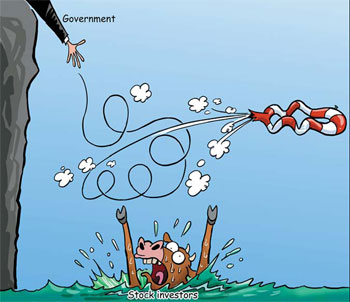
Updated: 2008-07-14 08:36 It is no longer a question of whether the Chinese government will save the market or not. It is whether the government measures are effective enough for today's stock market, which is driven by the law of value. The country's stock market remained very weak after a comprehensive commentary issued by Xinhua News Agency, which was seen as a signal of government policy support. The commentary, published on front pages of China's main financial newspapers on July 2, said the country's stock market is capable of achieving stable and healthy development given the strength of the country's economy. But performance in the days after the commentary remained far from encouraging, with the last day of the week - July 4 - seeing the benchmark Shanghai Composite Index fall 1.24 percent to close at 2669.89, with 474 of 907 stocks down. State-owned Xinhua published a similar commentary on the stock market 16 years ago after a long bear run on the market. The commentary was followed weeks later by the establishment of the China Securities Regulatory Commission (CSRC) and a major recovery by the market.
Securities analysts, experts and economists who agree that the government is strongly committed to creating a good environment for stocks, say the market has gradually emerged from the shadow of a "policy-support market". "Xinhua's commentary appeared after the market had experienced consecutive declines. It showed the government's insistence on maintaining a stable market," Liu Kaixuan, an analyst with Shanxi Securities, says. "It should have been a signal for government policy support, but it failed to have an effect on the market," he says. "The country's stock market has evolved into a value-driven era, when any single element or short-term policy stimulation can't change its movement," Niu Xiangyang, analysts with China Galaxies Securities, says. Since the beginning of this year, the country's stock market has experienced intense turmoil, but a series of government regulatory measures simply failed to drive the sentiment up. To relieve the market after it fell to half its peak in October 2007, the government changed the tax policy on April 24 by slashing the stamp tax from 0.3 percent to 0.1 percent. But the measure - a clear signal of the government's determination to bolster the fragile market - failed to change the stock market's decline. Apart from short-lived rebounds, the market gave a cold shoulder to the most aggressive stimuli to date and continued to slide. On April 20, several days before the tax policy change, regulators announced curbs on the sale of non-tradable shares that came out of lock-up periods. Except for a short-term fluctuation, the measure, aimed at controlling floods of shares coming into the secondary market, which could "put constant pressure on stock prices and distort the price formation mechanism", according to CSRC, also failed to stop the market's plunge. "It has become very difficult for government stimulation policy to relieve today's stock market because the capacity of the country's stock market is ten times larger than 10 years ago," Qiu Yanhuai, an analyst with Haitong Securities, says. "In today's market, the performance of stocks mainly depends on the overall fundamentals, including the country's macro economy, especially the inflation rate, corporate earnings, corporate future development and the corporate governance," Niu says. "At the same time, the international factors, including the growing international price of oil, the depreciating greenback, the slowing US and European economies, also have a great influence on the country's stock market," he says. The market will not rely on any single element but the maturation of all the components and factors although the country's stock market has not yet completely emerged from the shadow of a "policy-support market", Niu says. |
主站蜘蛛池模板: 四虎精品国产永久在线观看| 日韩AV无码精品一二三区| 91香蕉视频在线| 亚洲AV无码不卡一区二区三区| 又爽又黄又无遮挡的激情视频| 色狠狠色婷婷丁香五月| 国产av一区二区三区| 综合亚洲网| 在线涩涩免费观看国产精品 | 亚洲区一区二区激情文学| 人妻丝袜无码专区视频网站| 欧美色欧美亚洲高清在线视频| 四虎国产精品永久入口| 精品国产乱码久久久久夜深人妻 | 91中文字幕一区在线| 国产午夜影视大全免费观看| 曰韩高清砖码一二区视频| 欧美白人最猛性xxxxx| 天天夜碰日日摸日日澡性色AV| 国产激情视频在线观看首页| 人妻少妇偷人作爱av| 97人人模人人爽人人喊电影| 中国性欧美videofree精品| 亚洲大尺度无码专区尤物| 星空影院电影电视剧免费播放| 中文字幕色av一区二区三区| 亚欧乱色国产精品免费九库| 国产一区二区在线观看我不卡| 亚洲av中文乱码一区二| 國产AV天堂| 4hu四虎永久免费地址ww416| 国产香蕉尹人综合在线观看| 国产成人av无码永久免费一线天| 日韩精品一区二区三区色| 亚洲熟女精品一区二区| 91精品乱码一区二区三区| 亚洲成人资源在线观看| 午夜日本永久乱码免费播放片 | 中文有无人妻VS无码人妻激烈| 又黄又硬又湿又刺激视频免费| 亚洲亚色中文字幕剧情|