 |
|
|
News
President pledges continued reform and opening-up
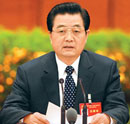
The following is the full text of Chinese President Hu Jintao's speech, entitled "Continuing Reform and Opening-up and Advancing Win-Win Cooperation," delivered at the opening ceremony of the Boao Forum for Asia annual conference on Saturday: Distinguished Guests, Ladies and Gentlemen, Friends, First of all, I would like to extend, on behalf of the Chinese government, warm congratulations on the opening of the annual conference and a warm welcome to all of you. Since its establishment, the Boao Forum for Asia has played an important role in deepening mutual understanding and friendship among the Asian peoples and promoting interaction and cooperation among countries and business communities in Asia, and we applaud the growth of the Forum and the achievements it has made. Ladies and Gentlemen, Friends,
This year is of special significance to China. Thirty years ago, under the leadership of Mr Deng Xiaoping, the Chinese people resolutely embarked on the historic journey of reform and opening-up, an initiative taken by Deng Xiaoping. It started a great new revolution in China under the new historical circumstances. Time flies, and thirty years have passed before one realizes it. Over the past 30 years, the Chinese people, acting in a pioneering spirit and making bold innovations, have unswervingly carried out reform and opening-up and pursued socialist modernization, and China has made great progress in terms of growing its economy, enhancing its overall national strength and improving the living standards of its people. Historical changes have taken place in China. China has successfully made the historic transition from a highly centralized planned economy to a robust socialist market economy and from a closed and semi-closed country to a country that is wide open to the outside world. China's economy has grown rapidly. The Chinese people, once lacking basic living necessities, are now enjoying initial prosperity. The poor rural population has dropped from over 250 million to about 10 million. Remarkable achievements have been made in our endeavor to improve the political system and promote cultural development and social programs.
If a country or a nation is to develop itself in this increasingly competitive world, it must advance with the times, carry out reform and opening-up, boost development, put people first and promote harmony. This is the conclusion we have drawn in the great cause of reform and opening-up. There is no ready or unchanging path and model of development that suits all countries in the world. We must explore and improve our development path and model in keeping with China's national conditions. In so doing, we must adapt to new trends both at home and abroad, and meet the people's growing expectation for a better life. We must make the Chinese society more vibrant. And we must truly keep up with the trend of the times and share the same destiny with the people. History provides the basis for making new progress. It is also a source of inspiration guiding our efforts to pursue a better future. China remains the biggest developing country in the world. It still has a long way to go before it can basically achieve modernization and bring about common prosperity for all its people. Reform and opening-up are what have made fast development in China possible in the last 30 years, and they also hold the key to China's future development. Reform and opening-up are a crucial choice that has shaped China today, a choice made by the 1.3 billion Chinese people. The Chinese people are dedicated to the great cause of reform and opening-up, and will continue to build a society of initial prosperity in all respects and realize basic modernization in China and contribute further to the noble cause of peace and development of mankind. Ladies and gentlemen, Friends, Three decades of reform and opening-up have brought about historic changes in China's relations with the rest of the world. China is now an integral part of the global economy. In 1978, China's GDP accounted for only 1 percent of the world economy, whereas its share rose above 5 percent in 2007. In 1978, China's share of global trade was less than 1 percent, whereas in 2007, its share jumped to about 8 percent. China's development has opened a huge market for international capital, attracting over $780 billion of net foreign investment over the last 30 years. Direct overseas investment by Chinese companies has also grown substantially. China's development has boosted the growth of global economy and trade. With its import growing at an average annual rate of 16.7 percent since 1978, China has become the world's third largest import market and the largest import market in Asia. China now contributes to over 10 percent of global economic growth and over 12 percent of global trade expansion. China's average annual import volume has reached close to $560 billion since 2001, generating some 10 million jobs for our trade partners. China is now a key participant in the international system. It is a member of more than 100 inter-governmental international organizations and a party to over 300 international conventions. China is actively involved in international and regional affairs, and earnestly fulfilled its international responsibilities. Over the past years, China has sent over 10,000 peacekeepers to 22 UN peacekeeping operations. Over 1,900 Chinese peacekeepers are now on active duty, making China the largest troop-contributing country among the five permanent members of the UN Security Council. The past 30 years of reform and opening-up have told us that China cannot develop itself in isolation from the world. And it is equally true that the world cannot enjoy prosperity or stability without China. In a world where the trend toward multi-polarity is irreversible, economic globalization is deepening and the scientific and technological revolution is accelerating, China's future is more closely linked with the future of the world than ever before. China will firmly keep to the path of peaceful development, a strategic decision made by the Chinese Government and people. This decision is based on China's realities and in keeping with the trend of our times. It demonstrates that China's foreign policy and domestic policy are consistent with each other and that the fundamental interests of the Chinese people and the common interests of the world's people are in harmony. Peaceful development is the only way leading to the great rejuvenation of the Chinese nation. China respects the right of other peoples to independently choose their development path. It does not interfere in other countries' internal affairs, nor does it try to impose its own will on others. China is committed to peaceful settlement of international disputes and follows a defense policy that is defensive in nature. China will never seek hegemony or expansion. China will unswervingly follow a win-win strategy of opening up. We are committed to promoting the sustained and steady growth of the world economy. We will expand market access in accordance with generally accepted international economic and trade rules. As we strive to develop ourselves, we are also ready to accommodate the legitimate concerns of other countries, developing countries in particular. We support international efforts to help developing countries to strengthen capacity for independent development and improve the lives of their peoples. We support efforts to improve international trade and financial systems, promote trade liberalization and investment facilitation and seek collective solution to financial risks and energy security. We hold that economic and trade frictions should be solved through consultation and cooperation, and countries should share in development opportunities and jointly meet challenges. China is dedicated to building a harmonious world of lasting peace and common prosperity. China abides by the purposes and principles of the Charter of the United Nations and observes international law and universally recognized norms governing international relations. We promote democracy, harmony, cooperation and common progress in international relations and respect diversity of human civilizations. We endeavor to make international relations more democratic. We take an active part in international cooperation in counter-terrorism, non-proliferation, climate change, environmental protection, and prevention and control of infectious diseases. We work for a more just and equitable international order. Ladies and Gentlemen, Friends, Asia's development is important not only to Asia's future but also to the future of our world. Asia has in recent years enjoyed overall stability and fairly fast economic growth. To develop good neighborly relations and handle problems and differences through dialogue and consultation has gained increasing support among the Asian countries. The numerous Asian regional and sub-regional cooperation mechanisms are playing an increasingly important role in promoting economic growth and stability in Asia. Asia remains one of the world's most dynamic regions. But Asia also faces some tough challenges in promoting economic development, building political institutions, and maintaining security and stability. To realize lasting peace and common prosperity in Asia is a long-term and arduous task. China will work with other Asian countries to seize opportunities, meet challenges and build a peaceful and open Asia of development and cooperation. To achieve this goal, I call on the Asian countries to take the following steps to increase cooperation: First, enhance political mutual trust. We should seek common ground and shelve differences and live in harmony on the basis of mutual respect and equality. We should resolve disputes and differences through dialogue and consultation. We should respect each other's security concerns, follow the new thinking on security featuring mutual trust, mutual benefit, equality and coordination, promote the development of regional security mechanism and work together to address security threats and maintain peace and stability in the region. Second, deepen economic cooperation. We should promote regional free trade arrangements and investment facilitation mechanisms, deepen fiscal and financial cooperation and enhance infrastructure interconnectivity across Asia. The Asian countries should strengthen coordination of macro-economic policies and jointly uphold financial, energy and food security. We should step up cooperation in poverty alleviation and human resources development, narrow gaps in development and promote common development and prosperity in the region. Third, meet challenges together. We should oppose terrorism in all manifestations and strengthen cooperation in counter-terrorism and non-proliferation. We should join hands to fight transnational crimes, illegal immigration and drug trafficking. We should increase cooperation in disaster prevention and reduction and public health. We should strengthen capacity for tackling climate change and promote exchange and cooperation in environmental protection and the proper use of water resources in a joint effort to foster a conservation culture in Asia. Fourth, increase cultural and people-to-people exchanges. We should carry out cultural exchanges of diverse forms and strengthen dialogue among different civilizations and promote contact and cooperation among parliaments, non-governmental organizations, academic institutions and the media of the Asian countries. Youth exchanges should also be strengthened to increase mutual understanding among the young people. And we should work together to ensure the dynamic growth of the Asian culture. Fifth, keep to the policy of openness. Regional cooperation should remain non-exclusive. We should draw on the development practices of other regions and use platforms such as the Asia-Pacific Economic Cooperation, Asia-Europe Meeting, Forum for East Asia and Latin America Cooperation, and Asia-Middle East Dialogue to enhance dialogue and cooperation with other regions and achieve common progress through extensive exchanges and cooperation with the rest of the world. Wish the 2008 annual conference of Boao Forum for Asia a full success! Thank you! (China Daily 04/14/2008 page3) |
|