China lets yuan appreciate a bit faster
Updated: 2007-12-29 11:46
http://www.nytimes.com/2007/12/29/business/worldbusiness/29yuan.html?pagewanted=1&_r=2
Hong Kong -- China’s currency rose steeply against the dollar this week, feeding speculation that Chinese authorities were allowing their currency to appreciate more rapidly.
|
|
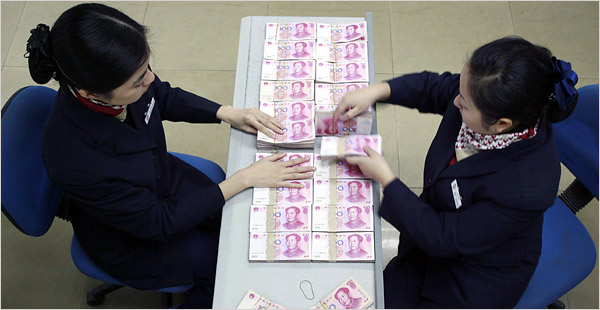
The currency, known as the yuan or renminbi, rose 0.9 percent this week -- faster than over any week since China stopped pegging it to the dollar on July 21, 2005. Thursday, the yuan rose 0.37 percent, the largest one-day increase since the peg ended. On Friday, it rose 0.18 percent, to close at 7.3041 to the dollar in Shanghai trading.
Yao Jingyuan, the chief economist of the National Bureau of Statistics in China, said Chinese officials were trying to figure out their next currency move.
"It is certain that the yuan will appreciate -- the time frame and magnitude of the adjustment is difficult to confirm at the current time. We are busy studying this issue right now," he said in a telephone interview. "What I can say is that it will be dependent on China's overall economic environment and outlook."
Yu Yongding, the director of the Institute of World Economics and Politics at the Chinese Academy of Social Sciences and until last year a member of the monetary policy committee of China's central bank, said that rising inflation at home was making it much easier for the Chinese government to accept a stronger yuan.
Until recently, the government worried that allowing the currency to rise would let in more imports and stifle exports, leading to deflation. But China's consumer price index was up 6.9 percent in November compared with a year earlier, led by an 18.2 percent rise in food prices.
A sustained appreciation of the yuan could ease frictions somewhat with the United States, the European Union and Japan.
The comments by Mr. Yao and Mr. Yu are the latest in a series of hints from current and former officials that suggest the country’s leadership is beginning to see some advantages to a stronger currency.
On Thursday, the newspaper China Securities Journal reported that Ba Shusong, a deputy director at the government's elite State Council Development and Research Center, had called for yuan appreciation to slow the rise of food and fuel prices. China imports half of its oil, but relatively little of its food. And on Monday, a newspaper in Shenzhen reported that central bank officials had suggested to the State Council, China's cabinet, a one-time increase in the yuan's value.
The central bank has long favored a stronger yuan, but the commerce ministry and interest groups have blocked it. Mr. Yu, like most of his Western counterparts, said the government is less likely to opt for a one-time revaluation and more likely to choose a faster pace of daily appreciation.
The danger of allowing a steady rise in the yuan's value, instead of a quick jump, is that it may encourage speculators to pour more money into China in an effort to ride the increasing value. The country's foreign exchange reserves are already rising by roughly US$1 billion a day, mainly because of a trade surplus that has continued to grow despite a 7 percent increase in the yuan against the dollar this year.
By comparison, the yuan rose just 3.3 percent against the dollar in 2006.
Mr. Yu said that China has become less attractive to speculators. He pointed to the ranking of China's stock markets as among the world's costliest in terms of price-to-earnings ratios; limits on foreign investments in already high-priced real estate markets; and restrictions on foreign money entering domestic money markets.
Hong Liang, a Goldman Sachs economist based in Hong Kong, expects faster appreciation next year but not a one-time revaluation.
Bloomberg News found that the median estimate of 28 analysts was for the yuan to reach 6.88 to the dollar next year; that would mean a further increase of 6.2 percent from the close Friday.
Stock markets fell across China Friday, partly in reaction to Thursday's stock market drop on Wall Street but also on the prospect that a stronger Chinese currency could narrow profit margins for many Chinese exporters. The Shanghai A share index declined 0.89 percent, the Shenzhen A share index fell 0.45 percent and the Hang Seng Index in Hong Kong plunged 1.7 percent.
Opposition to faster yuan appreciation has come from three directions in China, according to Chinese political and currency experts.
The most vocal bloc consists of exporters, who worry that an ever more valuable yuan will result in narrower profit margins. Chinese factories also face higher costs after Jan. 1 as a new labor law takes effect that could make it much harder to dismiss less productive employees.
But after years of having their prices beaten down by Wal-Mart and other big corporate buyers, Chinese factories have discovered this year that they can push through price increases.
The Bureau of Labor Statistics price index for American imports from China fell steadily from when the American government began calculating the series at the end of 2003 until February of this year. But it jumped 2.4 percent from February through November as businesses in China experienced such strong demand that they were able to raise prices and still keep assembly lines full.
Opposition to faster appreciation also has come from political leaders worried about urban unemployment.
But this worry seems to be abating as exporters have shown their ability to thrive even with currency appreciation, with Chinese exports 22.8 percent higher last month than a year earlier.
Until very recently, the third obstacle to a much stronger yuan has been the danger that it would lead to cheap food imports that would drive down the prices realized by China's farmers. This has been particularly important because many officials, from President Hu Jintao on down, want to narrow the gap between rural and urban incomes.
Higher food prices have benefited many peasant farmers this year, increasing their incomes as they sell their crops for more money. Not all peasants have gained, however, as part of the inflation has occurred because of an epidemic among Chinese pigs as well as drought in areas of southern China.
|
|
|
||
|
||
|
|
|
|