 |
|
|
News
Green road does not mean stunted growth
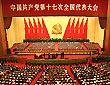
China's economic engine will hit the green road, though it will continue to run. That's the message of the 17th National Congress of the Communist Party of China (CPC) that concluded on October 21. The growth goal will not be compromised, though, as CPC General Secretary Hu Jintao has announced that the per capita GDP is expected to quadruple by 2020 compared to the 2000 figure. But the goal will be achieved through cautious urbanization, a new model for industrialization and further integration with the rest of the world. Growing domestic consumption, propelled by industrialization and urbanization, relatively cheap labor and competitive foreign trade will combine to achieve the 2020 target. But the country faces obstacles such as environmental problems, resource constraints, imbalanced foreign trade, economic restructuring, an incomplete social security network and a likely rise in the cost of labor, on its road to growth. Environmental problems and resource constraints have already prompted the government to resort to scientific and technological advancement to sustain its economic miracle, which has maintained an average annual growth of 10 percent for three decades. But by 2020, China wants to be seen as an innovative country.
According to the National Bureau of Statistics, China's per capita GDP reached 7,858 yuan ($1,058) in 2000 and jumped to 16,084 yuan ($2,166) last year. Which means it took only six years for per capita GDP to more than double. So the bureau says there should be "no major difficulty in realizing the 2020 goal". It means the country will be in the mid-developed countries' category by then. By that time, though, the country's growth pace is likely to slow down from today's blistering 11.5 percent to 8-9 percent. In fact, it's expected to drop to that growth rate by 2018. The abandoning of the extensive development model to save the environment will have a lot to do with that drop. The CPC acknowledges the deteriorating state of the environment and the threat of climate change. And that's the main reason why it included the important Scientific Outlook on Development approach in its amended constitution at the 17th Party congress. It reflects the down-to-earth attitude China has adopted to balance economic development and environmental protection, a dilemma widely believed to be unavoidable for a developing country when its economy takes off. Just four days after the congress, where more than 2,000 delegates set China's political, economic and social agenda, the National People's Congress (NPC) adopted a law linking officials' performances in implementing energy conservation measures to their career record. Now an "environmental veto system" is to be introduced into the law to ensure that officials are punished or denied promotion if they fail to meet the "green targets" set by higher-level governments. Such is the importance the central government attaches to environmental protection that it has began phasing out overproduction capacities in more than 10 sectors from this year, and hopes to do away with them completely by 2010. Facing closures are many factories including some producing iron and steel - so important for the booming construction industry and the economy as a whole. The closures, however, could leave millions of workers jobless. The authorities know that economic growth does not necessarily mean rosy employment prospects, especially for the poor. And an innovative economy cannot rectify that in the short term. Figures show that in the past few years, the number of jobs created doesn't match the strong economic growth. The International Labor Organization says China's GDP grew 38.3 percent between 1999 and 2003 but only 4.3 percent more jobs were created during that period. China's low labor absorption rate partly reflects a long-term structural change from employment-intensive to capital-intensive growth, especially in the industrial sector. The current innovation strategy will only accelerate this trend, that is, economic growth will create even fewer jobs. But despite that the government is determined to close the factories using out-dated technologies and harming the environment. "In the long run, the closures will help reduce energy consumption and greenhouse gas emissions, which will be helpful for generations to come," says Ministry of Finance spokesman Liu Ruijie. Liu concedes that the government faces an uphill task in creating more jobs for retrenched factory workers, given the competitive nature of the country's job market. Some officials say unemployment caused by closed factories could be as severe as that in the 1998-2001 period, when the government regrouped its State-owned enterprises. Millions of workers were laid off and brought under the social security net then. "We have already set up a basic social security system in urban areas, so we expect this round of closures to be much smoother than the previous one," Liu says. Today, the government has more financial resources to create jobs and provide social security for laid-off workers. But many migrant workers employed in factories are not fully insured or covered by pensions, and urgent measures are needed to ensure that the retrenched workers, too, are brought under the social security net. "We have to balance environmental protection and social stability," Liu says. And it seems that despite taking a sustainable development approach, the country can create more jobs. Environmental protection, taken as an industry, generated 3 million jobs in 2006, according to the State Environmental Protection Administration (SEPA). It is new business for 35,000 companies that had a cumulative revenue of 600 billion yuan ($80.80 billion) and a profit of 52 billion yuan ($7 billion) last year. The sector is estimated to grow at the rate of 15 percent a year or more during the 11th Five-Year Plan (2006-10) to register revenue of 1.1 trillion yuan ($148.14 billion). Combined with development, it seems that the environment sector alone has the potential to create a lot of jobs. (China Daily 11/21/2007 page12) |
|