The country's first lunar orbiter entered the moon's orbit after completing a critical maneuver, officials said Monday.
 Chang'e-I successfully completed its first braking at perilune and entered the moon's orbit Monday morning, becoming China's first circumlunar satellite.
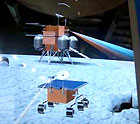
A video simulation of Chang'e I |
Chang'e I, following the instructions of the Beijing Aerospace Control Center (BACC), started braking at 11:15 am at a position around 300 km from the moon and entered the moon's orbit 22 minutes later, the BACC said.
"It turned the satellite onto a circumlunar path, marking a milestone in China's space history," said Sun Laiyan, deputy head of the Commission of Science Technology and Industry for National Defense.
"So far, each step in the lunar probe project has been completed almost perfectly."
President Hu Jintao and Premier Wen Jiabao sent congratulation letters to the scientists working on the mission, encouraging them to make further progress on the exploration of the moon.
Ma Yongping, deputy director of the BACC, said the braking was of great importance for Chang'e I, enabling it to be captured by lunar gravity.
He said that the probe had to arrive at the perilune - the point in a lunar orbit that is nearest to the moon - at the designed time and speed before it started braking.
"It would have flown away from the moon if the braking was too early, or crashed into the moon if the braking was too late," Ma said.
The orbiter is now traveling along a 12-hour elliptical moon orbit, with a perilune of about 200 km and an apolune - the point in a lunar orbit that is farthest from the moon - of about 8,600 km, said Pei Zhaoyu, spokesman for the China National Space Administration.
Pei said the orbiter's second braking at about 11 am today will slow its speed to 1.8 km per second, to enter a 3.5-hour orbit with a perilune of 200 km and an apolune of 1,700 km.
The third braking will take place at around 8:00 am tomorrow, further slowing the probe's speed to 1.59 km per second to enter a 127-minute round polar circular orbit.
"After the third braking, the orbiter will begin conducting scientific exploration work on the moon," said Pei.
Chang'e I is expected to relay the first pictures of the moon later this month. Its goal is to analyze the chemical and mineral composition of the lunar surface. It will use stereo cameras and X-ray spectrometers to map three-dimensional images of the surface and study the moon's dust.
The orbiter is the first step of a three-stage moon mission. In about 2012, China plans an unmanned lunar landing with a rover. In the third phase, about five years later, another rover is to land on the moon and be returned to Earth.
Long March 3B in 2nd stage mission
China is studying the feasibility of using the Long March 3B carrier rocket for the country's second-stage moon mission of lunar landing, a spokesman for the China National Space Administration said Monday.
The Long March 3B carrier rocket is from the same family as the Long March 3A on which Chang'e I was launched. It boasts "strong thrust power", Pei Zhaoyu, the spokesman, told a press conference.
Long March 3B is the most powerful carrier rocket developed by China. It can send 5.1 tons of payload into the geosynchronous orbit.
The 3B rockets have successfully launched large satellites, including Mabuhay, ChinaStar-1 and SinoSat-1.
Pei said the next generation Long March 5 rockets, which use pollution-free fuels, will not be ready for launch until after 2012.
Earlier reports said Long March 5 rockets shall be able to send 14 tons of payload into the geosynchronous orbit.