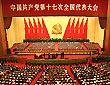
As the Communist Party begins its 17th Congress, one of the issues dominating the deliberations will be the growing income disparity that economic reforms and the consequent prosperity seem to have accentuated.

Debasish Roy Chowdhury
|
A recent report by the Asian Development Bank (ADB) shows China's Gini Coefficient, a measure of income inequality, rose to 0.473 in 2004 from 0.4 in 1993. A Gini Coefficient of zero indicates equal income distribution while 0.4 is considered the "danger mark." Anything above 0.4 should be cause for serious concern.
Concerned the Party leadership is, the reason why its new policy focus is building a "harmonious society." But how do we get there? Balancing the goal of equity with the pursuit of greater liberalization and promotion of consumption is no cakewalk. More so when income disparity has reached the scale it has in China.
The richest 10 percent of Chinese families now own more than 40 percent of all private assets, while the poorest 10 percent share less than 2 percent of the total wealth. The gap is starker between rural and urban areas and between coastal and inland regions. The average annual income of urban residents last year was 3.28 times that of their rural counterparts, up from 3.22 in 2005 and 3.21 in 2004.
This grim picture of growing inequality notwithstanding, China has made notable progress in poverty alleviation. In 1990, one out of three in China lived in poverty, while today the number is below one in 10, finds a report by the UN and the ADB. According to the World Bank, China's poverty rate fell from 64 percent when reforms began, to 10 percent in 2004, meaning about 500 million people have been lifted out of poverty in just one generation.
But as China prospers, cities are getting rich faster than the villages. Last year, urban residents' per capita disposable income rose 52.7 percent over 2002 while that of rural residents rose by just 27.1 percent. Clearly, as reforms pull people out of poverty, it's leaving some far better off than others, a situation fraught with negative social implications.
To China's credit, it has moved decisively to address this, by instituting an elaborate social assistance system to help those left behind by the reforms. The so-called dibao policy guarantees a minimum standard of living for the poor with the help of cash transfers to those who earn less than the set local standard. This has greatly helped in mitigating extreme poverty.
The essence of the dibao system is similar to bolsa familia, an immensely popular government welfare program in Brazil that provides financial aid to poor families. While dibao now covers 22.35 million people, bolsa familia reaches 46 million. The Brazilian program inspires hope for China as income inequality measured in 2004 in that country fell by almost 4.6 percent from 1995, largely because of bolsa familia.
So China is on the right path. More importantly, these two emerging economies have successfully established an alternative development paradigm that shows more market doesn't have to mean less State. It doesn't have to mean more disparity either, provided there is no poverty of ideas.
The author is a senior editor with China Daily. Previous to this, he worked in India and Thailand as a news editor for the South China Morning Post, Asia Times Online, Hindustan Times, The Statesman and The Telegraph, with a year in between as a research fellow at Fernand Braudel Institute of World Economics in Brazil.