An honest Japanese effort to own up to history
By Li Xing (China Daily)Updated: 2007-07-26 11:12
 Journalists ask questions and get answers. But answers to some questions are
tough to come by as Yomiuri Shimbun's special project team found.
Journalists ask questions and get answers. But answers to some questions are
tough to come by as Yomiuri Shimbun's special project team found.
Why did Japan plunge into the quagmire of what the Japanese call the "Sino-Japanese War" and what actually was the War of Resistance against Japanese Aggression?
Why did Japan wage war against the US despite lacking resources?
What caused the Japanese military to go on "kamikaze" attacks?
Could Japan have prevented the atomic bomb attacks?
Was the Tokyo Tribunal beset by problems?
For answers to these and many other questions, it was necessary to re-examine Japan's responsibility and pinpoint those who were to blame for the war that killed a great number of people and caused boundless suffering across Asia Pacific. And that's exactly what Yomiuri Shimbun group chairman Tsuneo Watanabe started in the summer of 2005.
Watanabe was opposed to the war as a student, but he was forced to become "one of the Imperial Japanese Army's last group of privates" to prepare to fight US troops on Japanese soil.
"Even the lowest-ranking soldier during the war would be 81 now. So the later generations in Japan know little about why (and how) the war started, how it was waged and what were its consequences," says Watanabe in an interview with China Daily.
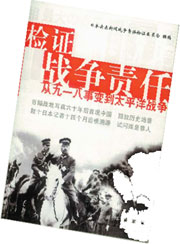
"I believe it is our obligation as Japan's most influential newspaper to tell our millions of readers who was responsible for starting the Sino-Japanese War and the Pacific War, why they did so and why the nation kept fighting until many of its cities had been almost completely reduced to ashes," Watanabe writes in his foreword to the book, From Marco Polo Bridge to Pearl Harbor: Who was Responsible, the result of the team's 14 months' of dedicated and hard work.
The team members cut across several generations, says Tetsuya Ennyu, a staff writer of the newspaper's political news department. Ennyu began his career with the newspaper in 1996. Even his parents were born after World War II. "That enabled us to take an objective view on the war."
 The Yomiuri Shimbun team's findings were published in installments in the
newspaper, selling some 14 million copies.
The Yomiuri Shimbun team's findings were published in installments in the
newspaper, selling some 14 million copies.
"Some of my friends frankly told me that they were surprised to learn from our articles all sorts of facts and details that Japanese history textbooks do not mention or just gloss over," Ennyu says. "Some members of the younger generation are only vaguely aware that Japan was a militaristic power in those days. Many of our readers said the series helped them deepen their views and understanding of history."
The series drew attention of Chinese scholars well versed in the Japanese language, and Tsinghua University's professor of communications Cui Baoguo recommended the book to Xinhua Publishing House.
"We read several chapters and realized its publication in China would be meaningful," Wang Qixing, managing editor of the publishing house, said at a forum yesterday. Leading Chinese scholars on Japan, too, shared their views on the book at the forum.
After Xinhua decided to publish the book in Chinese, Yomiuri Shimbun began the laborious work of translating its comprehensive report into Chinese, as well as English.
"I would like Chinese readers to know that there are people in Japan who have launched a re-examination of their own to identify which government and military leaders of Japan before and during WWII were specifically responsible for leading the country into such a silly and reckless war and taking it to the miserable defeat," says Watanabe, who is also the editor-in-chief of Yomiuri Shimbun.
The Chinese version reached bookstores across China last week. More loyal to the Japanese version than the English, it is divided into three major parts. In the first 11 chapters, the writers vividly narrated the political intrigues, economic rise and fall, social uncertainties and military domination and even terrors.
History photos - a few dozens more than those in the Japanese and English versions - are interwoven into the text to enhance its appeal.
Chinese people who have already read the book consider it very important because writings on the subject, especially from Japan, have been few and far between.
"It helps most of the Japanese to clear their vague ideas about the wars," Wang Dajun, former Xinhua chief correspondent in Tokyo, said at the forum. "The book is important because it admits that some Japanese war criminals fell through the net and efforts to put the responsibility on the emperor and the people have ended in failures."
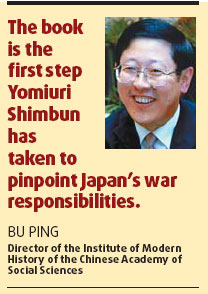
The book "can be viewed as the first step Yomiuri Shimbun has taken to pinpoint Japan's war responsibilities," says Bu Ping, director of the Institute of Modern History of the Chinese Academy of Social Sciences.
But some Chinese scholars say the research team has not delved deep enough and their findings are limited and at times erroneous. For instance, the Chinese cannot agree with their conclusions on who instigated the Marco Polo Bridge Incident or how many Chinese civilians and soldiers were killed in the Nanjing Massacre.
 The book narrates in detail how much Japan and the Japanese people suffered
from not only the two atomic bombs, but also the air attacks on Tokyo. In
contrast, it touches only lightly upon the atrocities the Japanese Imperial Army
committed in China and Korea, Wang Dajun said.
The book narrates in detail how much Japan and the Japanese people suffered
from not only the two atomic bombs, but also the air attacks on Tokyo. In
contrast, it touches only lightly upon the atrocities the Japanese Imperial Army
committed in China and Korea, Wang Dajun said.
The Yomiuri team's approach was to identify individuals responsible for the wars, says Bu, but the people in China, Korea and other Asian countries are more concerned about the responsibilities that Japan as a country must shoulder for starting the wars.
The Japanese have the tendency to discuss the wars as victims, Bu says. As a result, even this book shies away from the fact that Japan was the aggressor and the perpetrator of atrocities.
In chapters documenting and analyzing the actual battles, the book doesn't go beyond some Japanese scholars' conclusion that Japan was defeated because of its wrong tactics, misjudgment and other technicalities, Bu says. The team has failed to acknowledge that Japan was a militaristic power and it was squarely to blame for the war and all its tragic consequences.
The book even concludes that the Marco Polo Bridge Incident took place simply by chance and, if "handled properly, the crisis of the all-out war could have been avoided". Tracing the road Japan has traveled since the Meiji Reformation, chances are that it won't offer a scientific explanation for history, Bu says.
Watanabe says he was not witness to the atrocities that Japanese troops perpetrated on the Chinese. "I had no choice but to read relevant literature afterward to learn about what happened in China before and during the war. Therefore, I am afraid that from the perspective of Chinese readers, our efforts to delve into the damage caused to Chinese people are not sufficient."
Despite the drawbacks, Bu says: "It must have taken a lot of courage for Yomiuri Shimbun to start the project that transcended the narrow-minded nationalism at a time when neo-nationalism in Japan is rising and its politics is sliding to the right."
Watanabe, on his part, wants to achieve more with the book: "I would like the Chinese people to understand that the Japanese youth of today are not responsible for the war - Japan's war criminals are already dead. I am convinced that it is useful for the Japanese youth to learn about the cruelty of Japanese war criminals from the viewpoint of strengthening the friendship between Japan and China as peace-loving nations."
|
||
|
||
|
|