Australia, China have huge trade potential
By Su Qiang (China Daily)Updated: 2007-05-24 08:51
|
|
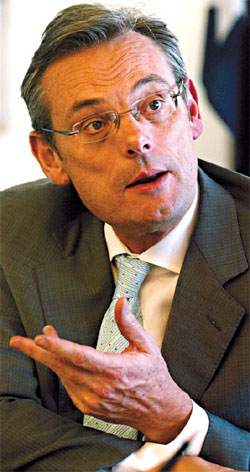
Today, although there isn't a copy of any agreement in his drawer or somewhere on his office desk, the Australian ambassador to China Geoff Raby has not lost his patience nor any hope of a deal breakthrough.
Actually, he is expecting an even better result because of the negotiations so far.
In an exclusive interview with China Daily, Raby said negotiations were proceeding slowly because both China and Australia wished to secure a comprehensive win-win agreement.
His comments echo those of Australian Trade Minister Warren Truss, who met with members of the Australian business community in Beijing last month to bring them up to date with discussions, following eight rounds of negotiations. Truss said progress so far was "mixed" and emphasized the need for patience.
"Despite the two countries' differences on issues such as agriculture, textiles and automobile products, it won't stop us from finding a lot of more common ground," Raby said.
"We must rise above those sensitive issues because the overall benefit of signing a free trade agreement is enormous.
"The current state of cooperation between China and Australia is excellent, but it has not reached its full potential.
"The maximization of full potential only comes as a result of removing all sorts of barriers not only at the border but also behind the border."
Australia is economically the biggest country that China has negotiated an FTA with, and also one of the few countries in the world that has a free trade agreement with the United States. Australia is also in negotiations with Japan.
China already has FTAs with Chile, Pakistan, Jordan and Thailand.
"Over 50 percent Australia's trade is with East Asia, so you can see immediately we have extremely deep interests in the region," Raby said, adding that this has a very big impact on Australia's foreign policy.
Figures released early this month from the Australian Bureau of Statistics show that China, including Hong Kong and Macao, had overtaken Japan as Australia's biggest trading partner.
Exports and imports between the two countries reached about $43.2 billion in the 12 months to March, compared with trade with Japan of $41.5 billion.
Trade complementarities will guarantee the rapid growth of bilateral trade, Raby said.
Australia also has a big capacity to supply China with some big necessities including natural resources, energy and food.
Most goods in Australia are made in China, but Raby also noted the rapid growth in services.
Educational exchange is one of the shining examples of how cooperation benefits both sides.
Last year, more than 100,000 Chinese students were studying in Australian educational institutions, with about 70,000 in Australia and another 30,000 in its institutions operating in China.
"The large number suggests that there are few obstacles in our educational exchanges," Raby said.
"The only thing for us to do is to increase our capacity to meet your demand, which is very high."
He added that an FTA will definitely enable more Australian institutions to supply the education market in China.
That works very much to the advantage of Chinese students because some of them cannot afford to study in Australia, Raby said.
"So we bring educational institutions to you here in China, rather than the high cost for them to fly to Australia," he said.
Environment is another area where China and Australia have a huge potential to cooperate.
"China is dealing with tremendous environmental challenges. And Australia wants to be seen as a partner to help China come to grips with China's environment management issues," Raby said.
Australia has the world's largest deposit of uranium, about 40 percent of the world's total. It is also rich in liquefied natural gas and has significant expertise in renewable energy, notably wind power.
"China is world's largest coal producer and consumer, and Australia is the world's largest coal exporter. So there is a real affinity of interest between Australia and China," he said.
"The reality is that coal will still be the basis of China's energy for many years to come. And we are working with China on developing new clean coal technology, so China can still use the coal without damaging too much the environment."
Before taking the post of ambassador in November last year, Raby traveled throughout Australia to talk to people who were dealing with China, and found a remarkable range of interests closely related to China.
"In business, finance, commerce, sports and arts, there are incredible exchanges between Australian and Chinese people," he said.
"It was amazing for me to find how much China features in Australians' thinking and how much people are engaged with China.
"And my role as an ambassador is to build on the momentum and help to extend the engagement in all areas."
Raby, 53, has worked in China a very long time - on and off for more than 20 years - and was regarded as one of Australia's most senior trade officials.
His appointment to China reflects the significance of how Australia values China - its new, biggest trading partner.
As the host country for the next Asia-Pacific Economic Cooperation (APEC) forum, which will be held in Sydney in September, Raby said Australia sees the APEC mechanism as a principle vehicle for integrating the economy in this region.
He called for liberalized trade and investment flows in the APEC context bringing a successful conclusion to the Doha round of WTO negotiations, which aims to lower trade barriers around the world and permitting free trade between countries of varying prosperity.
"Only by removing trade barriers can you promote integration," Raby said.
He also said China's entry into the WTO was a very good accession.
"The negotiation for China's entry took a long time. But like many things it takes time to get good result," said Raby, who has served as Ambassador and Permanent Representative to the WTO in Geneva.
"China has been a very good member of WTO since its accession. It has implemented its obligations. And you cannot separate the rapid growth in China over recent years from China's accession to the WTO."
Raby also urged China to take a more active role in the Doha round talks.
(China Daily 05/24/2007 page12)
|
||
|
||
|
|