Depend on dialogue to clear defense doubts
By Li Xing and Le Tian (China Daily)Updated: 2007-03-20 07:03
China's role in international affairs, especially its defense spending, has drawn the attention of the international media over the past few weeks. Some announcements made at the just concluded National People's Congress (NPC) annual session and the high-profile visits of Western experts on defense has intensified that attention.
French Defense Minister Michele Alliot-Marie, former US Defense Secretary William S. Cohen and his erstwhile deputy John J. Hamre are some of the foreign dignitaries to visit China recently.
Cohen is the chairman and chief executive of global business consultants Cohen Group and served as US defense secretary from 1997 to 2001. He attended the China Development Forum hosted by China Development Research Fund in Beijing on the weekend, and met with China Institute for International Strategic Studies President General Xiong Guangkai. Cohen considers talks between US and Chinese armed forces utterly important.
Dr John J. Hamre, Cohen's deputy from 1997 to 1999, is now the president and CEO of the Center for Strategic and International Studies. He held talks with officials on Chinese policy research, spoke at the China Development Forum and met with college students. A session at the China Foreign Affairs University in Beijing turned heated as students asked him a wide range of questions on his "new international order" concept in the context of Sino-US relations.
China Daily talked with Cohen and Hamre to get their views on China-US
defense ties.
Talks can help build trust
More exchanges and dialogues is William S. Cohen's prescription to remove the shadow of suspicion between China and the United States over defense spending.
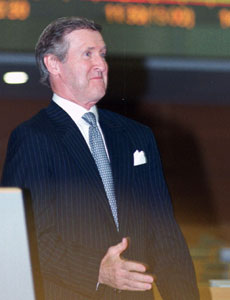 William S. Cohen visits Shanghai in this 2000 file photo. [newsphoto]  |
Though he was in Beijing in his present capacity as a businessman, he had the opportunity to discuss bilateral issues with Chinese government officials, including former deputy chief of staff of the People's Liberation Army General Xiong Guangkai.
"We (Cohen and Xiong) discussed the nature of China's relationship with the US and with the rest of the world, some of the challenges China faces both economically and certainly from a military perspective how should the rest of the world see China's growing military capabilities, and how should that be viewed with expectation and apprehension," Cohen said.
"China is certainly emerging as an economic power, and it will grow as a military power (too) because it is modernizing its military. That's all the more reason why we need to have greater contacts with each other."
Cohen first visited China in 1978 when he was a senator from the state on Maine. The US delegation that included four other senators met with late Chinese leader Deng Xiaoping. Cohen used that visit to explore Beijing by riding a bicycle through its streets.
During his tenure as US defense secretary, Cohen reversed the trend of a steady decline in defense budgets, which had begun in the 1980s. That was also the time when he advocated stronger military ties with China. He holds the same view even today, stressing the importance of reciprocal visits as part of military exchange.
China and the US should "seek ways to identify areas of mutual interests and find ways to cooperate", he said.
"Taking one step at a time, let us reduce the suspicions, let's see (whether) there are areas of mutual interests There are ways in which our two militaries can obviously talk to each other to make sure there is no miscommunication or misunderstanding - because when you have two great military powers and they have a misunderstanding, the consequence could be serious."
The best way to reduce friction is to have more interaction, he said. "It's very important we continue and deepen them."
Referring to the recent increase in China's defense budget, Cohen said more disclosures and discussions can reduce the two countries' uneasiness over one another's plans and intentions. "It's all the more important because other countries are skeptical, suspicious or wary of what you want to do."
China raised its 2007 defense budget early this month to 350.921 billion yuan ($44.94 billion), up 17.8 percent over last year. Responding to international concern, the Chinese government said the thrust of the increase was to bolster the salaries and allowances of the serving and retired personnel.
More money is needed to improve the living conditions of the armed forces, the government said. Bettering drill facilities, upgrading equipment and improving troops' capability to fight a defensive war with the help of information technology, too, need more funds.
On the concluding day of the NPC annual session, Premier Wen Jiabao explained to reporters: "We have a defense policy that is defensive in nature The limited armed forces that China has are only to safeguard the country's security, independence and sovereignty. On this matter, we are totally transparent."
China's defense expenditure is still much less than that of major military powers, both absolutely and proportionately.
For instance, China allotted only 7.3 percent of its total fiscal expenditures to defense in 2005, whereas the figures for the US, France and Germany were 20.04, 11.41 and 9.2 percent, respectively.
That China's defense budget will grow with its economic development and international stature is quite natural. Even Cohen recognizes that: "China will continue to modernize its military" as the country's stature and participation in international diplomacy grows.
The hope abroad, he said, is that with its economic and military growth, China will become "more integrated into the international security environment" and serve as a stabilizing and positive factor".
| 1 | 2 |  |
|
||
|
||
|
|