Beijing to form investment company
(agencies)Updated: 2007-03-10 10:12
Beijing is to create one of the world's biggest investing companies, with possible ramifications for global stock, bond and commodities markets, and might also affect how the US finances its huge budget deficits.
Chinese Finance Minister Jin Renqing said on Friday in Beijing on the sidelines of the ongoing National People's Congress session, that Beijing is trying to make more profitable use of its $1 trillion in foreign currency reserves. It is believed that most of the reserves are now parked in safe, but relatively low-yielding US Treasury securities and other dollar-denominated assets.
|
|
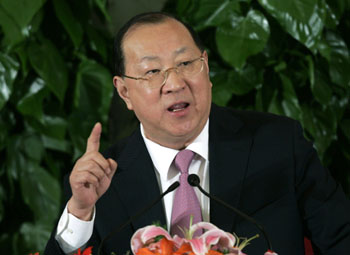

"We can achieve more profit from (wiser) investments (of the reserves)," Jin said at a news conference. "We are now in the stage of forming this new company."
The finance minister said China may follow the lead of Singapore's Temasek Holdings, which manages nearly $90 billion in government pension funds and other assets. It owns stakes in Singapore Airlines and Singapore Telecom, as well as in banks, real estate, shipping, energy and other industries in India, China, South Korea and elsewhere.
Analysts have speculated for some time that China would create an investment company, and officials have said repeatedly they want to make better use of the world's largest standing foreign currency reserves. Economists have suggested Beijing might allocate as much as $200-$400 billion to the new company, which could create one of the world's richest investment funds.
"They want to be more aggressive than what they do with current reserves," said economist Mingchun Sun at Lehman Brothers in Hong Kong.
"They could invest in higher-yield products - stocks, corporate bonds, maybe even commodities," Sun said. "Basically, the returns would be higher because the risk is higher."
A shift in China's investment strategy could change its purchases of foreign government debts, affecting a market that Washington relies on to help finance multibillion-dollar budget deficits, and might eventually push up US interest rates. But Lehman Brothers' Sun played down that risk. He said that with its reserves growing by as much as $20 billion a month, Beijing could afford to keep buying US government bonds while also channeling billions into new investments.
Even so, news of the Chinese announcement - along with an upbeat US jobs report, which reduced expectations the US Federal Reserve will cut its interest rates - came on the same day of a big drop in the price of the benchmark 10-year Treasury note on Friday. That pushed up its yield to 4.58 percent from 4.51 percent.
Jin gave no details of how the Cabinet-level company might invest the reserves, nor did he say what portion of the reserves might be channeled to the company or when it would start to operate. Spokespeople for Jin's ministry and China's central bank declined to give any other details.
US Treasury Secretary Henry Paulson, in an interview this week on the US television network ABC, rejected suggestions that changes in Chinese bond purchases could affect the United States economy. Paulson said Beijing's entire holdings of US Treasuries represent the equivalent of less than a single day's trading in Treasuries on global bond markets.
Chinese economists and media reports have suggested China might adopt more unusual investment approaches, ranging from stockpiling oil and other raw materials to spending more on social programs in order to encourage Chinese consumers to spend more domestically and reduce its dependence on exports.
The growth in China's reserves is driven by the rapid growth of its exports, which brings in dollars, euros and other foreign currencies, and by the billions of overseas investment dollars being poured into the country. The surge in money flooding in from abroad forces the central bank to drain billions of dollars from the economy every month by selling bonds in order to reduce inflationary pressures.
The precise composition of China's foreign currency reserves is a secret. But economists believe that as much as 75 percent is believed to be in US dollar-denominated instruments, mostly Treasuries, with the rest in euros and a small amount in yen.
Stephen Green, chief economist at Standard Chartered Bank in Shanghai, calculated that last year the central bank made a $29 billion profit on its Treasury holdings after paying interest on its own bonds and other expenses.
But even that represents a return of less than 3 percent on the $1 trillion in holdings. By contrast, Singapore's Temasek says it has averaged an 18 percent annual return since it was created in 1974.
|
||
|
||
|
|