|
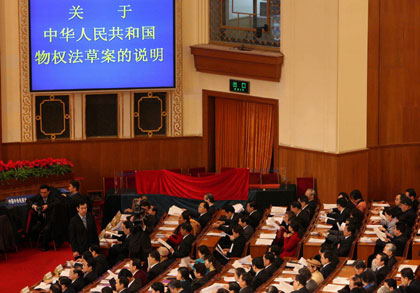
Lawmakers listen to an explanation
about the draft Property Rights Law that grants equal protection to state
and private properties in the Great Hall of the People March 8, 2007.
[Xinhua]

|
China's top legislature, the National
People's Congress (NPC), on Thursday started examining two draft laws aimed to
grant equal protection to state and private properties and introduce a unified
income tax for domestic and foreign-funded enterprises.
The draft property law and the draft enterprise income tax law were submitted
for deliberation to the ongoing annual full session of the Tenth NPC, as the
lawmakers started their second plenary meeting at the Great Hall of the People
in Beijing at 9 a.m. Thursday.
"Enacting the property law is necessitated by the need to uphold the basic
socialist economic system...by the need to regulate the order of the socialist
market economy...(and) by the need to safeguard the immediate interests of the
people," said Wang Zhaoguo, vice chairman of the NPC Standing Committee, while
reading an explanation on the law to the lawmakers (click for full text of the explanation ).
The law is enacted to apply "the principle of equal protection to the
property of the state, the collective and the individual in accordance with the
provisions of the Constitution" and " strengthen the protection of state-owned
property", Wang said.
He said under the conditions of the socialist market economy, the country's
development choice stipulated in the Constitution, all players have equal status
on the market, enjoy the same rights, observe the same rules and bear the same
responsibilities.
"If the different subjects of the market are not provided with equal
protection, or if the methods used for settling disputes or the legal
responsibilities to be borne are varied, it will not be possible to develop the
socialist market economy, nor will it be possible to uphold and improve the
basic economic system of socialism," Wang said.
To prevent loss of state property, the draft strengthens the protection of
state-owned property from five aspects, stipulating that illegal possession,
looting, illegal sharing, withholding or destruction of state property is
prohibited.
Those who cause loss of state property shall bear legal liability, according
to a full text of the draft distributed to reporters at the session.
Wang said the law was also drafted with the principle of " giving a full and
accurate expression to the basic policies of the Party in rural areas at the
present stage".
In order to grant the farmers a long-term and guaranteed land- use right, the
draft property law stipulates that when farmers' land contracts expire, the
contractor can have the contract renewed.
As part of the draft civil code, the property law was submitted to the NPC
Standing Committee for the first review in 2002 after nearly 10 years of
preparation.
To fully consider the interests of all social sectors, the law' s drafters
published the law to the public in July 2005 and pooled more than 10,000
suggestions.
After an unprecedented seven times of reading, NPC Standing Committee decided
last December to put it for voting at the Fifth Session of the Tenth NPC,
believing that the draft "represented a crystallization of the wisdom of the
collective and was about to be mature".
China's legal experts said that the draft reflects China's basic socialist
economic system and will help improve China's socialist market economy and speed
up the building of the harmonious socialist society once adopted.
The draft enterprise income tax law [click for full text of the explanation] suggests a unified income tax rate for
domestic and foreign-funded companies at 25 percent.
Delivering an explanation to the lawmakers, Finance Minister Jin
Renqing said the law was drafted to "establish a scientific and standardized
enterprises income tax system uniformly applicable to various type of
enterprises and create an environment for fair competition".
The income tax is currently levied on domestic and foreign- funded
enterprises at the same rate of 33 percent. However, foreign-funded enterprises
in some special regions are levied at a preferential rate of 24 or 15 percent,
and domestic low-profit enterprises are levied at two brackets of special rates
of 27 percent and 18 percent respectively.
"Too many brackets of tax rates contribute to a relatively large disparity
between nominal income tax rate and effective income tax burden of various types
of enterprises. Therefore, it is necessary to unify the income tax rate," Jin
said.
An estimate based on a national survey of enterprise income taxes shows that
the average enterprise income tax burden on foreign-funded enterprises is 15
percent while that on the domestic enterprises is 25 percent, 10 percentage
points higher than the former.
Jin said the proposed 25 percent of tax rate is mainly intended to ease the
tax burden on domestic enterprises and keep a rise as little as possible for the
foreign-funded enterprises.
Statistics showed that the average enterprise income tax rate is 28.6 percent
in 159 countries and regions and the average rate in China's 18 neighboring
countries and regions is 26.7 percent.
"The rate of 25 percent set in the draft is relatively low in the world and
will be conducive to enhancing enterprises' competitiveness and attracting
foreign investment," Jin told lawmakers.
Transitional preferential measures were given to allow the old enterprises,
which had an income tax rate of 15 percent or 24 percent under the current tax
laws, to enjoy a gradually increasing income tax rate within five years after
the new tax law takes effect, according to the draft law.
If the new tax law is implemented in 2008, China's domestic enterprise income
tax will drop by 134 billion yuan while foreign- funded enterprise income tax
will increase by 41 billion yuan. China's total fiscal revenues will drop by 93
billion yuan.
Given transitional measures to be applied to old enterprises, the decrease in
fiscal revenues will be bigger. "But such decrease is still acceptable to
Government finance," Jin said.
China adopted preferential tax policies at the end of 1970s when it started
the economic reform and opening-up drive to attract foreign investment and boost
its economy.
By 2006, China has approved 594,000 foreign-funded enterprises, with 691.9
billion U.S. dollars of foreign fund used.
In 2006, all the foreign-funded enterprises paid 795 billion U. S. dollars in
all types of taxes, accounting for 21.12 percent of the total national tax
revenue.