China to open renminbi business to foreign banks
(Bloomberg/Xinhua)Updated: 2006-11-16 08:41
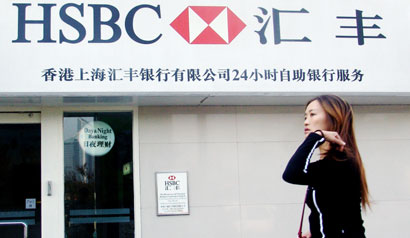 A woman walks past an HSBC outlet in Shanghai in this July 1, 2006 photo. A new banking regulation says Foreign banks operating in China will have to incorporate within the country to offer bank cards and mass-market banking services in yuan from December 11. [newsphoto]  |
Foreign banks operating in China will have to incorporate within the country to offer bank cards and mass-market banking services in yuan, less than a month before the industry fully opens, according to new rules issued by Chinese regulators on Wednesday. The rules will take effect on December 11.
Overseas lenders that don't incorporate locally must set aside two times as much capital, or 200 million yuan (US$25.4 million), as those that do, according to rules released November 15 on the Chinese central government's Web site. They also can't issue bank cards and can take only large deposits, limiting their ability to amass funds and grow through lending.
| |||

"Both Chinese and foreign-funded banks are required to be registered in China and locally incorporated so as to conduct the Renminbi service," he said on Thursday at a press conference in Beijing.
The regulations comply with the WTO rule, the principle of prudence and international common practice, he said.
The requirement to incorporate may be the biggest hurdle after December 11, when China removes all geographic and business restrictions on overseas banks to meet commitments made to join the World Trade Organization five years ago. Foreign banks are eager to offer loans, mortgages and credit-card services in the local currency to spur expansion in the US$5.1 trillion industry.
"HSBC welcomes the promulgation of the new regulations on foreign banks," said Richard Yorke, chief executive officer of HSBC Holdings Plc's unit in China. "It is a historic milestone to mark the fifth anniversary of China's entry into the WTO and its commitment to fully open the financial market."
The proposed changes "certainly will add costs to foreign banks' China strategies," said Qiang Liao, a Beijing-based associate at Standard & Poor's Rating Services. The rules "might serve as China's latest effort to enhance the ability of domestic banks to compete with overseas rivals."
Foreign banks wishing to open a new outlet in China must first receive approval from the nation's banking regulator, which will issue its decision within six months of getting an application, according to the new rules. The overseas bank must then complete preparations to open the new outlet within six months of receiving permission from the China Banking Regulatory Commission, according to the rules.
The Chinese government, while preparing to open the market, is trying to bolster the ability of its own banks to cope with more competition. China has spent about US$400 billion on bailouts since 1998, according to Fitch Ratings' estimates, and four of the five largest have held initial public offerings to raise capital.
No 'Threat'
"Foreign banks don't post a significant threat to Chinese ones in the short term," said Zhang Jianguo, president of China Construction Bank Corp, in an interview in Beijing on Wednesday. "No matter how many overseas banks pour in as the market opens, they'll continue to lag behind Chinese banks in branch coverage and client base for the immediate future."
Foreign banks, which have more than doubled their profit in the country in the past five years, aim to tap the nation's US$2 trillion of household savings, partly through offering credit cards and asset-management services. They earned a combined US$446 million last year, compared with US$196 million in 2001.
Domestic banks still have far larger networks, according to figures from June 30. The 70,000 branches for China's four biggest state-owned lenders dwarf the 214 for overseas banks.
Under China's new rules, any overseas lender must have operated in the country for three years and been profitable for two straight years to offer services in the yuan currency. Banks that don't incorporate can't accept deposits less than 1 million yuan, limiting their reach to the mass market. Seventy-seven percent of urban Chinese households live on less than 25,000 yuan a year, according to a 2006 report by McKinsey & Co.
"The impact of the rules on the foreign banks depends on their size," said Charlene Chu, a Beijing-based director at Fitch Ratings. "The larger ones are already sizable so there won't be too much operational cost added to them in terms of capital requirements."
HSBC, which has the largest foreign branch network on the mainland with 26 outlets, and its Hang Seng Bank unit plan to incorporate locally. Standard Chartered Plc, which makes two-thirds of its profit in Asia, also said it will.
"If you are into retail banking, if you are into personal financial services, asset management, you have to become locally incorporated," Michael Smith, HSBC's Asia chief executive officer and Hang Seng's chairman, said in September. "That's what the regulation is looking at, to provide protection for the individual."
Rules requiring foreign banks to incorporate locally are not unusual in other Asian countries such as Australia, Malaysia, Indonesia and Singapore. Still, China's new requirements may squeeze out smaller foreign lenders.
"Only those dedicated ones with strong personal financial services abroad will incorporate locally," said Orlando Wang, general manager of Rabobank Groep's China operations. The Dutch bank isn't likely to, as it targets corporate markets, he said.
Chinese lenders have improved their operations since the WTO agreement was signed, carving out bad loans, fixing internal controls and selling shares to the public.
Industrial & Commercial Bank of China Ltd, Bank of China Ltd, China Construction Bank Corp, and Bank of Communications Ltd raised more than US$40 billion from share sales since June 2005 as investors bet loan growth that averaged 14.5 percent in the past five years will be sustained.
|
||
|
||
|
|