Japan's new prime minister, Shinzo Abe, concluded his visit to China on
Monday, which was not only Abe's first foreign trip since he assumed the
premiership, but also the first visit to China by a Japanese prime minister in
the past five years.
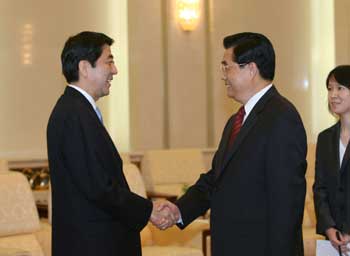
Chinese President Hu Jintao (R)
shakes hands with Japanese Prime Minister Shinzo Abe during their meeting
in Beijing, capital of China, Oct. 8, 2006.
[Xinhua] |
The two-day trip symbolized the
thaw of the deadlocked China-Japan political relationship and opened the window
of hope for improving relations between the two neighbors separated by a strip
of water. The visit will have positive effects on the exchange and cooperation
in politics, economy, diplomacy and culture between China and Japan.
In the past five years, former Japanese Prime Minister Junichiro Koizumi's
repeated visits to the Yasukuni Shrine, in which 14 Japanese class-A war
criminals in the Second World War are honored among the country's war dead, had
hurt seriously the feelings of the 1.3 billion Chinese people, eroded the
political base of China-Japan relations, and resulted in an interruption of the
exchanges between the leaders of the two countries.
Since taking office late last month, Abe has expressed his hope to improve
China-Japan relations on various occasions and made positive gestures on
historical issues. He admitted that Japan's colonial rule and aggression in the
Second World War had inflicted huge pains and sufferings upon many countries,
particularly Japan's Asian neighbors. He also said that Japan accepted and would
not dispute the verdicts delivered by the Fareastern International Military
Court of Justice.
Thanks to their joint efforts, China and Japan reached consensus on
overcoming the political obstacles hampering the development of bilateral
relations and on promoting the healthy development of their friendly and
cooperative relations, thus paving the way for Abe's visit.
During Abe's visit, both sides agreed that since the normalization of their
relations 34 years ago, the exchange and cooperation between China and Japan in
various sectors had expanded and deepened continuously, the interdependence
between the two neighbors had further increased, and the China-Japan
relationship had become one of the most important bilateral arrangements for
both countries.
The two sides also agreed to build mutually beneficial bilateral relations
and to realize the lofty goals of peaceful co-existence, friendship from
generation to generation, reciprocal cooperation and common development.
Another vital outcome was that China and Japan reaffirmed their adherence to
the spirit of the three political documents signed by the two countries and the
importance of maintaining the political foundation of their bilateral ties.
At his meeting with Abe, Chinese President Hu Jintao pointed out that to
achieve the long-term stable development of China-Japan relations, the two
countries must first and foremost strengthen political mutual trust and abide by
the principles set out in the three political documents.
The three political documents call for the establishment of a correct
historical view -- "taking history as a mirror and looking into the future,"
which is the political prerequisite to ensure the stable and healthy development
of China-Japan relations.
Abe reflected deeply the huge pains and sufferings Japan had inflicted upon
the peoples of Asian countries, and stressed that this stance would never change
in the future. He also declared that Japan would never praise militarism, nor
prettify class-A war criminals.
Abe noted that Japan would continue to deal with the Taiwan issue in
accordance with the Sino-Japanese Joint Communique and this position would not
change. He added that Japan stuck to the one-China policy and did not support
"Taiwan independence."
Chinese and Japanese leaders agreed to strengthen their contacts and
dialogues so as to facilitate the all-around development of their friendly
cooperation in such fields as politics, economy, security, culture and
international affairs.
"Both sides believe that contact and dialogue between their leaders is
significant to the healthy development of bilateral relations," said a joint
press communique issued on Sunday.
The Japanese side invited Chinese leaders to visit Japan, for which the
Chinese side expressed gratitude and consent in principle. They also agreed to
hold frequent talks on the occasions of international meetings, the communique
said.
History has shown that visits and meetings between the leaders of the two
sides are crucial in China-Japan relations. If problems happened to the contact
and dialogue between Chinese and Japanese leaders, various exchanges between the
two nations would be weakened.
During Abe's visit, the two countries' leaders reached consensus on enhancing
the exchange of high-level visits and dialogues, paving the way for China and
Japan to expand their exchanges and deepen their cooperation in various fields.
The visit is viewed as a turning point for the improvement of China-Japan
relations. However, there still remain some historical and practical factors
that are likely to constitute possible obstacles to the smooth development of
bilateral ties in the future.
Nevertheless, to develop a friendly cooperative relationship between China
and Japan is in the fundamental interests of the two countries and the two
peoples, and conforms to the world trend of political multipolarization and
economic globalization.
As long as the two sides "take history as a mirror and look into the future,"
abide by the principles of the three political documents, meet words with
actions, and implement seriously the consensus reached by the two countries'
leaders during Abe's visit, China-Japan relations will develop deeply and
widely.
| 1 | 2 |  |
