For three years in a row, the State has launched special environmental
protection campaigns to rectify enterprises that have discharged pollutants in
violation of the law and to protect people's health.
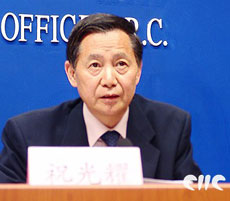
Zhu Guangyao, deputy
head of the State Environmental Protection Administration, explains the
white paper at the press conference organized by the State Council
Information Office in Beijing June 5, 2006.
[ciic] |
The campaigns have dealt with over 75,000
environmental law violation cases, and had 16,000 enterprises closed down for
having discharged pollutants in violation of the law. More than 10,000 warnings
have been issued to environment polluters, obliging them to remedy the problems
under government supervision.
In 1998, the Chinese government changed the name of the State Environmental
Protection Bureau to the State Environmental Protection Administration (SEPA),
and elevated it to the ministerial level, says the paper.
There are now 3,226 environmental protection administration departments at
different levels all over China, with 167,000 people engaging in environmental
administration, monitoring, scientific research, publicity and education. There
are 3,854 environmental supervision and environmental law enforcement organs
with more than 50,000 staff members.
The white paper stresses that prevention and control of industrial pollution
is the focal point of China's environmental protection endeavors.
Statistics show that the amount of industrial waste water, oxygen for
industrial chemicals, industrial sulfur dioxide, industrial smoke and industrial
dust discharged in generating one unit of GDP in China in 2004 dropped by 58
percent, 72 percent, 42percent, 55 percent and 39 percent, respectively, from
1995. Energy consumption per 10,000 yuan (1,250 U.S. dollar)-worth of GDP in
2004 declined by 45 percent from 1990.
Compared with 1996, in 2005 the proportion of cities with air quality
reaching Grade II of the state standard increased by 31 percentage points, while
that of cities with air quality lower than Grade III decreased by 39 percentage
points.
In recent years, China has completed more than 800,000 rural drinking water
projects, solving difficulties and insecurity in this regard for 67 million
rural residents.
The white paper says that the eco-environment in some parts of China has
begun to improve after a long period of unswerving efforts.
According to its statistics, the total newly afforested area has reached over
6.67 million hectares every year since 2002. At present, the national forest
acreage is 175 million hectares, the forest cover 18.21 percent.
By the end of 2005, there were 2,349 nature reserves of various kinds and
levels in China, covering 1.5 million square km and taking up about 15 percent
of the country's land territory, the paper says.
The last decade has seen the largest increase ever in China's investment in
its environmental protection. A pluralistic financing system based on government
support has taken initial shape after years of efforts.
Between 1996 and 2004, China's investment into environmental pollution
control reached 952.27 billion yuan (119 billions U.S. dollars), amounting to
one percent of that period's GDP. In 2006, expenditure on environmental
protection has been formally itemized in the State's financial budget, the white
paper says.
The paper highlights environmental impact assessment (EIA) as a legal measure
to curb environmental pollution and ecological destruction at the source.
China attaches great importance to and consistently seeks to enhance the
support capability of science and technology for environmental protection,
actively promotes the industrialization of environmental protection, the paper
says.
By the end of 2004, China had 11,623 enterprises, each with an annual sales
income of more than 2 million yuan (250,000 U.S. dollars), engaged in
environmental protection businesses, employing a total of 1.595 million workers.
The white paper notes that the Chinese government has endeavored to boost
public participation in environmental protection. There are now more than 1,000
non-governmental environmental organizations in China.
So far, China has acceded to more than 50 international conventions on
environmental protection, and has been active in performing the obligations
stipulated in these conventions, which include the United Nations Framework
Convention on Climate Change and its Kyoto Protocol, the Montreal Protocol on
Substances that Deplete the Ozone Layer and the Convention on Biological
Diversity.
The white paper, however, also notes that the government is fully aware of
the grave situation of environmental protection in the country.
In some regions, environmental pollution and ecological deterioration are
still very serious. The discharge of major pollutants has surpassed the
sustaining capacity of the environment. Water, land and soil pollution is
serious, and pollution caused by solid wastes, motor vehicle emission and not
easily degradable organic matter is increasing, the paper warns.
In the 11th Five-Year Program for Economic and Social Development
(2006-2010), China has clearly set forth its main goals for environmental
protection for the next five years: by 2010, while the national economy will
maintain a relatively stable and fast growth, the environmental quality of key
regions and cities will be improved, and the trend toward ecological
deterioration will be brought under control.
The 11th Five-Year Program also requires energy consumption per unit of GDP
to be declined by 20 percent, compared with the end of the 10th Five-Year Plan
period. The total amount of major pollutants discharged will be reduced by ten
percent, and forest coverage will be raised from 18.2 percent to 20 percent.
In its conclusion, the white paper stresses that China is a big, responsible
developing country. Solving China's environmental problems is in keeping with
China's development goals. It will contribute to the well being of the 1.3
billion Chinese people, and it is also an important manifestation of the shared
interest of mankind.
"The Chinese government and the Chinese people will join all other
governments and peoples in the world in protecting the Earth-- our beautiful
home," the paper says.
