"Needle exchange programmes help more than AIDS prevention; it
provides a communication platform for IDUs, helps them gain confidence and build
their social responsibility." -- GU QIAN, An official with
the Centre for Disease Prevention and Control in Ziyang, Sichuan Province
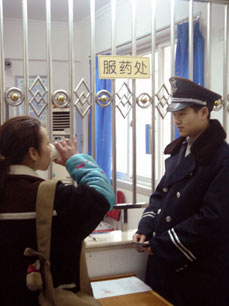 The 25-year-old woman surnamed Lu refused to talk about her past -- a
past destroyed by heroin.
The 25-year-old woman surnamed Lu refused to talk about her past -- a
past destroyed by heroin.
For the past seven years, the pretty woman has been addicted to injecting
drugs, which led to numerous needle scars on her arms and the deadly HIV virus.
The city where she resides, Ningming city of South China's Guangxi Zhuang
Autonomous Region, bordering Viet Nam, has been troubled by drug trafficking.
Around 500 HIV/AIDS cases have been reported there, most of them injected drug
users (IDUs) who became infected by sharing tainted syringes, rinse water,
cotton and other injection equipment.
"It's a very tough problem; IDU will continue to be the leading factor to
aggravate the epidemic," said Professor Chen Jie, director of Guangxi's Centre
for Disease Prevention and Control (CDC). The region is among the areas most
heavily hit by HIV/AIDS.
Threat to public health
The marriage of drugs and HIV has led to a serious public health problem in
China.
After HIV/AIDS was first detected in Yunnan Province among drug users, drugs
have played a predominant role in the spread of the disease. Statistics show
that from 1997 to 2004, IDUs made up about 62 per cent of reported HIV/AIDS
cases. The more alarming figure is that HIV infects more than 10 per cent of
IDUs in Yunnan, Xinjiang, Sichuan, Guangxi, Guangdong and Ningxia. In some areas
the number is as high as 80 per cent, like Yili of Xinjiang and Dazu city in
Sichuan.
The Chinese Government has spent a huge sum of money and additional police to
crack down on drug trafficking and rehabilitate drug abusers. But such policies
are inadequate when HIV is involved in the battle.
"If I have money to buy syringes, why not use it for drugs?" said Lu, adding
that many drug abusers can't afford the daily cost for clean syringes - 1.5 yuan
(US$0.18) each. In addition, buying syringes risks exposure to the police and
results in compulsory detoxification.
It's not enough just telling drug abusers not to share syringes - financial
pressure
and the behaviour of group injection usually cause them to neglect
the risk of transmitting HIV.
The experience of other countries indicates that to curb the behaviour
requires more proactive - and controversial - measures, such as providing IDUs
with clean injection equipment or methadone maintenance therapy at very low
cost.
Needle exchange programmes
Supported by the government and several international organizations, 30
cities in Guangxi have carried out needle exchange programmes since 2004,
covering more than 6,100 IDUs.
Lu has not only benefited from the project, but also has helped deliver
syringes to other IDUs as a peer educator.
She collects used syringes from around 30 IDUs, counts them and delivers them
to the needle exchange centre under the Ningming Health and Disease Prevention
Institute. From the centre, she gets the same number of free, clean syringes and
rinse water.
As a peer educator, she also regularly educates her peers about the HIV/AIDS
and advises them to quit risky behaviour, including needle sharing and
unprotected sex.
Lu is happy with her job, which brings her a stable monthly salary of 300
yuan (US$37). She is proud of doing something good for society. "I can say that
none of my peers share needles."
"Being infected with HIV is the most horrible thing. But we couldn't control
ourselves not to share needles when the addiction would come up," said a drug
user surnamed Lin in Ningming who uses free syringes from the project.
"Without the needle exchange programme, the disease (HIV) would be
prevalent
among people like me."
Around 100 needle exchange centres have been established in 12 provinces in
est and south China that have severe drug problems. Comparative studies show
needle exchange, together with community outreach work to IDUs, has caused a
decrease in heroin use and drug-related crimes among participants.
"Needle exchange programmes help more than AIDS prevention; it provides a
communication platform for IDUs, helps them gain confidence and build their
social responsibility," said Gu Qian, a CDC official in Ziyang city of Southwest
China's Sichuan Province.
The needle exchange centre in Ziyang under Gu's charge has served near 1,000
IDUs since 2004.
Methadone maintenance therapy
Lu hopes the day will come soon when she will be rid of the heroine nightmare
by taking methadone maintenance treatment (MMT). In Ningming, the first
government- sponsored clinic is expected to be open by June.
The first MMT programme was piloted in China in March 2004. By last year, a
total of 34 methadone clinics had been established in 11 provinces including
Sichuan, Zhejiang, Guangxi and Guizhou.
Since last June, 29-year-old Liao and her husband have visited the MMT Clinic
located in Wuhou District People's No. 2 Hospital in downtown Chengdu. A small
cup of methadone every day costs them only 10 yuan (US$1.20). The green and
bitter liquid has helped them quit injecting heroin.
The couple are HIV positive. A screening of 200 patients in the clinic last
year found 20 patients to be HIV positive, seven of them confirmed as HIV
carriers.
"The city needs at least 11 such clinics to effectively control HIV
prevailing among and through IDUs," said Deng Jingfu, director of the clinic,
which has a staff of 12.
The clinic, the only one in Chengdu, has received more than 330 patients,
much more than the designed capability of 250 patients.
"We need more financial support and experienced medical staff who are capable
of dealing with drug problem," said Deng.
The pilot MMT projects have had mixed results: uneven adherence by patients,
decrease in crimes and also medical accidents involving death. The central
government has approved dozens more MMT clinics for the third-stage pilot MMT
programme.
Experts say that most injected heroin users need to take methadone for the
rest of their lives if they are to remain heroin free. The cost of providing
them cheap methadone and running the clinics requires a heavy financial
investment.
