Is it ethical for busy public figures to charge fees for interviews? At the
same time, is it incumbent on them to answer every journalist's queries despite
their busy schedule?
Renowned Chinese sociologist and sexologist Li Yinhe, who has charged money
for interviews and set off a debate, has defended her move.
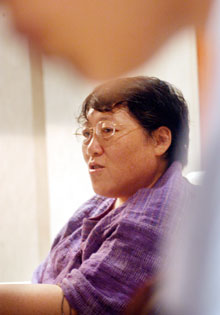
Li Yinhe. [newsphoto
file] |
She said the fees enable her to screen
numerous requests from media organizations to talk on sex-related subjects.
Li, a researcher with the Chinese Academy of Social Sciences, courted
controversy when a Guangzhou Daily reporter tried to talk to her about her
proposal for legalizing gay marriages earlier this month, at the latest session
of the Chinese People's Political Consultative Conference (CPPCC), China's top
advisory body.
The reporter was told that he had to pay to get the interview 500 yuan
(US$61.7) per hour with the first 15 minutes free of charge. After a one-hour
question-and-answer session, the reporter paid the fee.
Li admitted in her blog on Sina.com, a Chinese language
website, that she had previously charged foreign journalists for interviews.
The British Broadcasting Corporation (BBC) paid Li 50 pounds (700 yuan) for a
5-minute interview and Hong Kong-based Phoenix Satellite Television offered her
500 yuan (US$60) for a 15-minute interview.
Li is not the only person in China to charge for talking to the press. A year
ago, Sun Daolin, a well-known actor of yesteryear, also asked for an interview
fee.
His reason, as some art commentators have speculated, may be that he could
have earned a lot of money by publishing the stories he was giving to reporters.
It is also common practice today for Chinese media to pay regular commentators,
particularly TV stations.
In the case of Li, however, many journalists and the general public have
misgivings about whether she should charge for the occasional interview as she
would for her consulting services.
Li is China's first female sociologist on marriage and sex issues, and was
once listed as one of China's 50 Most Influential People by Asiaweek magazine.
In a brief (free) telephone interview, Li told China Daily that she believes
the charge is necessary to avoid having to field endless requests for interviews
asking similar questions.
Li was critical of journalists wasting her time by not doing their research
before they interview her, asking questions about facts she has explained many
times before. "They don't do their homework and they expect me to do all the
talking," Li said.
"But I've talked about those issues hundreds of times and the answers can be
easily found on the Internet."
This is why she began setting down rules: the first 15 minutes of the
interview are free. Lengthier interviews will attract a fee. In doing so, Li
believes her media interviews will be condensed so that she can retain her
allocated research time.
"Fifteen minutes are absolutely enough for any regular interview about any
current news event. If you ask for more time from me, you have to pay.
Otherwise, I'd like to keep the time for my research."
Interviews extending beyond 15 minutes often involve greater professional
expertise, she said. "In this aspect, the media are paying for my intelligence
and years of research."
Li deflected criticism that she is already employed by the Chinese Academy of
Social Sciences and therefore should not expect extra payment, saying that her
job description does not include receiving media interviews. "I deserve to earn
more if I work more," she said.
Li also believes that the media should pay for the experts who have made
possible their programmes which are then sold for profit by contributing their
opinions.
"Not paying them (experts) is an unreasonable way for media organizations to
save costs," she said.
Media professionals have aired many, sometimes sharply divided, views on Li's
interview charges.
Zhao Chenyun, secretary-general of the All-China Journalist Association, told
China Daily that although there are no rules concerning fees for interviews,
it's common practice that experts have the right to accept or decline an
interview, but that they should not charge the media for giving an interview.
With protection of intellectual property rights high on the agenda, however,
consultants and researchers are now more mindful of being quoted and the issue
of payment. "On this matter, we could hardly judge it as right or wrong to pay
for an interview," Zhao said.
Liu Hao, deputy editor-in-chief of Caijing Magazine, believes public figures
should not charge the media for their expertise. "Experts are being spoilt by TV
producers paying them to talk. It is a fair deal experts receive exposure when
they appear in the media. This will more or less raise their publicity and thus
bring other chances for making money," Liu said.
Zhao Jing, a media researcher with the New York Times' Beijing office, said
he was shocked to hear of Li's demand for fees.
He said it is wrong to use money to buy opinions, and that it is unacceptable
to buy news and even more unacceptable to buy a person's opinion.
"An expert's opinion is easily influenced by money. If they were paid to
comment, it would be media talk instead of the expert's voice," he said.
Charging money for press interviews goes against the practice of the
international media industry, according to Samuel Freedman, professor of the
Graduate School of Journalism of Columbia University.
"It is not considered ethical to charge a fee for an interview," he told
China Daily. "I know of no reputable journalists who would consent to such an
arrangement."
According to Peking University sociologist Xia Xunluan, who has also been
frequently quoted by the media on social issues, "to pay or not to pay, it
entirely depends on the person's choice."
But Xia said he did not demand payment from the media because he regards his
comments as a contribution to society.
On the flipside, Xia raised the problem of reporters stealing the ideas of
interviewees and using them without giving acknowledgement.
He said sometimes reporters might quote one or two sentences from an
interviewee but base the rest of their story on the interview, unacknowledged.
It is a minor infringement of intellectual property rights.
(China Daily 04/04/2006 page1)