CHINA> Steven Chu

|
CHINA> Steven Chu
|
|
Steven Chu
(Agencies)
Updated: 2009-05-21 15:32 Steven Chu, Ph.D (born February 28, 1948), is an American physicist and currently the 12th United States Secretary of Energy. As a scientist, Chu is known for his research in cooling and trapping of atoms with laser light, which won him the Nobel Prize in Physics in 1997. At the time of his appointment as Energy Secretary, he was a professor of physics and molecular and cellular biology at the University of California, Berkeley and the director of the Lawrence Berkeley National Laboratory, where his research was concerned primarily with the study of biological systems at the single molecule level. He is a vocal advocate for more research into alternative energy and nuclear power, arguing that a shift away from fossil fuels is essential to combat global warming. Personal life
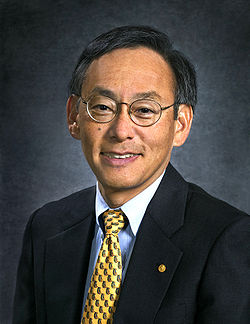 Chu, a Chinese American, was born in St. Louis, Missouri, and graduated from Garden City High School. He received his bachelor’s degree in 1970 from the University of Rochester, and his doctorate degree from University of California, Berkeley in 1976, during which he was supported by a National Science Foundation Graduate Research Fellowship. Chu comes from a family of scholars. His father earned an advanced chemical engineering degree at the Massachusetts Institute of Technology and taught at Washington University in St. Louis and Brooklyn Polytechnic Institute, while his mother studied economics. His maternal grandfather earned advanced civil engineering degrees at Cornell University and his mother's uncle, Li Shu-hua, a notable physical scientist, studied physics at the Sorbonne before they returned to China. His older brother Gilbert Chu is a professor and researcher of biochemistry and medicine at Stanford University. His younger brother, Morgan Chu, is a partner and the former Co-Managing Partner at the law firm Irell & Manella LLP. According to Chu, his two brothers and four cousins earned three M.D.s, four Ph.D.s, and a J.D. among them. In 1997, he married Jean Fetter, a British American and an Oxford-trained physicist. He has two sons, Geoffrey and Michael, from a previous marriage to Lisa Chu-Thielbar. Beside his scientific career, Chu has also developed interest in various sports, including baseball, swimming and cycling. On May 15, 2009, he made a surprise appearance at Bike-to-Work Day in Washington DC, where he stated his goal to decrease his cycling time from Chevy Chase, Maryland to the Georgetown boathouse from 18 to 15 minutes. He taught himself tennis by reading a book in the eighth grade, and was a second-string substitute for the school team for three years. He also taught himself how to pole vault using bamboo poles obtained from the local carpet store. Chu said he never learned to speak Chinese because his parents always talked to him and his brothers in English, although he said (in 1997) that he was trying to learn Mandarin, believing that if he could stay in China for "at least six months", he would become fluent. Career and research After obtaining his doctorate degree, Chu remained at Berkeley as a postdoctoral researcher for two years before joining Bell Labs, where he and his several co-workers carried out his Nobel Prize-winning laser cooling work. He left Bell Labs and became a professor of physics at Stanford University in 1987, serving as the chair of its Physics Department from 1990 to 1993 and from 1999 to 2001. While at Stanford, Chu, together with three other professors, initiated the Bio-X program, which focuses on interdisciplinary research in biology and medicine, and played an important role in securing the funding of the Kavli Institute for Particle Astrophysics and Cosmology. In August 2004, Chu was appointed as the director of the Lawrence Berkeley National Laboratory, a U.S. Department of Energy National Laboratory, and joined UC Berkeley's Department of Physics and Department of Molecular and Cell Biology. Under Chu's leadership, the Lawrence Berkeley National Laboratory has been a center of research into biofuels and solar energy technologies. He spearheaded the laboratory's Helios project, an initiative to develop methods of harnessing solar power as a source of renewable energy for transportation. Chu's early research focused on atomic physics by developing laser cooling techniques and trapping atoms using lasers. He and his co-workers at Bell Labs developed a method of cooling atoms by employing six laser beams opposed in pairs and arranged in three directions at right angles to each other. Trapping atoms with this method allows scientists to study, with great accuracy, individual atoms which exist in the air, and determine their inner structure. Additionally, it is believed that a technique can be developed with this method to construct an atomic clock with great precision. While at Stanford, Chu's research interests expanded into biological physics and polymer physics at the single molecular level. In the field of biological physics, he studied enzyme activity and protein and RNA folding using techniques such as fluorescence resonance energy transfer, atomic force microscopy, and optical tweezers. Chu's research in polymer physics made use of individual molecules of DNA to study polymer dynamics and phase transitions associated with these dynamics. He further continued his research in atomic physics as well, developing new methods of laser cooling and trapping. Energy and global warming Chu has been a vocal advocate for more research into alternative energy and nuclear power, arguing that a shift away from fossil fuels is essential to combat global warming. Chu said that a typical coal power plants emits 100 times more radiation than a nuclear power plant. Chu warns that global warming could wipe out California farms within the century. He has joined the Copenhagen Climate Council, an international collaboration between business and science, established to create momentum for the 2009 United Nations Climate Change Conference in Copenhagen. Chu was instrumental in submitting a winning bid for the Energy Biosciences Institute, a BP-funded $500 million multi-disciplinary collaborative project between UC Berkeley, the Lawrence Berkeley Lab and the University of Illinois. This sparked controversy on the Berkeley campus, where some fear the alliance could harm the school’s reputation for academic integrity. Honors and awards Steven Chu is a co-winner of Nobel Prize in Physics in 1997 for the "development of methods to cool and trap atoms with laser light", shared with Claude Cohen-Tannoudji and William Daniel Phillips. He is a member of the United States National Academy of Sciences, the American Academy of Arts and Sciences, the American Philosophical Society and the Academia Sinica, and is a foreign member of the Chinese Academy of Sciences and of the Korean Academy of Science and Engineering. Dr. Chu also received an honorary doctorate from Boston University when he was the keynote speaker at the 2007 commencement exercises. Energy Secretary His nomination to be Energy Secretary was unanimously confirmed by the U.S. Senate on January 20, 2009. On January 21, 2009, Chu was sworn in as Secretary of Energy in the Barack Obama administration. Chu is the first person appointed to the Cabinet after having won a Nobel Prize. He is also the second Chinese American to be a member of the Cabinet after Elaine Chao. |
主站蜘蛛池模板: 亚洲无人区码一二三区别| 2020国产欧洲精品网站| 久久精品免视看国产成人| 国产精品午夜福利视频| 国产精品视频不卡一区二区| 成全影视大全在线观看| 久久a级片| 国产精品亚洲一区二区三区| 国内精品一区二区不卡| 亚洲一区中文字幕人妻| 精品国产小视频在线观看 | 农村乱色一区二区高清视频| 国产亚洲av手机在线观看| 亚洲精品福利一区二区三区蜜桃| 9久久伊人精品综合| 亚洲天堂视频网| 国产清纯在线一区二区| 亚洲视频免| 人妻少妇偷人精品一区| 在线中文字幕日韩| 午夜国产精品福利一二| 久久国产精品免费一区| 国产精品一区二区性色av| 性色在线视频精品| 波多野结衣av无码| 久久久久无码精品国产h动漫| 亚洲国产精品综合久久网络| 黑人巨大av无码专区| 黑人巨大精品oideo| 狠狠躁夜夜躁人人爽天天天天| 国产微拍精品一区二区| 国产不卡一区不卡二区| 国产精品视频久久| 亚洲av成人无码精品电影在线| 96精品国产高清在线看入口| 国产精品第一页一区二区| 国产片AV在线永久免费观看| 熟女亚洲综合精品伊人久久 | 国产美女久久久亚洲综合| 日韩国产亚洲欧美成人图片| 亚洲男女羞羞无遮挡久久丫|
